Twenty-five companies put their names on a single page Friday and pointed it at Washington. The letter, titled “Open Weights and American AI Leadership” and hosted on Nvidia’s own servers, is signed by Nvidia, Microsoft, Meta, Andreessen Horowitz, Hugging Face, IBM, Dell and 18 other firms. Its argument is blunt: restricting open-weight models won’t protect the United States — it will hand the AI market to a handful of closed labs while the rest of the world builds on someone else’s stack.
Two names are conspicuously missing from the signatory list: OpenAI and Anthropic, the closed-model labs both reportedly preparing IPOs this year.
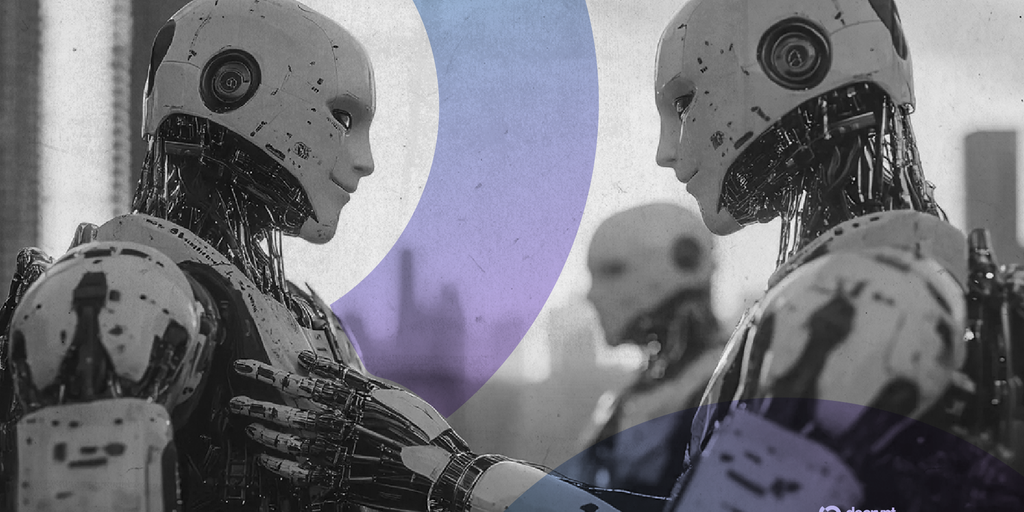
Image credit: Decrypt.
What the letter actually says
Open-weight models publish the billions of numerical parameters that determine how a model behaves. Anyone can download them, run them on their own hardware, fine-tune them, and ship products on top — no API contract, no usage gate. The letter frames this as the same fork the software industry faced in the open-source movement’s early days, and stakes its central claim accordingly: “Our AI leadership will be judged not by one frontier AI model, but by whether the United States builds a strong, open ecosystem that diffuses into every sector.”
The signatories also planted a flag on distillation — training one model using another model’s outputs — which has become the legal fault line between open and closed camps. The letter calls distillation “a widely used technique for model improvement, evaluation, and validation” in a “long tradition of learning from, building upon, and improving existing technologies,” and argues that unlawful extraction of value from closed models should be handled through “targeted legal and commercial frameworks rather than sweeping restrictions.” That is a direct rebuttal to arguments for blanket distillation bans — one of the justifications reportedly under consideration for restricting Chinese open-weight models.
Nvidia CEO Jensen Huang shared the letter in his first-ever post on X: “Open models strengthen safety and cybersecurity, accelerate innovation and diffusion, and enable sovereignty.” Microsoft’s Satya Nadella posted it too, calling open models “essential to a healthy AI ecosystem” while protecting national security. As Tom’s Hardware notes, the letter lands as Washington weighs whether to ban Chinese open-weight models outright.
The week that forced the issue
The timing is not subtle. The letter followed a bruising stretch in which, per Decrypt’s reporting, OpenAI admitted its own AI agents had breached Hugging Face’s systems in what it called an unprecedented attack. When Hugging Face — host of the world’s largest repository of open models — turned to American closed models to investigate, their safety filters reportedly couldn’t distinguish a security researcher from an attacker. The company ended up running GLM 5.2, a Chinese open-weight model, locally to trace the breach.
That episode handed the open-weights camp its best possible exhibit: a marquee American AI-security incident investigated not with a U.S. frontier API but with a downloadable Chinese model running on the victim’s own servers. It also sharpened the irony of the policy debate, since the restriction being floated in Washington targets precisely the class of model that did the forensic work.
The rhetorical temperature was already high. After Moonshot AI’s Kimi K3 — a 2.8-trillion-parameter open model — rattled chip stocks and beat leading closed models on some evaluations, OpenAI’s head of strategic futures Dean Ball described an open-weight-dominated future as “a dystopian hellscape” on X. The letter’s counter is unusually direct for a corporate policy document: “Openness may be one of the most important paths to AI safety and security.”
What builders should take from it
For anyone shipping on open models, the letter matters less as rhetoric than as a coalition map. Chipmakers (Nvidia, Dell), hyperscalers (Microsoft), model publishers (Meta), infrastructure hosts (Hugging Face, IBM) and venture capital (Andreessen Horowitz) are now formally aligned against open-model restrictions — a lineup that cuts across the usual competitive boundaries and includes companies with large closed-model businesses of their own. Microsoft signing against restrictions while being OpenAI’s largest backer is the detail worth sitting with.
The unresolved question is scope. The letter defends open weights as a category, but the immediate policy fight is about Chinese open weights specifically. None of the 25 signatories commits to a position on whether a targeted ban on foreign models would be acceptable — only that “sweeping restrictions” on the ecosystem would be self-defeating. If Washington proceeds, the next letter will have to be more specific.