- 30 May 2026 → arXiv abstract — submission date of the position paper to arXiv
Walk down any grocery aisle and a nutrition label tells you what is inside the box. A new position paper argues that AI systems deserve the same thing — a standardized, machine-readable tag that lays out their bias, energy use, and data provenance.
The proposal was submitted to arXiv on 30 May 2026 arXiv abstract by a six-person team including Azmine Toushik Wasi. Wasi argued that the world’s AI rules have fractured into incompatible silos.
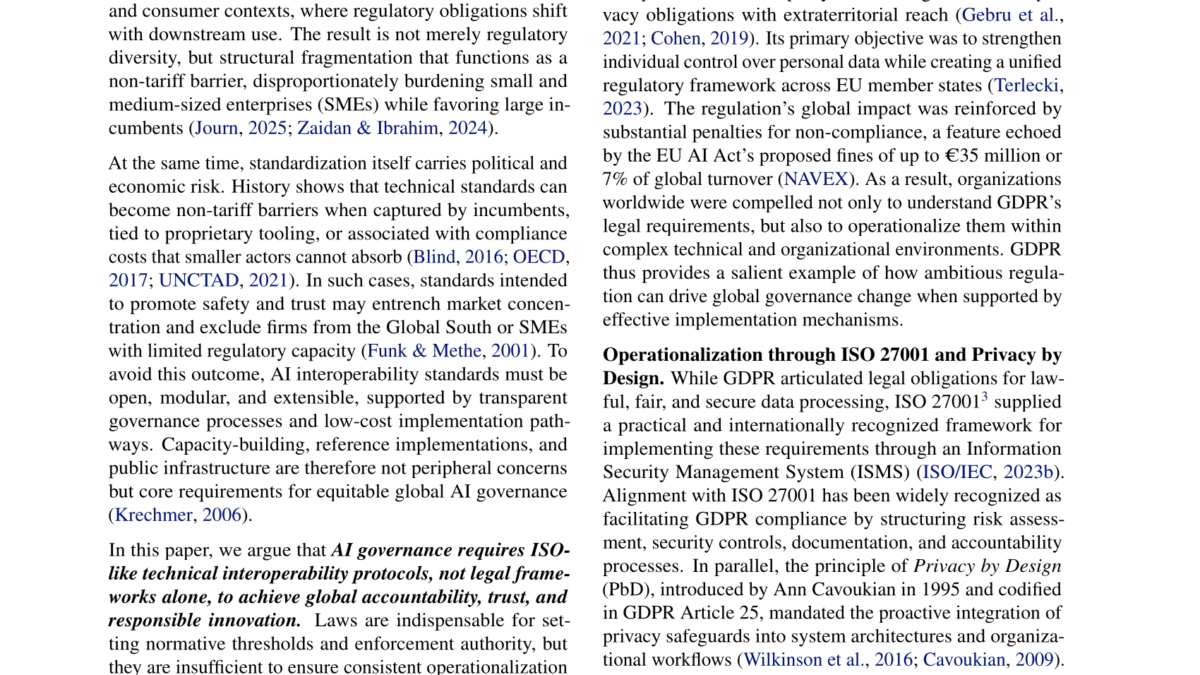
The European Union has its AI Act. China runs algorithm-governance rules. The United States leans on the NIST AI Risk Management Framework. The co-authors argued, “AI governance must be built not on laws alone, but on ISO-like interoperability protocols that enable standardized, machine-readable risk communication across borders” arXiv DOI.
Their fix is less a new law than a new protocol. Wasi noted that the GDPR offers a working precedent: it was made operational through standards such as ISO 27001 and the Privacy by Design principle. The co-authors argued for “standardized AI nutrition labels containing unified metrics for bias, energy usage, and data provenance” arXiv DOI. A single label, they say, would let regulators trust one submission instead of three.
Not everyone will cheer.
Critics argue that standards bureaucracies can freeze innovation in place. The authors acknowledge those concerns but argued the protocols should be “modular, versioned protocols designed to evolve in tandem with technological change” arXiv DOI. The framing aims to keep requirements moving with the technology instead of locking it down.
For builders shipping open models, the stakes are concrete. The open-source AI ecosystem has already shifted from loose model releases toward managed platforms, a change zBrandco charts in its analysis of open AI infrastructure how open models became platforms. Smaller developers today drown in duplicate filings; a shared label would lower that barrier.
The paper closes with a call “for a shift from siloed legal compliance toward interoperable technical conformance” arXiv abstract. Whether standards bodies actually adopt a shared vocabulary — and who gets to write it — remains the harder, still-open question.