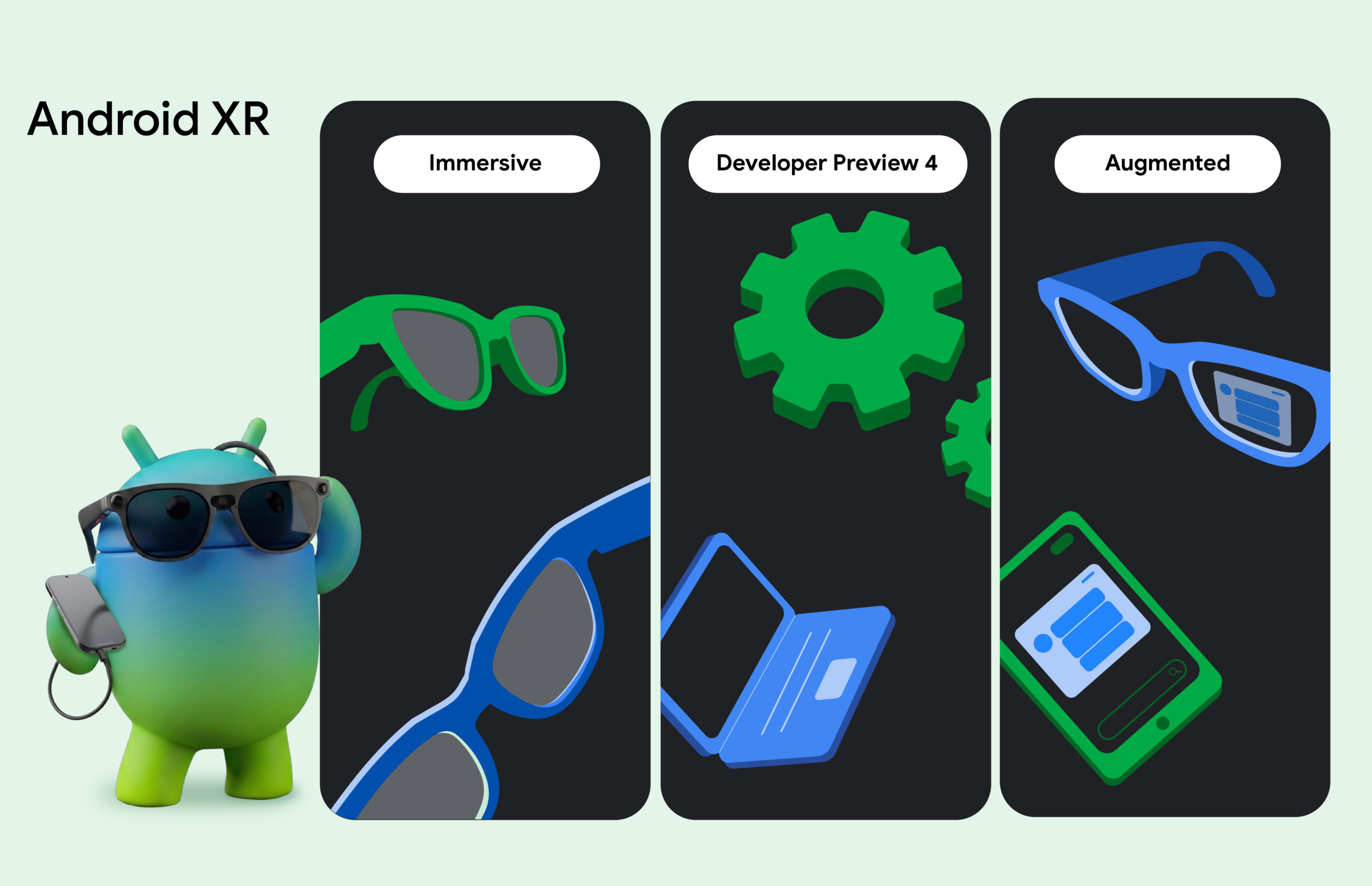

Google released Android XR Developer Preview 4 on June 15, 2026, adding official support for Unreal Engine and Godot, a Windows-based Engine Hub for real-time viewport testing, and opening applications for the Android XR Developer Catalyst Program. The update is built to target both the Samsung Galaxy XR headset and the upcoming Xreal Aura display glasses, per Google’s announcement on the Android Developers Blog.
Developer Preview 4 includes libraries for building immersive and augmented experiences directly from a laptop, with no physical hardware required for initial iteration. The XR emulator integrated into Android Studio lets developers test and refine apps without access to a physical headset or glasses. The Jetpack Projected library extends existing mobile apps to display content on XR glasses, with a Device Availability API that hooks into standard Android lifecycle states so apps adapt automatically when glasses are worn or removed.
The Android command-line interface now includes a display glasses skill built with Jetpack Compose Glimmer knowledge, which adds optimized text legibility for optical see-through displays and touchpad-optimized navigation components. NAVER Papago is already testing these tools to adapt its mobile translation experience for display glasses. For location-based immersive use cases, Preview 4 introduces Kotlin-first architectural upgrades to core perception libraries and an early preview of the Geospatial API for wired XR glasses.
The Geospatial API combines ARCore for Jetpack XR with Google’s Visual Positioning System (VPS) to anchor digital content to high-precision real-world locations, a capability previously limited to phone-based AR. It supports centimeter-level anchoring accuracy outdoors and in select indoor venues covered by the VPS database.
With Developer Preview 4, Google expands official engine support beyond its previous Unity-only offering to include Unreal Engine and Godot for wired XR glasses development. This lets teams port existing XR projects to Android XR without rewriting code for a new engine. The new Android XR Engine Hub is a Windows desktop tool that brings real-time testing directly into each supported engine’s native viewport, shortening iteration cycles by eliminating the need to switch between the engine and separate emulation tools.
The Android XR Developer Catalyst Program opened for applications on June 15, 2026, offering accepted developers pre-release access to both display glasses and wired XR glasses. Participants also get access to dedicated support forums and Google Play launch guidance for their XR apps.
The program addresses a prior access gap for developers, who had limited paths to test apps on the Samsung Galaxy XR headset or upcoming Xreal Aura glasses before consumer launch. Applications are open with no stated deadline, and Google positions the program as a way to give developers direct access to ecosystem resources to support innovation.
Preorders for the Xreal Aura, the second Android XR device after the Samsung Galaxy XR headset, opened on June 16, 2026, via a $99 deposit scheme. The glasses are scheduled to launch in fall 2026 in the US, UK, Japan, Canada, and South Korea. The Aura weighs under 95 grams and runs on Qualcomm’s Snapdragon Reality Elite chip.
Ziad Asghar, head of Qualcomm’s XR division, stated the chip is built to deliver better immersive experiences, higher performance, greater intelligence, and improved power optimization. Early reservers who place a deposit within the first two-week window receive a $199 credit toward the final purchase price, an effective $100 discount.
Best Buy will serve as the first in-store retail partner for the Aura, though final pricing has not been announced. Xreal plans to showcase the Aura at AWE, which runs June 15–18, 2026, in Long Beach, California.