Lin Du noted that memory design “remains a highly coupled architecture problem” arXiv paper. The researcher and eight collaborators reached that line by running a brute-force experiment on agent memory — and found there is no single best way for an agent to remember.
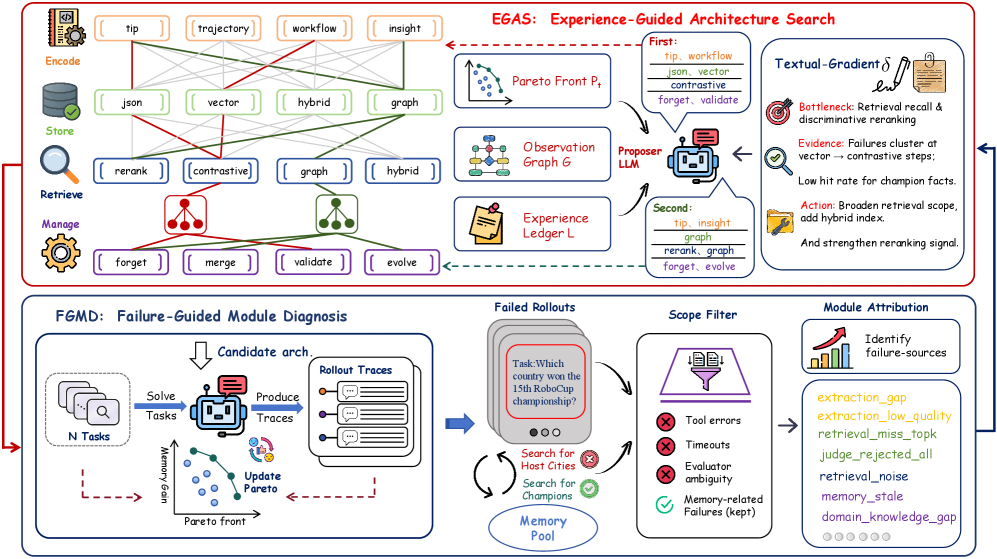
The team built a discrete search space spanning five encoders, five stores, six retrievers, and four managers — twenty moving parts that decide what an agent keeps, how it files the memory, how it pulls the memory back, and how it manages the whole pile arXiv DOI record. They report that different tasks favor wildly different combinations, opening performance gaps a fixed memory cannot close.
Du and the other eight authors are blunt about the takeaway: no single memory architecture consistently dominates. Because different tasks want different module mixes, they argue the human’s job is not to design memory but to supervise a search for it arXiv paper.
AutoMem is their answer: a text-gradient recursive framework that searches for the right memory architecture per task instead of prescribing one. It works in two moves. Experience-Guided Architecture Search proposes candidates drawn from past search runs and the team’s accumulated reflections. Failure-Guided Module Diagnosis takes a memory failure and points a finger at the specific module that caused it, turning the miss into written feedback the next search can use arXiv DOI record.  See the arXiv paper.
The numbers behind the search
Across GAIA, WebWalkerQA, and xBench-DeepSearch — run on two different LLM backbones — the searched architectures beat the strongest human-designed memory baselines by an average of 2.8 accuracy points over six benchmark-backbone settings arXiv paper. The same method also trimmed token cost by 14.3 percent against the strongest accuracy-focused baselines on Qwen3.5-122B-A10B, and it found better architectures than far larger random searches in just a few guided iterations.
Why “let the agent decide” is also a warning
The result is a genuine trade-off, not a free lunch. AutoMem shifts the human’s job from designing memory to supervising a search — and that search itself spends tokens and compute hunting for the winning layout. For teams already squeezed by inference bills, trading a fixed memory for a per-task search adds a new line item, even when the final run is cheaper. The paper also stops short of claiming the method generalizes beyond the three benchmarks it reports.
The work sits inside a busy stretch for agent-memory research. A related zBrandco report examined an arXiv agent-memory model that bars stale and retracted data from being recalled Agent-memory model bars stale data. AutoMem’s angle is complementary: not just what an agent should forget, but how it should be built to remember in the first place.
Memory was treated as a component you pick.
AutoMem suggests it is a configuration you grow — one task, one architecture, one search at a time.
Editorial note: Citation cleanup: we trimmed duplicate citation links that repeated the same source after multiple paragraphs. Every fact and quote is unchanged; the source remains cited where each claim appears.