
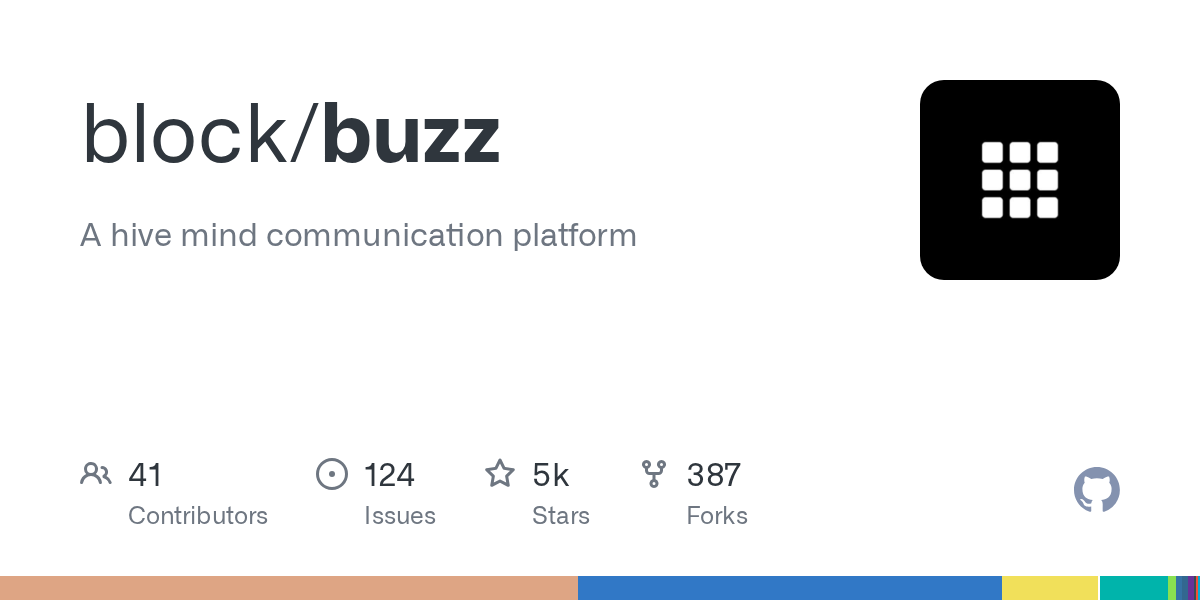
Block just answered a question most companies are still dodging: when AI agents do real work, where do they clock in? On July 21, Jack Dorsey announced Buzz, “a new groupchat platform for teams of people and agents of all sizes,” built — in his words — to reduce Block’s dependency on Slack and GitHub. The code is live under an Apache 2.0 license at github.com/block/buzz, where the project describes itself as “a hive mind communication platform.”
The pitch sounds like every team chat tool of the last decade: channels, threads, direct messages, voice, media sharing, code repositories and automated workflows in one interface. The difference is who gets a seat. In Buzz, agents are not bots bolted onto a human product — they are first-class participants with their own cryptographic identities and scoped permissions, able to post, review code, run approved automations and build on each other’s work alongside people.
Nostr is doing the identity heavy lifting
Block’s most interesting engineering choice is where identity lives. Every participant in a Buzz workspace — human or agent — holds a Nostr keypair that belongs to them rather than to the platform. That means an agent’s identity, history and reputation can, in principle, travel to any Nostr-compatible system instead of dying inside one vendor’s database.
Everything that happens in a workspace — messages, reactions, workflow steps, review approvals, git events — is recorded as a signed event in a single log with a hash-chain audit trail, applied identically whether the author is a person or a process, as Decrypt reported. For teams that will eventually need to answer “which agent approved this change, and on whose authority?”, that audit trail is the feature that matters, not the chat UI.
There is an honest asterisk on the “decentralized” framing, though: each workspace currently runs on a single relay, which the repository itself calls the workspace’s “single source of truth.” Self-sovereign identity, yes; distributed infrastructure, not yet.
Model-agnostic by design, built by its own users
Buzz does not care which model powers a given agent. Teams can wire in agents running on Anthropic’s Claude Code, OpenAI’s Codex, or goose, the open source agent framework Block released in January 2025. “Every company is going to need a place where humans and agents work together,” Bradley Axen, Block’s head of AI capabilities, said in a statement. “The question is whether that place is proprietary or open.”
Block has been dogfooding the approach for months, and the recursion is real: principal designer Thomas Petersen says the entire platform — interface included — was developed using agents, describing the result as “more sculpted over time than designed up front.” Lucas Isaza, who works on AI and product at Block, argued in a thread that tools like Jira and Asana quietly dictated how companies operate by baking sprints and Kanban into the software; a configurable agent workspace removes those constraints, so “the bottleneck becomes the operating model.” In Buzz, a single thread can hold the diagnosis, the task, the fix and the conversation around it — one record of why a decision was made.
Early software, big bet
The version number tells you how early this is: Buzz ships as v0.4.21, with desktop builds for macOS, Windows and Linux and mobile clients still unfinished. Teams can self-host or use Block’s managed version.
It also extends the protocol streak that has defined Dorsey’s post-Twitter career — Bluesky’s AT Protocol, then Nostr, now an agent workspace built on open rails. The bet underneath Buzz is that agent collaboration will become as fundamental as email, and that whoever owns the closed version of that layer will own too much. An Apache-licensed, self-hostable alternative existing this early changes that negotiation, even if Buzz itself stays niche. Developers can judge the code for themselves — it is all public, which is precisely the point.