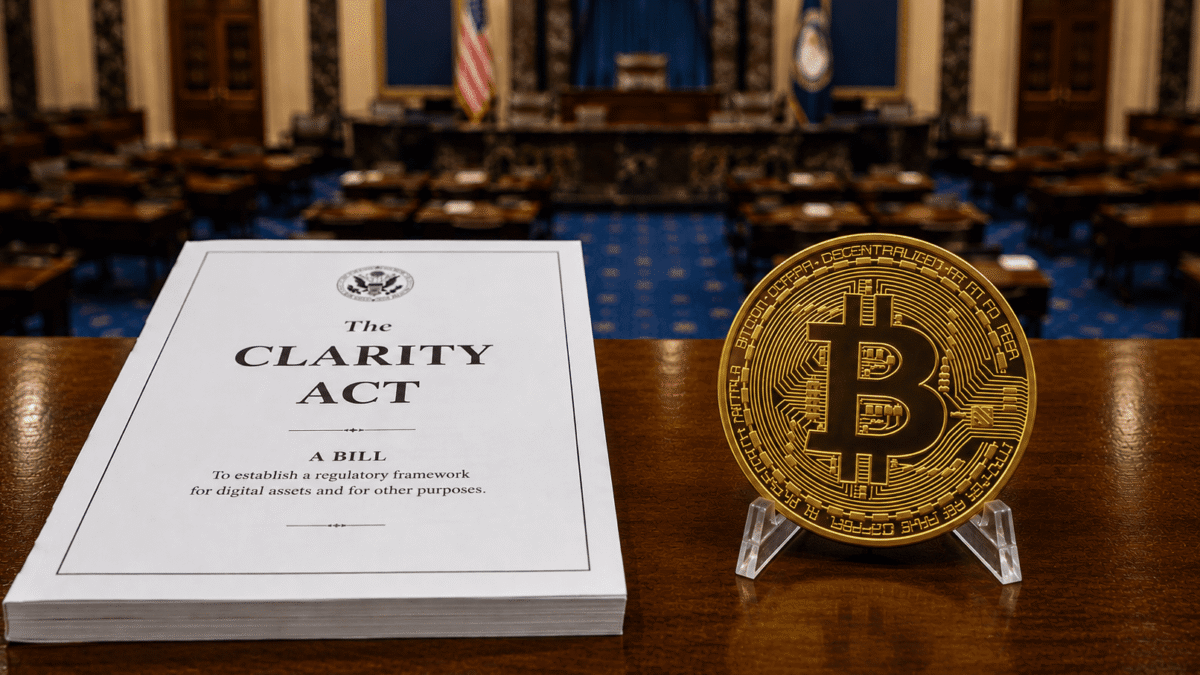
The bill that crypto traders keep calling a Bitcoin catalyst is no longer the bill the House passed. Every page of the House text was struck out in the Senate Banking Committee, and the replacement version answers a different set of questions. A guest analysis by Isaiah Austin, published by Bitcoin Magazine, walks through the post-rewrite text section by section. The short version for anyone holding Bitcoin: the surviving provisions are mostly defensive, and the one genuinely price-relevant section has nothing to do with token classification.
This guide unpacks what the current CLARITY Act text does for Bitcoin, what it quietly dropped, and why even passage would not produce enforceable rules any time soon.
Start with the rewrite, not the headlines
The legislative history matters because it explains why so much online commentary is out of date. During the July 2025 stretch that House Republicans branded “Crypto Week,” three bills moved together: GENIUS, CLARITY, and the Anti-CBDC Surveillance State Act. GENIUS was signed into law within 24 hours and set up a framework for dollar-backed stablecoins, while the Anti-CBDC bill squeezed through the House by a very narrow margin and then sat in the Senate without a floor vote for more than a year, according to Bitcoin Magazine’s account of the sequence.
CLARITY took a slower route. According to the Bitcoin Magazine analysis, after bipartisan House passage it waited in the Senate Banking Committee for close to a year. When it finally came out, the cover page carried the instruction to strike everything after the enacting clause and insert new italic text. In practice that means the first 256 pages — the entire House-passed bill — appear struck through line by line on the official text, with the Senate’s version starting on page 257, as Bitcoin Magazine describes from the filed text. A further-updated draft has circulated since, but it has not been formally filed as an amendment.
So when you read a thread promising that CLARITY will “act as the catalyst for the next bull run,” check which version the author is describing. Most of the optimism traces back to language that no longer exists in the filed bill.
Three things the current text does for Bitcoin
Self-custody gets statutory backing
Section 605, the Keep Your Coins Act, bars federal regulators from restricting or impairing a person’s ability to self-custody digital assets for any lawful purpose. That right currently rests on nothing more than regulatory restraint. The Bitcoin Magazine analysis points to a concrete precedent: in 2020, Treasury Secretary Steven Mnuchin directed FinCEN to propose a rule aimed at “unhosted wallets” that would have required exchanges to collect names and home addresses for anyone moving more than $3,000 a day to a private wallet, plus reports to FinCEN above $10,000 a day. The proposal lost momentum but stayed un-withdrawn for roughly four years, meaning any successor could have finalized it without new legislation.
Read Section 605 as insurance rather than upside. It does not move the price. It removes a category of tail risk that self-custody users have carried since the beginning.
Developers and node operators get a defined line
Section 604, the Blockchain Regulatory Certainty Act, states that a non-controlling developer or provider cannot be classified as a money transmitting business simply for building or running non-custodial software. The stakes here are not theoretical. Samourai Wallet’s founders pleaded guilty in April 2026 and Tornado Cash’s Roman Storm was convicted on the same money-transmitter theory in August 2025, both cases involving open-source, non-custodial code, per Bitcoin Magazine.
Section 604 does not reopen either prosecution. What it changes is the position of the next wallet developer, node operator or privacy-tool maintainer, who would no longer need a federal trial to learn where the line sits. For anyone running infrastructure — a Lightning node, a coordinator, a self-hosted wallet backend — that is the most practically useful clause in the bill.
Banks get an explicit green light
Section 401, on the permissibility of digital asset activities, is the section with real market consequences. It would let financial holding companies, national banks, state banks and credit unions custody digital assets, lend against them as collateral, run nodes, provide brokerage and clearing services, and act as market maker or dealer without extra prior approval beyond existing banking law. Crucially, it uses the term “digital asset” as already defined in the enacted GENIUS Act, so Bitcoin qualifies unambiguously rather than depending on contested labels like “digital commodity” or “ancillary asset.”
The scale argument is straightforward. US commercial banks hold about $25.7 trillion in total assets, roughly 20 times Bitcoin’s $1.3 trillion market capitalization, and custody firms such as State Street and Northern Trust each administer books that dwarf the entire Bitcoin market several times over, according to the figures cited by Bitcoin Magazine. None of that capital needs to reallocate aggressively to matter at Bitcoin’s size; it needs a statutory door. Traditional banks are already walking toward similar doors elsewhere — see our report on how Israel’s largest bank plans to offer Bitcoin trading in 2027.
Two things the bill no longer does
The first omission is the big one for anyone who assumed CLARITY would settle Bitcoin’s legal identity. Bitcoin is treated as a commodity today because the CFTC says so and courts have gone along in enforcement cases. That is precedent, not statute, and nothing stops a future regulator from taking another view. The House version would have closed that gap; the Senate rewrite of June 1 struck the language and left it empty for weeks. A July 22 draft merges in the Senate Agriculture Committee’s CFTC framework and restores the definition, but that draft is neither law nor a filed amendment, Bitcoin Magazine notes.
The second omission is the CBDC ban. The Anti-CBDC Surveillance State Act language, which would have prohibited the Federal Reserve from issuing a retail CBDC, was inside the 256 struck pages, and the current text carries no operative section on the subject.
Why passage would not mean rules
Even a signed bill does not arrive with a working regulator attached. The CFTC would have to build a digital asset regime close to from scratch, and its track record on capacity is the constraint. GENIUS, signed last year, missed its entire one-year rulemaking deadline with zero final rules across six federal agencies as of mid-2026, while the CFTC currently has a single sitting commissioner and has seen staff headcount fall 21 percent in a year, per Bitcoin Magazine.
That is the gap between a legislative win and an operational one. If you are modelling timelines, the useful anchor is not the vote date but the first final rule — and GENIUS suggests that can slip well past a statutory deadline.
How to read this as a Bitcoin holder
Three practical takeaways. First, treat Sections 604 and 605 as risk reduction you already benefit from if you self-custody or maintain open-source tooling; they change your legal exposure, not your position size. Second, Section 401 is the clause worth tracking for flows, because bank custody and collateral lending are what convert institutional interest into balance-sheet activity. Third, discount any timeline that assumes rules follow enactment quickly.
The broader framing in the source analysis is that CLARITY is bullish for crypto generally and only narrowly bullish for Bitcoin, because most of the bill exists to give other tokens an exit from securities-law limbo — a problem Bitcoin does not have. That does not make the Bitcoin-specific sections unimportant; it makes them worth supporting on their own, modest terms.
For readers who follow this legislation closely, Bitcoin Magazine distributes its coverage through its own news apps as well as the web: the iOS listing describes real-time price, hash rate, block height and fee data alongside the article feed, and the Google Play listing records more than 5,000 downloads with a last update on March 6, 2026. If you are building or hosting anything on top of that kind of live data, our guide on when a CDN actually speeds up your website covers the delivery trade-offs.
Editorial note: Citation cleanup: we trimmed duplicate citation links that repeated the same source after multiple paragraphs. Every fact and quote is unchanged; the source remains cited where each claim appears.