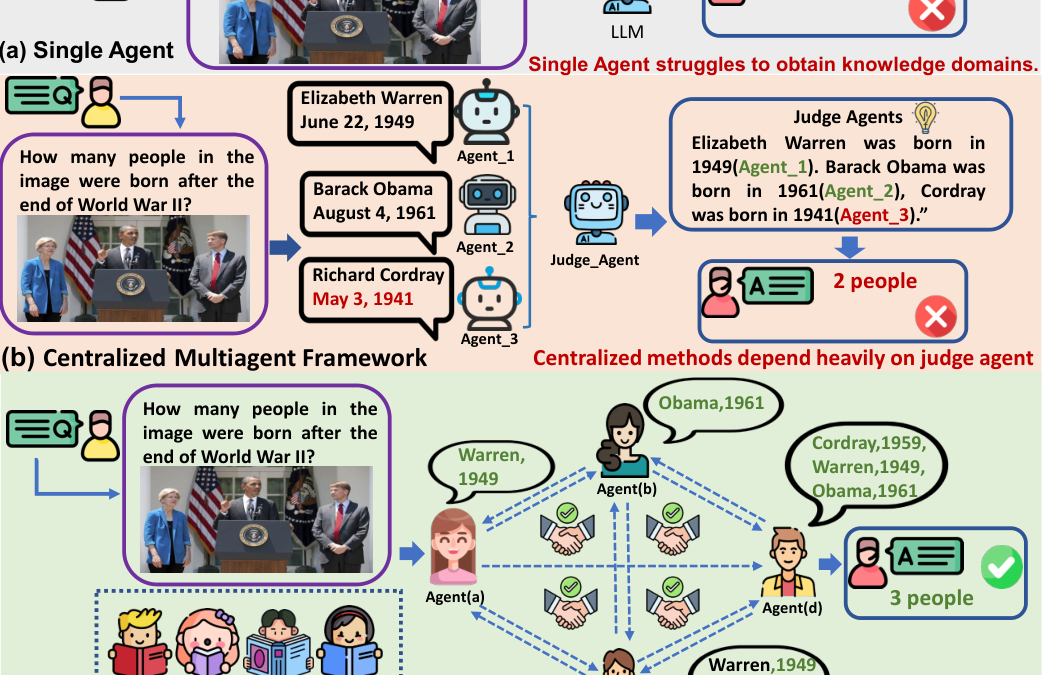
The dispatcher is the part of a multi-agent system nobody praises and everybody fights. A central controller reads the task, hands out roles, and routes every answer back through itself. It works until a single query needs two kinds of knowledge at once — then the controller becomes the bottleneck, and the static role assignment that looked sensible at startup starts mismatching the actual question.
The researchers behind DeAR, a preprint posted to arXiv arXiv abstract, treat that bottleneck as structural rather than incidental. “Existing agentic reasoning systems typically rely on centralized protocols,” they write. “This design introduces routing bottlenecks and static role allocations that often fail when handling complex multimodal queries.” Their fix swaps the dispatcher for a peer-to-peer mesh in which each agent decides when to consult a neighbor and when to stop.  See the arXiv paper.
Three mechanisms carry the load. Decentralized capability grounding lets an agent size up an incoming query and specialize on the fly, instead of being handed a fixed role at startup. Thought map navigation gives agents a shared map of partial reasoning steps, so a stuck agent can find the peer that actually holds the missing piece rather than broadcasting to the whole group. Topology update lets the network rewire itself when a line of reasoning stalls, treating an error as a signal to reroute rather than a failure to restart.
Across nine multimodal reasoning and text-based question-answering benchmarks, the team reports that DeAR consistently beat recent baselines arXiv DOI. The widest gaps showed up on knowledge-intensive tasks where no single agent held the full answer — exactly the cases a central router tends to mangle. The authors frame the result plainly: “decentralized and adaptive collaboration among agents enhances accuracy in knowledge-intensive reasoning tasks.”
There is a bill to pay. Decentralized systems are harder to debug than one controller, and peer-to-peer messaging adds both latency and the chance of agents talking past each other. A central design stays easier to audit, which matters for anyone shipping agents into production where a wrong answer is costly. DeAR trades that predictability for resilience when the task outgrows the original role plan.
The code is slated to be released upon acceptance arXiv abstract. For builders already fighting orchestration overhead, the paper is a concrete wager that agentic reasoning’s future looks less like a hierarchy and more like a marketplace where expertise finds expertise.
The work sits alongside other attempts to model how reasoning spreads across models Mean-Field Dynamics of Chain-of-Thought Reasoning.
Editorial note: Citation cleanup: we trimmed duplicate citation links that repeated the same source after multiple paragraphs. Every fact and quote is unchanged; the source remains cited where each claim appears.