
Docker on August 17, as announced on the Docker blog, detailed an expansion of Docker Hardened Images (DHI) that pushes the company’s supply-chain security beyond a catalog of safe base images. The change reaches the packages inside those images, the charts that deploy them, and the policy that gates them, so a platform team treats “zero known CVEs” as the default rather than a per-image project.
What Docker is shipping now
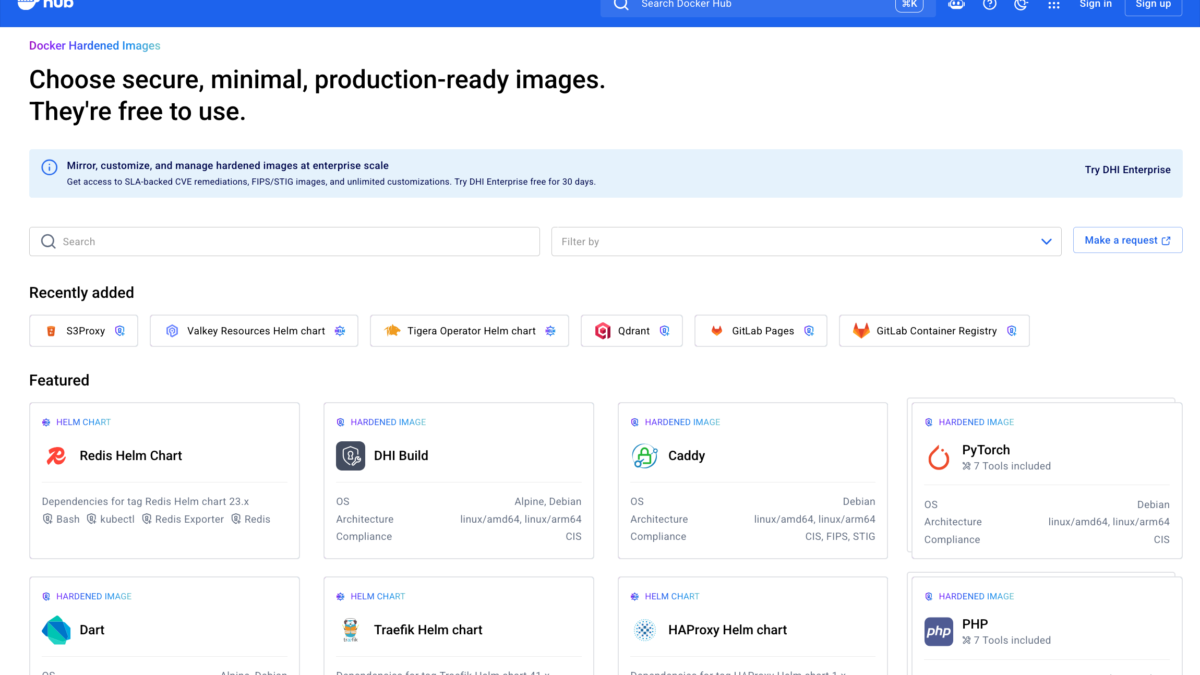
The DHI catalog has grown past 4,000 hardened images and now pulls more than 3.5 million times a week, with builds running regularly to keep every image patched, according to Docker’s announcement. The public Docker Hub catalog lists those hardened images across Alpine and Debian, from Redis and Traefik to PyTorch, each shipped with signed SBOMs and SLSA Build Level 3 provenance.
Docker Hardened System Packages push the hardening below the image to the packages inside it, across both Alpine and Debian, every package built from upstream source in the same SLSA Build Level 3 pipeline, as documented in the DHI package index. DHI Enterprise customers can point apt or apk at that hardened package repository, and the Debian and Alpine package lists are public so teams can watch the catalog harden in real time.
Why the baseline matters
Over a quarter of production code is now AI-authored, and agents pull dependencies at machine speed, so platform teams inherit responsibility for code none of their own engineers wrote. Mark Lechner, Docker’s Chief Information Security Officer, called the latest wave of supply-chain attacks “a permanent shift in the threat landscape.”
The pressure is not theoretical: Trivy and KICS, tools the industry trusts to defend supply chains, were among the targets hit in this year’s supply-chain campaign. System packages are notoriously slow to fix upstream, so a patch can sit waiting on a distribution’s next release for months; Docker patches at the package level and ahead of upstream when it counts.
The agent and policy angle
Docker AI Governance now streams every policy decision an organization’s agents trigger into the SIEM the security team already runs, with a searchable record in Docker Cloud. The move to govern what agents do fits a wider shift toward isolating AI-assisted work; zBrandco recently looked at how Docker pairs ESP32 firmware builds with AI agent sandboxes in this earlier coverage.
Docker Scout policy evaluates customizable Rego policies from the CLI and in CI, and ships with the same policies Docker uses to verify every hardened image, so the same rules travel to every developer machine. The developer machine is exactly where the current wave of attacks aims, and portable policy is how Docker holds every image to the standard it holds itself to.
What platform teams should do
DHI Extended Lifecycle Support keeps end-of-life software patched, with SBOMs and provenance maintained, for up to five more years; MinIO joined after its upstream archived the project in February 2026. EU-hosted customizations, for teams with data-residency requirements, arrive in September, and Docker will host a live webinar in early September to walk through how the pieces fit together, per the official announcement.
For teams already on Docker, the controls are additive: Scout policy works alongside existing scanners and ships in the Docker subscription they already have, so adopting a zero-CVE baseline is a configuration change rather than a new platform. The catalog stays free for every developer, and adoption is a FROM-line change, not a migration.