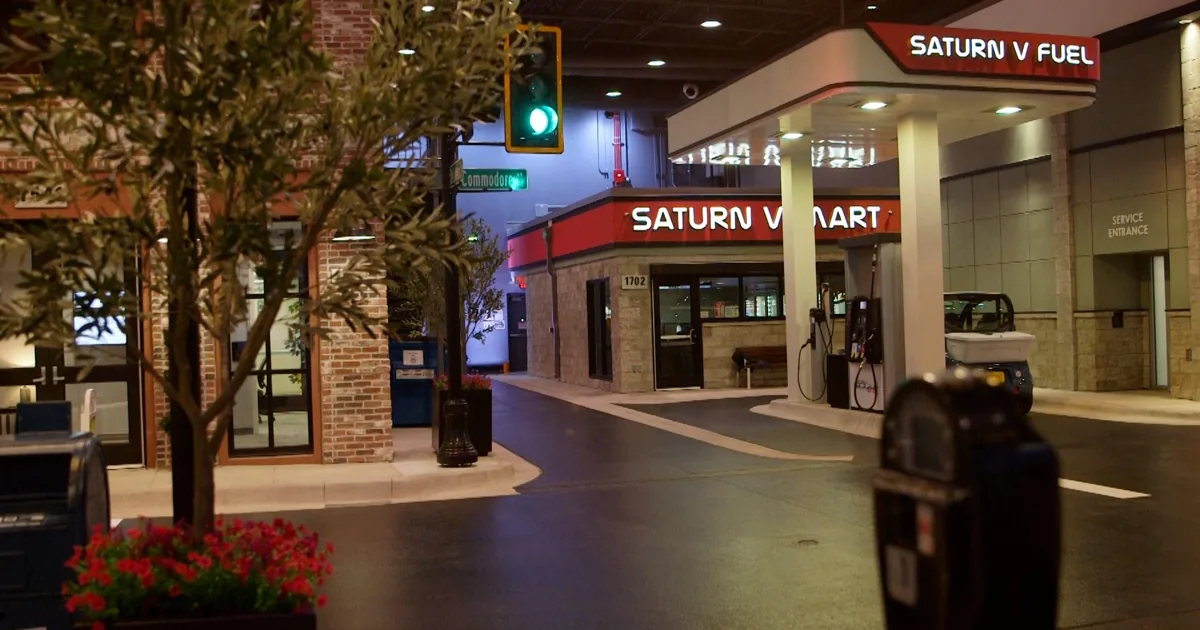
TL;DR — The FBI’s Kinetic Cyber Range (KCR) — a 22,000-square-foot replica town at its Huntsville, Alabama campus — has trained 1,400+ agents and partner personnel since opening February 2025. The facility includes a hospital, power company, gas station, hotel, arcade, and 200+ server data center, all wired to behave like real infrastructure while isolating live malware (per FBI.gov). TechCrunch covered the facility June 13, 2026 (TechCrunch).
The town that hacks back
Walk into the FBI’s North Campus at Redstone Arsenal and you’ll find a fully furnished small town: houses with lived-in bedrooms, a hotel with keycards, a gas station with a convenience market, a hospital with patient monitors, a power company with SCADA systems, a business center, an arcade, and a trailer park.
Every structure is wired with functioning IoT devices, Active Directory networks, and enterprise-grade firewalls. The 200+ server data center runs Windows and Linux — “cold, cramped, noisy, dark, miserable,” per program manager Dave Beachboard (FBI). That’s by design.
“This is about as real as it’s going to get before people go out in the field.” — Dave Beachboard, KCR Program Manager
Why a fake town? $20.9 billion reasons
The FBI’s 2025 Internet Crime Report: $20.9 billion in U.S. cybercrime losses (record high, 26% YoY increase) (IC3 Report). Ransomware remains the #1 threat to critical infrastructure. Traditional classroom training doesn’t prepare investigators for the physical + digital convergence of modern attacks.
The KCR bridges that gap. It’s air-gapped from the internet — safe for live ransomware detonation, vehicle ECU extraction, and hospital crisis simulations where alarms sound and role-players simulate patient-care emergencies.
What they actually train on
1. Hospital ransomware attack (high-pressure scenario)
Simulated ransomware locks the hospital network. Alarms sound. Role-players simulate doctors unable to pull up patient records. Trainees navigate technical problem + human crisis simultaneously. The goal: make mistakes here so they don’t in the field.
2. Vehicle forensics (8-week Digital Forensic Examiner Course)
Physically extract a vehicle’s electronic control unit — the “digital brain.” Peel back plastic and upholstery, trace wires. Pull location history, usage patterns, driver identification. The KCR has a dedicated vehicle bay for this (FBI).
3. Residential IoT investigation
Navigate a home filled with smart devices: thermostats, cameras, voice assistants, connected appliances. Decide what to seize vs. leave behind. Practice evidence collection in domestic environments.
4. Corporate search warrant execution
Serve a warrant at the business center. Work with sysadmins to access buried data. Navigate corporate legal/compliance constraints. Role-players include executives and legal teams — trainees practice explaining scope: “what we are collecting, but more importantly, what we are not collecting.”
5. Data center forensics (the miserable part)
Work among 200+ running servers. Cold, loud, dark, cramped. Experience the physical realities of server-room investigation. “We want them to make the mistakes in the Kinetic Cyber Range.” — Stephanie Cassioppi, FBI Cyber Division
The methodology: safe failure, interdisciplinary ops
| Division | Focus | Training Contribution |
|---|---|---|
| Operational Technology Division | Digital forensics | Device seizure, evidence extraction, on-site processing |
| Cyber Division | Computer intrusions | Network tracing, malware analysis, threat actor attribution |
“The success of our investigations and operations require the various job roles that make up a cyber squad working together.” — Stephanie Cassioppi
The KCR forces cross-division collaboration. Forensics specialists and intrusion analysts train side-by-side — mirroring real investigations where you need both skillsets.
Continuous evolution: past cases → future scenarios
The scenario library updates based on:
– Past case studies (what went wrong in real investigations)
– Emerging threats (new ransomware variants, supply-chain attacks)
– New IoT devices (latest smart home gear, industrial sensors)
– Drone forensics
– Vehicle forensics advances
– Latest software vulnerabilities
“If we see gaps in training, we will adjust, making sure that students are encountering the latest software, the latest Internet of Things, the latest drones, the latest vehicle forensics — all of that to keep us cutting edge.” — Dave Beachboard
The controversy you should know
The KCR’s digital forensics training relies on undisclosed vulnerabilities in devices (Apple, Google, etc.) for extraction. These are never disclosed to manufacturers. The FBI argues this capability is essential for investigations; security researchers argue it leaves consumers exposed. This tension — law enforcement tooling vs. responsible disclosure — isn’t new, but the KCR institutionalizes it at scale.
The takeaway
Paradigm shift: From classroom theory → immersive realism. Physical + digital convergence (OT/IT systems in context). Interdisciplinary training (technical + soft skills: interviews, negotiation, crisis communication). Safe failure encouraged.
Precedent setting: The KCR is the largest known dedicated physical cyber training town in U.S. law enforcement. Other agencies and nations are watching. Expect similar ranges from DHS, DoD, and allied intelligence services.
What’s next
- FY 2026 Internet Crime Report (early 2027) — will the $20.9B trend continue?
- Interagency adoption — will CISA, Secret Service, or NSA build companion ranges?
- Private sector access — currently FBI + partner agencies only; could critical infrastructure operators buy training slots?
- Drone/vehicle forensics expansion — KCR adding automotive ECU and UAV forensics scenarios
FAQ
Q: Where is the Kinetic Cyber Range located?
A: FBI North Campus, Redstone Arsenal, Huntsville, Alabama.
Q: How many people have trained there?
A: 1,400+ FBI agents, analysts, forensic specialists, and partner agency personnel since opening February 2025.
Q: Is the facility connected to the internet?
A: No — it’s air-gapped. This allows safe detonation of live ransomware and malware without spillover risk.
Q: Can private companies or civilians train there?
A: Currently no — only FBI and partner federal/local agencies. Private sector access is a future possibility.
Q: What’s the controversy about undisclosed vulnerabilities?
A: KCR forensics training uses exploits in consumer devices (Apple, Google) that aren’t reported to vendors. Law enforcement says it’s necessary; security researchers say it leaves users at risk.
Bottom Line
Verdict: The Kinetic Cyber Range is the most ambitious physical cyber training facility in the U.S. — and it’s operational now, not a pilot. 1,400+ trained in 16 months. $20.9B in annual cyber losses demanded something beyond PowerPoint slides. The fake town delivers. Watch for interagency replication and whether the undisclosed-vulnerability policy draws congressional scrutiny.
Internal links for deeper context
- US government bans Anthropic Claude Fable under export controls — AI security implications
- Best student laptops for cybersecurity studies 2026 — hardware for forensics work
Source: FBI, “Inside the FBI’s Kinetic Cyber Range,” published June 9, 2026 (FBI.gov). TechCrunch, “The FBI built its own replica small town to simulate real-world cyberattacks,” by Zack Whittaker, published June 13, 2026 (TechCrunch). FBI 2025 Internet Crime Report (IC3) (PDF).
Editorial note: Citation cleanup: we trimmed duplicate citation links that repeated the same source after multiple paragraphs. Every fact and quote is unchanged; the source remains cited where each claim appears.