
Funny Steam reviews have quietly become one of the few discovery channels on the platform that an indie developer can win without spending a cent. Every Steam store page — from a two-person studio’s debut to Valve’s own Steam Deck — carries a dedicated Funny review tab that ranks user reviews purely by how many “Funny” votes they collect. When a joke review goes viral, the game riding on it gets front-page-adjacent visibility that no recommendation algorithm and no paid placement can guarantee.
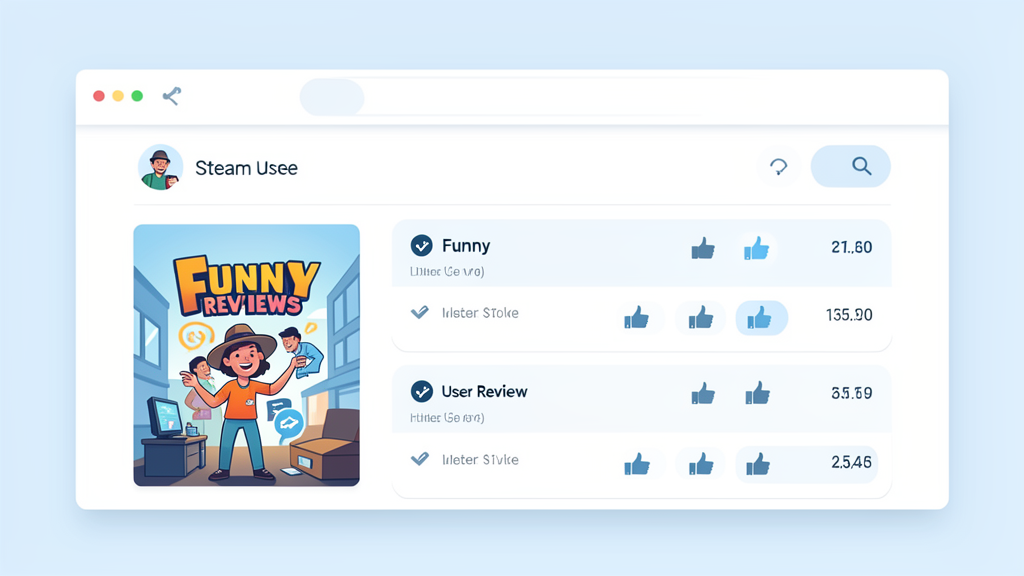
Editorial illustration: the Funny review tab as a vote-driven discovery surface. Source: Valve’s Steam store interface.
When Steam reviews actually started
Valve introduced crowdsourced user reviews across the Steam store in 2013, replacing the old third-party Metacritic-style blurbs with a system where any buyer could post a written verdict. From the start, reviews carried reaction buttons — Helpful, Funny, and later Unhelpful — that let other shoppers weight a review by voting on it. The “Funny” button was never a joke feature: it was a first-party signal that Valve has kept as a permanent, separate sort on every product page.
The mechanics got a meaningful tune-up in 2024, when Steam changed how it calculates review helpfulness, shifting toward a method that accounts for the readers actually trying to make a decision rather than raw vote totals. The Funny sort kept its simple, durable rule — most Funny votes rises to the top — which is exactly what makes it useful as a discovery tool.
The Funny tab is distinct from the Recommended / Not Recommended split that reflects purchase sentiment. A review can be “Not Recommended” yet still be the funniest on the page, and it will surface in the Funny section regardless of whether the voter liked the game. That separation is the whole point: it ranks entertainment value, not endorsement.
Why a joke review can out-pull a marketing budget
For an indie team with no UA spend, the Funny tab is the rare Steam surface where placement is earned by the community, not bought. A single review that the audience decides is hilarious can accumulate thousands of Funny votes and pin itself to the top of a game’s page, where every subsequent visitor sees it first. That impression is free and it sits outside the algorithmic recommendation widgets that tend to favor already-popular titles.
Valve does not editorialize the Funny section. The ranking is decided by user votes alone — no human curation, no paid boost. A small studio’s page and Valve’s own first-party hardware pages use the identical rule.
The Steam Deck proof point
When the Steam Deck launched globally on February 25, 2022, its three listings — 64GB eMMC, 256GB NVMe SSD, and 512GB NVMe SSD — each inherited the same Funny review interface available to every indie publisher. That matters because it shows the feature is platform-wide, not a perk reserved for blockbusters. An indie title published after that date gets the exact same Funny infrastructure as a Valve flagship, and the only requirement for entry is that shoppers find the reviews funny enough to vote.
The handheld’s arrival also expanded the catalog of first-party pages hosting the section, but the mechanism was unchanged: user-submitted Funny votes, sorted descending.
How indie devs can actually use it
The takeaway for developers is practical. Steam’s algorithm rewards engagement signals, and a funny, screenshot-worthy moment in a game is a repeatable way to manufacture them. Studios that design a beat players will quote — a absurd death, a ridiculous physics glitch, a deadpan line of dialogue — give their audience something worth reviewing. The review writes itself; the votes do the distribution.
This is not a replacement for a real store-presence strategy, but it is a complement that costs nothing. A title with weak algorithmic weight can still surface in the Funny tab purely on the strength of one viral post. For a studio that cannot afford a Steam featuring slot, that is the closest thing the store offers to free placement.
The limits to keep in mind
The Funny tab is a visibility channel, not a quality signal. A game can top the Funny sort while sitting at “Mixed” overall review score, so developers should not treat humorous traction as validation of the product itself. And because ranking is vote-driven, it is also volatile — today’s top funny review can be overtaken tomorrow. The channel works best as a top-of-funnel attention source that feeds into the game’s real review score, not as a stand-in for it.
How the funny loop compounds
The Funny tab does not exist in isolation from Steam’s other signals. A review funny enough to hold the top slot tends to increase how long visitors linger on a store page, and those extra seconds feed the same engagement metrics the recommendation widgets watch. In other words, a strong funny-review moment can pull a game into the algorithmic stream indirectly, even though the Funny tab itself ranks on votes alone. Developers who notice a review gaining funny traction often amplify it by sharing the clip off-platform, which brings new visitors back to the page to vote — a self-reinforcing loop that costs the studio nothing but attention.
This is also why the channel rewards personality over polish. A slick trailer is expensive and easy to ignore; a genuinely funny player quote is cheap and hard to scroll past. For an indie team competing against marketing budgets an order of magnitude larger, that asymmetry is the entire appeal.
What is the Funny review tab?
A dedicated section on every Steam store product page that sorts user reviews by the number of user-submitted “Funny” votes they earn. It is separate from the Recommended / Not Recommended tabs that show purchase sentiment.
When did Steam get user reviews?
Valve launched community user reviews on the Steam store in 2013, with reaction buttons that have included Funny from the start. The helpfulness calculation was reworked in 2024.
Do indie games get the same Funny tab as big releases?
Yes. Every product page on the store uses the identical vote-sorted Funny section, including Valve’s own Steam Deck listings that went live on February 25, 2022.
Does Valve edit which reviews are funny?
No. Funny-section reviews are entirely user-generated, ranked by user votes, with no editorial oversight from Valve.
Bottom line: the Funny tab is a free, algorithm-independent discovery surface that has existed on Steam since 2013 and still runs on the same vote-driven rule today. Indie developers who ship shareable, genuinely funny moments give players a reason to review — and those reviews do the marketing for them.