
GitHub has launched configurable pull request limits for all repositories, a new tool that lets maintainers set a maximum number of open pull requests per user without write access to a given repository. The feature is designed to reduce low-effort contribution noise and unmanageable review backlogs for open source maintainers.
The launch responds to a 3.6x surge in monthly merged pull requests across the platform, from roughly 25 million per month in January 2023 to over 90 million per month as of the announcement GitHub Blog.
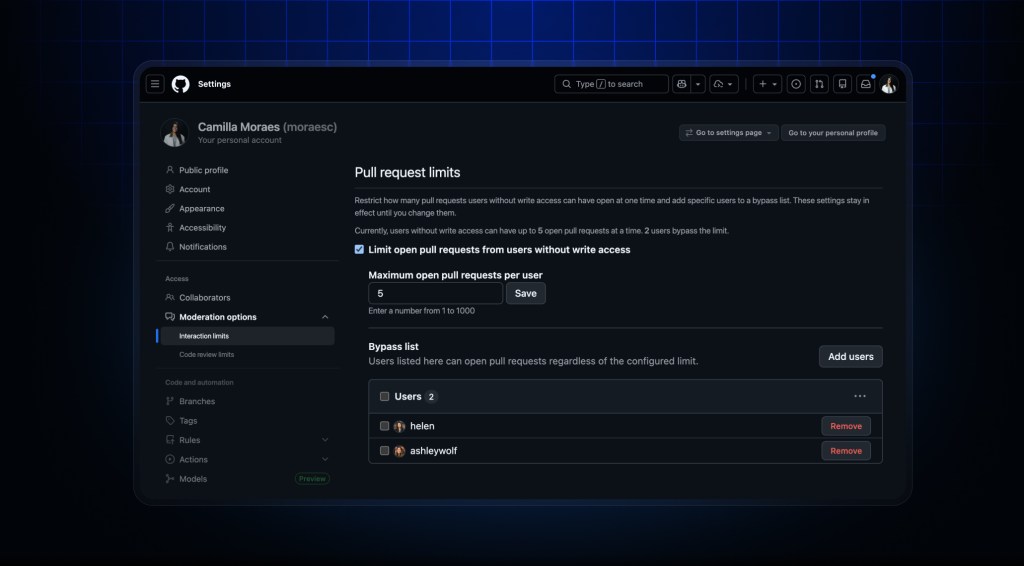
Per GitHub’s official announcement, the new pull request limits set a persistent, configurable maximum number of open pull requests a user without write access can have in a given repository. This is a departure from the platform’s existing temporary interaction cooldowns, which pause user activity for a set period before resetting GitHub Blog.
Hitting the configured cap requires contributors to close or merge an existing open PR before they can open a new one in the same repository. Draft PRs and users added to a maintainer-curated bypass list are exempt from the limit GitHub Blog.
Pull requests opened by AI coding agents, including GitHub Copilot, count toward a user’s open PR total under the new rules.
How pull request limits address the contribution surge
The limits launch during a period of unprecedented open source contribution volume. GitHub data shows developers merged roughly 25 million pull requests per month across the platform in January 2023; that figure now tops 90 million per month, a 3.6x increase GitHub Blog.
The surge has been accelerated in part by AI-powered coding tools increasing the volume of contributions submitted to repositories. GitHub’s data shows this trend has contributed to a growing share of low-effort, near-identical submissions that require the same review time as hand-written contributions. Volunteer maintainer teams have not seen a corresponding increase in review capacity, leading to unmanageable backlogs GitHub Blog.
GitHub has referenced the “Eternal September” concept to describe this imbalance, as lowered barriers to submitting contributions have coincided with flat maintainer review capacity GitHub Blog.
The new pull request limits shift some of the prioritization work to contributors before their submissions enter the review queue. When contributors can only have a small number of open PRs at once, they are more likely to polish and prioritize their highest-impact work, rather than submitting rough drafts alongside stronger contributions GitHub Blog.
This pre-queue filtering is a key difference from existing spam and abuse filters, which do not target good-faith low-effort noise that clogs review pipelines. The new pull request limits are designed to address this category of submissions, which falls outside the scope of existing spam and abuse filtering GitHub Blog.
Planned expansions to contribution management controls
GitHub stressed that pull request limits are only the first step in a broader roadmap of maintainer tools, driven by direct feedback from open source teams. Four upcoming features are in active development or exploration GitHub Blog:
– Archived pull requests (shipping soon): Repository admins will be able to hide low-quality or spammy PRs from the default queue without deleting them, a compromise designed to accommodate organizations with legal or compliance requirements that bar permanent deletion of contribution records.
– Issue limits (in development): The same per-user cap model will be applied to issues, letting maintainers limit the number of open issues a user without write access can have at once, with an option to restrict issue creation entirely to collaborators.
– Smarter bypass signals (up next): Instead of manually curating bypass lists, maintainers will be able to auto-exempt contributors who meet trust signals such as having a previously merged PR in the repository, a minimum account age, or membership in the repository’s parent organization.
– Cross-repository controls (in exploration): GitHub is testing ways to catch users who spam PRs across hundreds of repositories at once, via cross-repo rate limiting or shared trust signals, addressing a gap in the current per-repository cap model.
Pull request limits differ from existing GitHub moderation tools
The new feature is distinct from GitHub’s pre-existing interaction limits, which impose temporary cooldowns designed to curb abusive behavior. Those cooldowns expire after a set window, and do not prevent a user from opening dozens of PRs once the timer resets GitHub Blog.
Pull request limits, by contrast, are persistent and fully configurable by repository admins. This persistent model ensures that users who repeatedly submit low-quality contributions cannot simply wait out a cooldown to flood the queue again GitHub Blog.
The feature is now available in repository settings for all GitHub users. Early testers of the feature reported reduced time spent reviewing low-quality contributions, as teams no longer need to sort through high volumes of low-effort submissions that previously clogged the queue GitHub Blog.
Bottom line: Open source maintainers facing unmanageable PR backlogs can enable configurable pull request limits in their repository settings immediately to reduce low-effort noise and cut time spent reviewing low-quality contributions. Upcoming features including per-user issue limits, automated trust-based bypass signals, and cross-repository spam controls will expand contribution management options for maintainers in coming months.
Editorial note: Citation cleanup: we trimmed duplicate citation links that repeated the same source after multiple paragraphs. Every fact and quote is unchanged; the source remains cited where each claim appears.