
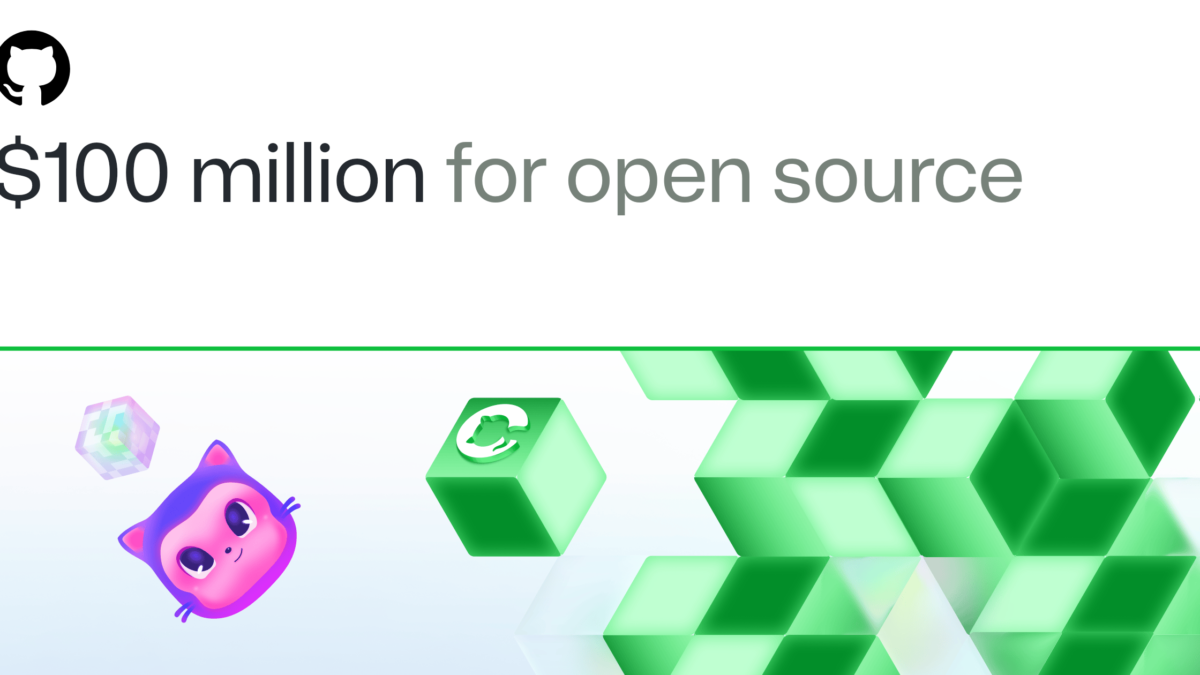
GitHub said this week that more than $100 million has moved from sponsors to open source maintainers and projects through GitHub Sponsors since the program launched in 2019 — a number that matters less as a trophy and more as evidence that paying the people who build the internet’s plumbing is finally becoming a habit rather than a charity case GitHub’s milestone announcement. The figure is GitHub’s own, and it is a self-reported milestone rather than an independent audit, but as a directional signal it is one of the clearer ones we have for whether “pay the maintainers” has moved from slogan to default behavior.
Seven years in, the number finally means something
GitHub launched GitHub Sponsors in 2019 on a fairly simple premise: the people who write and maintain the libraries everyone else ships should be able to get paid for it directly, by the developers and companies who depend on them GitHub Sponsors. What changed between then and a nine-figure cumulative total is not a single big donation but a slow normalization of the behavior. The program now spans 103 regions, has partnered with Patreon, and has added the kind of unglamorous machinery — bulk sponsorships, invoice payments — that lets a procurement department actually approve the spend instead of routing a $5 monthly tip through an expense report.
From individuals tossing in coffee money to Fortune 500 line items
The early version of Sponsors was almost entirely individuals: developers throwing a few dollars a month at the maintainers whose packages they relied on. The shift that actually moved the needle was organizational sponsorship, which GitHub made generally available in 2023 GitHub Sponsors documentation. Shopify was an early adopter, funding its dependencies at scale, and Mercedes-Benz’s open source program has since framed sponsorship as both practical risk management and values-driven support. When a large company treats open source funding as a line item rather than a donation, the economics change: GitHub says each organization-funded sponsorship has historically been worth roughly 15 times the average individual one, and that in 2022 nearly 40% of all sponsorship funding already came from organizations.
The pace is the real story
A cumulative total is easy to shrug at. The slope is harder to dismiss. According to GitHub, the first $10 million took almost two years to accumulate after the 2019 launch. The most recent $10 million took about five months. That is a four-to-five-times compression in time per ten-million tranche, driven by a wider region footprint and the friction removers mentioned above. The network now supports more than 70,000 maintainers and organizations and includes over 280,000 sponsors ranging from solo developers to large enterprises.
What $100 million actually bought
The number is a stand-in for something less quantifiable: people who can now do open source as a job instead of a second shift. Sebastián Ramírez (tiangolo), the creator of FastAPI, describes Sponsors as having first shown him “people’s appreciation,” then shown him “I could and should figure out how to do more open source.” Caleb Porzio, behind Livewire and Alpine.js, says sponsorships let him quit his job and work on his projects full time. Kelvin Tegelaar of Lime Networks credits it with giving him “a direct, sustainable way to fund the time it takes to build and maintain projects.” These are not marginal hobbyists — they maintain infrastructure that a large slice of the modern web and AI stack is built on top of.
Why this matters for the open source AI toolchain
There is a direct line from this milestone to the open source AI ecosystem the rest of the site covers. FastAPI and a long tail of model-serving and inference libraries are maintained by exactly the kind of developer Sponsors was built to support. As organizations fund the dependencies they actually ship — and as that share keeps growing — the baseline stability of the open source AI toolchain improves. It is not glamorous, and it does not show up in a model benchmark, but a maintainer who is not burning out is a maintainer who patches the next CVE.
The honest limits of a $100 million milestone
Two caveats keep this from being a victory lap. First, the figure is GitHub’s, and “invested in open source maintainers and projects” rolls together one-time and recurring payments, individual and organizational — useful, but not the same as “X maintainers are now sustainably employed.” Second, the distribution is almost certainly skewed: a handful of high-profile projects capture the majority of sponsorship dollars while the long tail of unglamorous but essential packages still runs on volunteered time. Sponsorships are a partial fix, not a replacement for foundational grants or institutional support. The 15x organization-to-individual ratio is good news for the orgs involved and a reminder that individual sponsors alone were never going to close the gap.
The takeaway
A hundred million dollars is a rounded, vendor-reported number, and it should be read as a trend indicator rather than a scoreboard. But the trend is the point: direct funding of open source maintainers has gone from a novel nice-to-have in 2019 to a line item for procurement teams at some of the largest companies in the world by 2026, and the acceleration curve suggests the next $100 million arrives considerably faster. For the developers who keep the ecosystem running — and for the AI tooling that depends on them — that is the meaningful part of the milestone.