
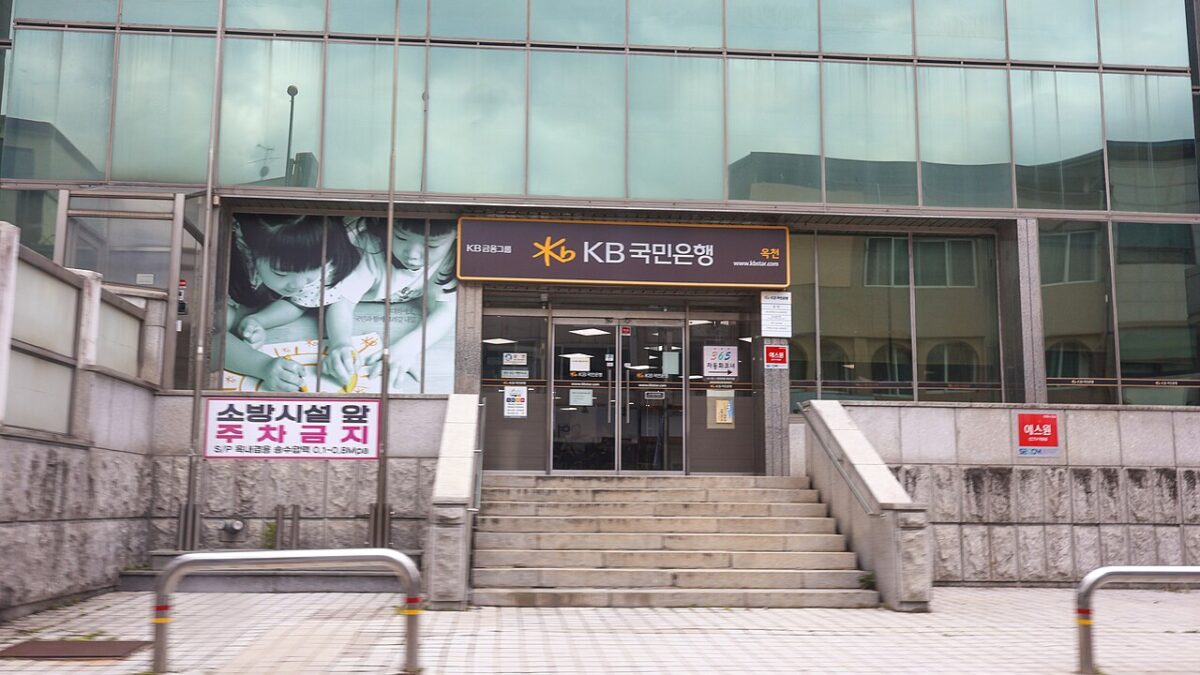
KB Kookmin Bank, South Korea’s largest lender, will start settling cross-border payments for import and export businesses on JPMorgan’s Kinexys blockchain network in August, according to reporting by Cointelegraph citing multiple Korean media outlets. The service opens with US dollar transfers across 10 countries — including the United States, Singapore, Saudi Arabia and the United Arab Emirates — and it is aimed squarely at the least glamorous, highest-friction corner of banking: paying overseas suppliers.
That framing matters. This is not a pilot, a proof of concept, or a tokenization press release. It is a commercial bank routing real corporate trade payments over a permissioned blockchain operated by another commercial bank, with a launch month attached. For anyone tracking how institutional blockchain adoption actually happens — quietly, through plumbing — this is one of the clearer recent examples.
The deal in concrete terms
The service KB Kookmin is launching handles US dollar cross-border transfers for import and export clients. Ten countries are in the initial corridor set. The launch window is August 2026. And according to Yonhap’s reporting cited in the Cointelegraph piece, the service will integrate with the existing SWIFT network to deliver near-instant cross-border payments and foreign exchange settlement.
The scale of the bank behind it is worth pausing on. An April research report from S&P Global ranked KB Financial Group — KB Kookmin Bank’s parent, whose corporate profile is published at kbfg.com — as South Korea’s largest lender by assets and the 28th-largest bank in the Asia-Pacific region, with $552.76 billion in total assets. When an institution of that size commits a client-facing product to a blockchain rail, it has already answered its own internal questions about compliance, custody of value in transit, and operational risk. Those answers are usually the hard part.
What Kinexys actually is
Kinexys is JPMorgan’s bank-led blockchain platform, rebranded from its earlier identity as Onyx. JPMorgan’s Kinexys platform page describes a stack built around programmable money movement that runs 24/7/365: blockchain deposit accounts, JPM Coin for on-network value transfer, advanced programmable payments, and on-chain foreign exchange. Around that payments core sit adjacent services — digital financing, a tokenized collateral network, and tokenized money market funds — that let assets already sitting on a balance sheet be mobilized for liquidity.
The piece of that stack most relevant to KB Kookmin’s use case is the combination of deposit-account money and on-chain FX. In a conventional correspondent-banking flow, a Korean exporter’s dollar payment hops between intermediary banks, each with its own cutoff times, fees and reconciliation lag. On a shared ledger where both ends of the transaction bank against the same network, the transfer and the FX leg can settle together, near-instantly, at any hour. That is the concrete promise being sold to KB’s import-export clients — not decentralization, not tokens, just fewer hops and no waiting for Tuesday morning in New York.
The SWIFT twist
The most interesting detail in the Korean reporting is that the new service integrates with SWIFT rather than bypassing it. That runs against the popular framing of blockchain settlement networks as SWIFT killers, and it reflects how these systems are actually being deployed.
SWIFT is a messaging network; it tells banks what to move, not how the money settles. By keeping SWIFT in the loop for messaging and compliance workflows while moving settlement onto Kinexys, KB Kookmin gets to offer near-instant settlement without asking its correspondent relationships, sanctions-screening processes, or clients’ back offices to change how they communicate. The upgrade is invisible to most of the participants — which is precisely why it can ship in August rather than in a five-year roadmap.
For the crypto-native reader, this is the pattern worth internalizing: the institutional adoption curve is not running through public chains or stablecoins first. It is running through deposit tokens on permissioned networks that slot into existing message rails. Whether that eventually converges with public-chain infrastructure is an open question, but the sequencing is now unambiguous.
Why an importer actually cares
Strip away the infrastructure story and the client pitch is simple. A mid-sized Korean importer paying a supplier in Dubai or Singapore today faces settlement that can take one to several business days, uncertain landing times, FX conversion at a rate locked somewhere in the middle of the process, and fees layered by intermediaries. Working capital sits dead in transit.
Near-instant settlement changes the cash-flow math. Payment can be released against documents or delivery milestones with the funds arriving while the counterparty is still on the phone. FX settles at execution rather than drifting through a multi-day window. And because Kinexys operates around the clock, a payment instructed on a Korean Friday evening does not wait out a weekend of closed correspondent desks. For import-export businesses running on thin margins and letter-of-credit timelines, those are operational gains, not ideological ones.
The 10-country corridor list also tracks real Korean trade flows. The US and Singapore are obvious. Saudi Arabia and the UAE reflect the deepening Korea-Gulf trade relationship — construction, shipbuilding, defense and energy contracts that generate exactly the kind of large, recurring dollar payments where settlement friction is most expensive.
Where this fits in the bank-chain race
JPMorgan has spent years positioning Kinexys as infrastructure other institutions build on, and the KB Kookmin deal is a template case: a foreign bank consuming Kinexys as a network service to upgrade its own client offering. Every additional bank that joins makes the network more useful to the next one — the same network-effect logic that made correspondent banking sticky for a century, now working in favor of whoever assembles the largest shared-ledger settlement club first.
That has competitive implications in three directions. For other Korean banks, KB Kookmin just set a client-expectations bar for trade-payment speed that will be hard to ignore. For stablecoin issuers courting the same cross-border corporate flows, a top-30 Asia-Pacific bank choosing a permissioned deposit-token network over any stablecoin rail is a data point about where regulated corporate money is comfortable settling. And for SWIFT, being kept in the loop is both a validation and a warning — the messaging layer survives, but the settlement economics underneath it are being renegotiated by someone else.
What to watch from here
Three things will indicate whether this is a milestone or a footnote. First, corridor expansion: 10 countries at launch is a start, and the pace at which KB adds currencies beyond the US dollar — or destinations beyond the initial list — will show whether client demand is real. Second, volume disclosure: neither bank has published expected transaction volumes, and the difference between a marquee integration and a workhorse rail is measured in billions settled, not press coverage. Third, imitation: if other large Asian banks announce Kinexys integrations or rival deposit-token corridors in the next two quarters, August 2026 will look in retrospect like the point where blockchain trade settlement in Asia stopped being experimental.
None of this touches a public blockchain, an exchange, or a token you can buy. That is exactly why it matters. The unglamorous migration of trade payments onto shared ledgers is the institutional adoption story playing out on its own terms — one corridor, one bank, one August launch at a time.