A memory table trained to serve one language model can be lifted out, frozen, and dropped next to a completely different model — and still answer questions. That is the claim a new arXiv preprint puts to the test, and the result turns out to be less about the memory itself than about the small component that reads it arXiv preprint.
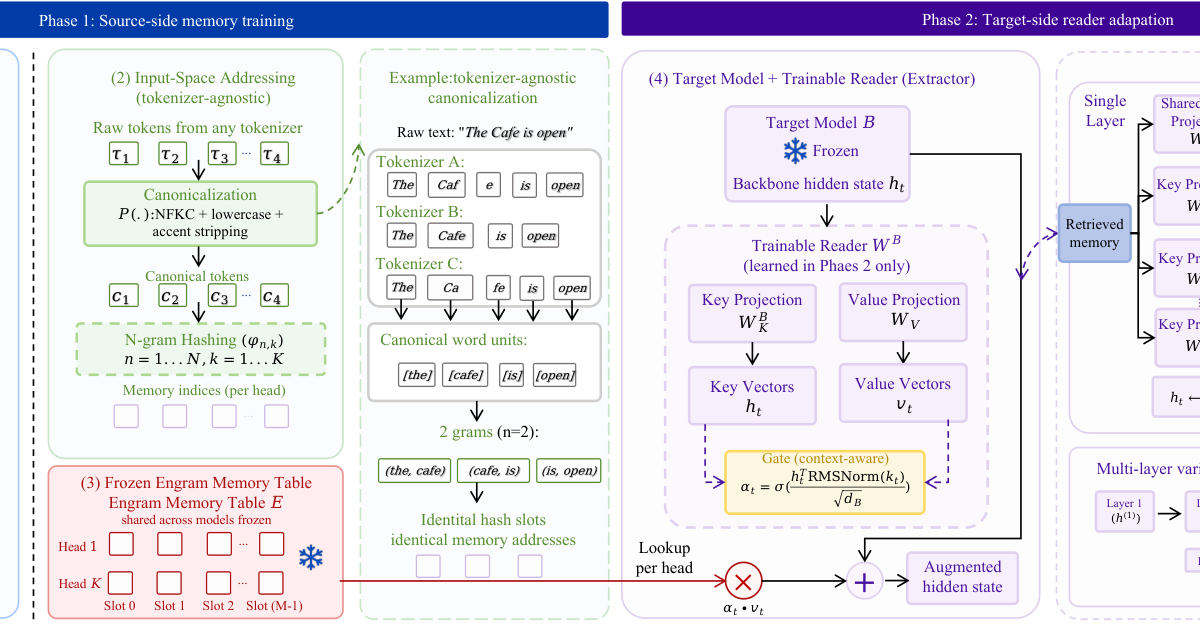
Most attempts to give a model more knowledge sit at opposite ends of a trade-off. Retrieval pulls facts from outside the model on demand, but it adds latency and keeps that knowledge at arm’s length. Fine-tuning bakes knowledge into the weights, but then it is hard to update, audit, or move. Engram-style hashed memory sits in the middle: an external, addressable table that a model consults through a small learned “reader” arXiv preprint.

The paper’s authors asked a pointed question. When you move that frozen memory onto a new backbone, what actually carries the value — the stored table, or the reader that knows how to address it?
Their method, which they call cross-model frozen-memory extraction, freezes a memory trained on a source model and attaches it to a target model, training only a lightweight reader on the new side arXiv preprint. The ablations are blunt: both the learned content and correct addressing matter, but a transferred table “becomes useful only through a reader aligned to the target model.”
That sentence is the tension at the heart of the work. The memory is portable in principle, yet powerless until something on the destination side learns to speak its language.
The payoff is concrete. In downstream question-answering tasks, a dual-layer, four-branch reader nearly closed the gap between reusing memory on the same model and reusing it across models, posting an average score of 38.8 under the paper’s controlled evaluation protocol DOI record.
There is a cheaper path, too. When the provider’s reader is already compatible with the target’s interface, the frozen artifact can deliver real utility with no target-side training at all; optional reader adaptation then squeezes out further gains.
For builders, the implication is a potentially reusable external knowledge artifact — memory you train once and deploy against several models, as long as each target can reach a compatible reader. It is a narrower, more audit-friendly cousin of retrieval-augmented generation, with the knowledge living in a table you can inspect rather than in prompt context you cannot.
The catch is the interface tax. Portability is real, but it is gated by how well a target-side reader can be aligned, and the paper stops short of showing the approach scale across many architectures at once.
Related reading: an earlier zBrandco report examined an agent-memory model designed to bar stale and retracted data from contaminating shared knowledge zBrandco.
Editorial note: Citation cleanup: we trimmed duplicate citation links that repeated the same source after multiple paragraphs. Every fact and quote is unchanged; the source remains cited where each claim appears.