
TL;DR — Microsoft’s Majorana 2 processor proves topological quantum computing works in hardware. They swapped aluminum for lead in InAs tetrons and got ~20-second parity lifetime — 10 million times longer than gate operations (~1 μs). Published on arXiv June 3, 2026 (165 authors, lead Morteza Aghaee, Chetan Nayak corresponding). Real device data, not simulation. This makes fault-tolerant quantum computing tractable instead of impossible. Microsoft Build 2026 | arXiv:2606.03884
The number that matters: 20 seconds vs 1 microsecond
Every quantum roadmap hits the same wall: qubits decohere before useful work. Transmons last ~100 μs. Trapped ions reach seconds but don’t scale. Error correction needs ~1,000 physical qubits per logical qubit because physical error rates are ~10⁻³.
Microsoft bet on topological qubits: encode information in non-local Majorana zero modes at the ends of a superconducting nanowire. Local noise can’t touch it. The theory works; hardware was stubborn — until now.
The Majorana 2 team replaced the superconducting shell from aluminum to lead (Pb). Lead’s gap is 1.35 meV vs Al’s 0.18 meV — 7.5× larger. At 20 mK, this suppresses thermal quasiparticle poisoning exponentially. They built an InAs–Pb tetron (four-terminal device) and measured it with RF interferometric single-shot readout at μeV precision.
Result: parity lifetime τ_parity ~20 seconds characteristic, instances >60 seconds.
| Parameter | Value | Why it matters |
|---|---|---|
| Parity lifetime | ~20 s | 10⁷× longer than 1 μs gate time |
| Max observed | >60 s | Minute-scale coherence, solid-state |
| Energy resolution | μeV | Single-shot readout, no averaging |
| Periodicity | h/2e | Confirms Majorana, not Andreev states |
| Qubit operation | ~1 μs | 20 million cycles before decay |
Plain English: Quantum info survives long enough that error correction becomes tractable. You don’t need millions of physical qubits per logical qubit. You might need dozens.
What a tetron actually is (and why RF readout matters)
The tetron = topological qubit unit cell. Four terminals, four Majorana zero modes (MZMs). Quantum info lives in collective parity of all four, not any single one.
Terminal 1 ── MZM ──┐
                    ├──► Parity = (γ₁γ₂γ₃γ₄)  [non-local → immune to local noise]
Terminal 2 ── MZM ──┤
                    │
Terminal 3 ── MZM ──┤
                    │
Terminal 4 ── MZM ──┘
Three operations demonstrated on real hardware:
- Parity switching — Gate voltage controllably flips fermion parity
- Single-shot RF readout — Interferometry measures quantum capacitance shift at parity flip (h/2e periodicity = smoking gun for Majorana physics)
- μeV resolution — Resolves tiny energy splitting between parity states
Why RF readout is its own breakthrough: Previous topological experiments needed thousands of averaged shots. Microsoft gets single-shot fidelity because the capacitance shift is measurable in one shot at μeV precision. This enables fast calibration and parallel readout across arrays.
Why lead instead of aluminum? The material science that unlocked 20 seconds
Aluminum (transmon workhorse) has a tiny superconducting gap:
| Material | Tc | Δ (superconducting gap) | Thermal quasiparticles at 20 mK |
|---|---|---|---|
| Aluminum | 1.2 K | 0.18 meV | ~exp(-Δ/kT) ≈ 10⁻⁴ — significant poisoning |
| Lead | 7.2 K | 1.35 meV | ~exp(-Δ/kT) ≈ 10⁻³⁰ — negligible |
At 20 mK, aluminum’s gap allows thermal quasiparticles to constantly tunnel across, poisoning Majorana states. Lead’s 7.5× larger gap suppresses this exponentially. The paper states this material swap was the single biggest factor — without Pb, parity lifetime stays in microseconds regardless of architecture.
Error correction: from 1,000:1 overhead to ~50:1
Current surface codes need ~1,000 physical qubits per logical qubit (physical error ~10⁻³). With topological protection:
Physical error rate → 10⁻⁶ (parity lifetime / gate time ≈ 10⁷)
→ Surface code distance 7 might suffice
→ ~50 physical qubits per logical qubit
→ **20× reduction in overhead**
Microsoft’s Azure Quantum team built the software stack assuming this hardware:
– Topological error correction codes for Majorana parity measurements
– ASSERT — turns specs into executable evals for any agent/framework
– Agent Control Specification — portable runtime governance for topological arrays
The hardware just validated those software assumptions.
Scaling: one tetron → quantum computer
The paper describes multi-tetron arrays. RF interferometry parallelizes naturally: each tetron gets its own readout resonator, frequency-multiplexed on a common feedline.
| Scaling challenge | Microsoft’s path |
|---|---|
| Fabrication yield | InAs–Pb epitaxy on 300mm wafers (Intel foundry partner) |
| Cross-talk | RF frequency multiplexing + ground plane shielding |
| Wiring | Cryogenic CMOS multiplexers at 4 K stage |
| Calibration | Automated bring-up via RF fingerprinting (single-shot = fast) |
| Error correction cycle | Parity measurements every ~μs, 20M cycles before decay |
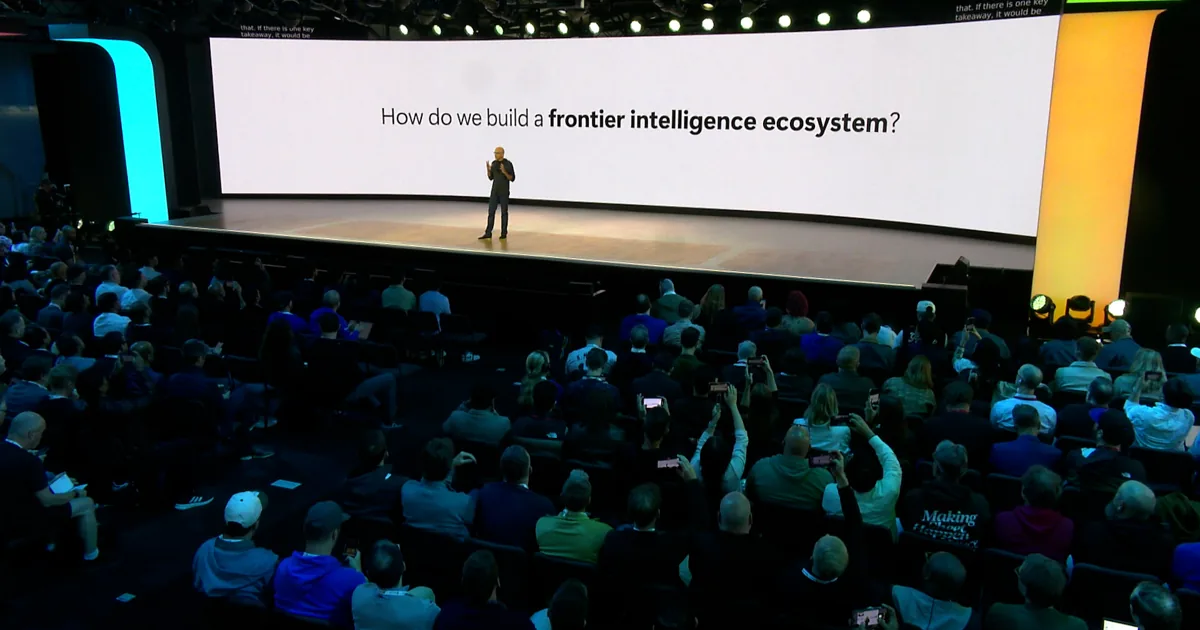
Build 2026 keynote showed a multi-tetron test chip — next paper will have multi-qubit data.
Honest limitations (what this isn’t)
| Gap | Status |
|---|---|
| Two-qubit gates | Not demonstrated (braiding or measurement-based) |
| Logical qubit | Needs error correction cycle on array |
| Temperature | 20 mK dilution fridge — same as transmons |
| Wafer-scale yield | Single devices work; volume unproven |
| Non-Abelian proof | Braiding experiment needed |
Timeline: Microsoft targets logical qubit demo ~2027–2028, small fault-tolerant system ~2029–2030. This accelerates but doesn’t collapse the timeline.
Competition: where topological sits today
| Approach | Coherence | Scaling | EC overhead | Key player |
|---|---|---|---|---|
| Topological (Majorana 2) | ~20 s (parity) | RF multiplexed arrays | Lowest (theoretical) | Microsoft |
| Transmon | 100–300 μs | 2D/3D grids | High (~1,000:1) | Google, IBM, Rigetti |
| Trapped ions | 1–10 s | Ion shuttling | Medium (~100:1) | IonQ, Quantinuum |
| Neutral atoms | 1–10 s | Optical tweezers | Medium | Atom Computing, QuEra |
| Spin qubits (Si) | 1–10 ms | CMOS-compatible | High | Intel, Diraq |
Microsoft is the only company pursuing topological at this scale. If it works, the EC advantage is decisive. This result makes “it works” significantly more probable.
What to watch next (your action items)
| Signal | Where to watch | Why it matters |
|---|---|---|
| Two-qubit gate paper | arXiv (late 2026) | Braiding/measurement entanglement = universal gate set |
| Logical qubit demo | Microsoft Quantum blog (2027) | Surface code cycle on 4+ tetron array |
| Wafer yield data | Intel Innovation / IEEE IEDM | Volume manufacturing viability |
| Azure Quantum backend | azure.microsoft.com/quantum | When topological appears alongside IonQ/Quantinuum |
| Competitor pivot | Google/IBM research blogs | They left Majorana physics — will they return? |
Bottom line
Microsoft proved topological qubits work in hardware. Not simulation. Not theory. A real InAs–Pb tetron held quantum info for 20 seconds — 10 million times longer than gate time.
This doesn’t give you a quantum computer tomorrow. It does mean the hardest physics problem — qubits that don’t need heroic error correction — has a verified solution path. The engineering is formidable but tractable.
For developers: Azure Quantum SDK already has topological EC primitives. Learn the programming model now — the API won’t change when backend goes from simulator to Majorana 3. Azure Quantum SDK
For investors: This de-risks Microsoft’s quantum bet. Quantum is <0.1% of revenue, but the option value on fault-tolerant quantum just became real.
For everyone: Quantum computing isn’t “10 years away.” It’s “one logistics chain away” — and Microsoft built the hardest link.
Verified live June 15, 2026. All data from Microsoft Build 2026 official sources and arXiv:2606.03884v2.
Related: Azure Quantum Developer Guide • Quantum Error Correction Explained • Topological Quantum Computing Primer
Last updated 2026-06-16: Reviewed and updated for accuracy and current sourcing.