NVIDIA has released Cosmos-H-Dreams, an open, action-conditioned world model that generates surgical robotics video fast enough to be driven interactively — around 160 frames per second on a single RTX PRO 6000, up from the roughly 10 fps of the teacher model it was distilled from. The announcement landed on the Hugging Face blog on July 27, and unlike a lot of world-model demos, this one ships with the full stack: model weights, the inference engine, and a training recipe for adapting it to your own robot data.
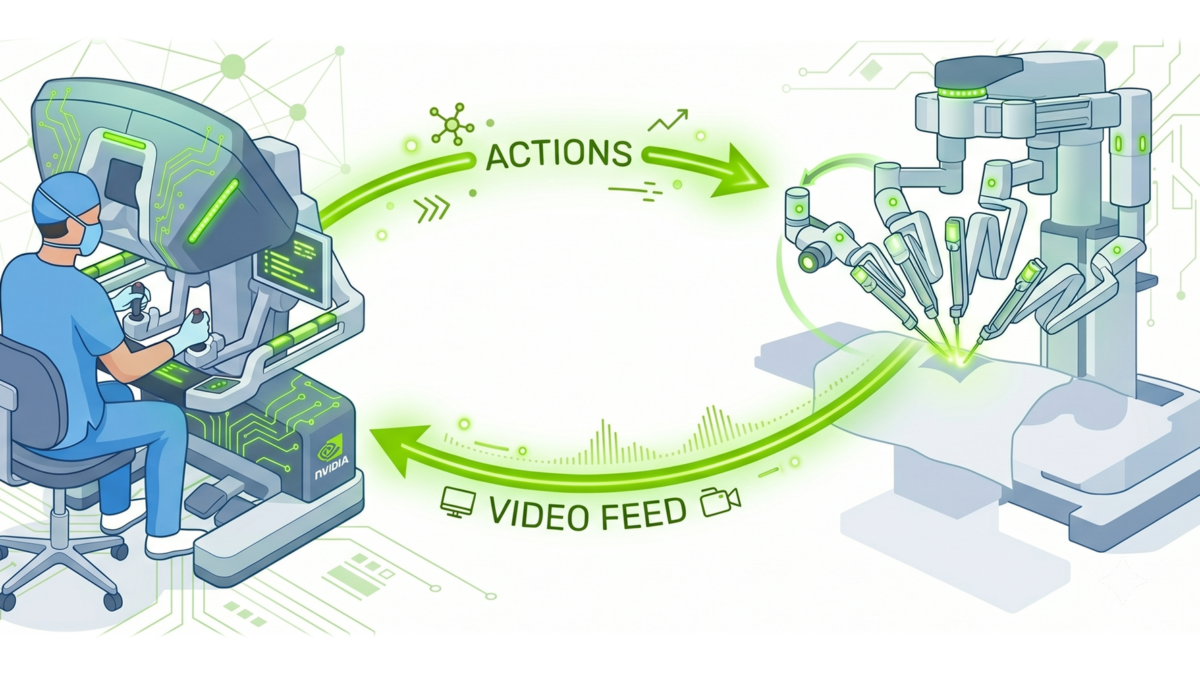
The short version: earlier this year NVIDIA’s Cosmos-H-Surgical-Simulator showed that a world foundation model — built on Cosmos-Predict2.5-2B and post-trained on the Open-H-Embodiment dataset — could take a surgical scene frame plus a planned robot trajectory and generate video of what would likely happen. Useful for offline policy evaluation, but too slow to sit inside a control loop. Cosmos-H-Dreams closes that gap by distilling the big bidirectional teacher into a causal, few-step student that generates frames autoregressively as robot kinematics stream in. A person with a keyboard, a Meta Quest controller over WebXR, or a learned surgical policy can now steer the simulation live and watch the consequences render in real time.
Why the distillation pipeline is the interesting part
If you build with open video or world models, the training recipe is worth reading even if you never touch a surgical robot. The pipeline has three stages, and each one addresses a failure mode that plagues autoregressive generation.
First, the teacher — fine-tuned from the Cosmos-H-Surgical-Simulator Open-H checkpoint on a Johns Hopkins dVRK (da Vinci Research Kit) tabletop suturing mixture — is deliberately trained on failures as well as clean demonstrations: dropped needles, missed throws, botched knot ties. NVIDIA’s argument is blunt and correct: a simulator meant to evaluate policies has to reproduce the consequences of bad actions, not just replay ideal ones. The temporal horizon is also grown progressively during training, from 12 frames up to 72, re-warming from pretrained weights at each bump to keep long rollouts stable.
Second, a “causal warmup” stage caches the teacher’s denoising trajectories and trains a causally-attending student to imitate them, so the student learns to work with a streaming key/value cache before it ever has to trust its own outputs.
Third — and this is the piece most transferable to other domains — comes self-forcing distillation. Autoregressive models are usually trained on clean ground-truth context but deployed on their own imperfect generations, so small errors compound. Here the student rolls forward on its own generated context during training, while distribution-matching supervision from the frozen teacher pulls those rollouts back toward realistic surgical video. The result generates with as few as two denoising steps per latent frame.
FlashDreams does the serving
Distillation alone doesn’t get you to interactive frame rates. The model is served through FlashDreams, a newly published inference library for autoregressive world and video models that layers streaming KV-cache management, CUDA Graph capture, and model compilation on top of the few-step student. That combination is what moves the system from ~10 fps to ~160 fps on one GPU. A browser client streams generated frames over WebRTC; the Quest client maps tracked controller motion into robot actions.

Image: NVIDIA via Hugging Face
NVIDIA also says it has integrated the system with CMR Surgical’s Versius surgeon controller — in collaboration with Cambridge Consultants — showing the approach isn’t welded to the dVRK platform it was trained on.
What you can actually download
The release is unusually complete for a research-grade system. The Cosmos-H-Dreams checkpoint is on Hugging Face alongside the Cosmos-H-Surgical-Simulator teacher, the code and examples live in the isaac-for-healthcare GitHub repository, and the underlying evaluation methodology is documented in the Cosmos-Surg-dVRK arXiv paper. There’s a step-by-step recipe for teacher fine-tuning and self-forcing distillation on your own embodiment and dataset, which is the part that turns this from a demo into a template.
The obvious caveats apply, and NVIDIA states them itself: Cosmos-H-Dreams is a research and development platform, not a diagnostic tool, not a replacement for intraoperative imaging, and not a controller for a physical surgical robot. The released checkpoint covers tabletop suturing on the dVRK, a constrained setting far from a full operating theatre.
Still, the direction matters. Rare surgical failures can be generated on demand for training data. Policies can be evaluated in a closed loop without booking time on scarce, expensive robot hardware. And the same distill-then-accelerate pattern — surgical teacher, causal student, FlashDreams serving — is a blueprint any team with domain video and action logs can now copy, in robotics or well beyond it.