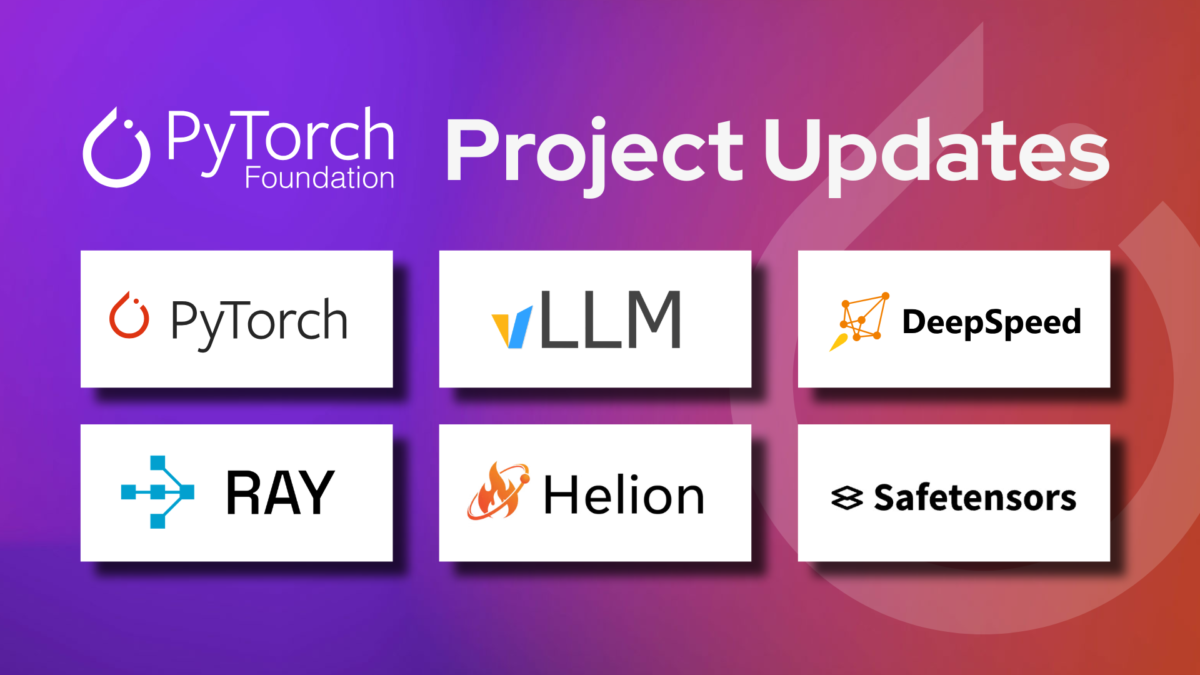
The PyTorch Foundation has published its first consolidated status report covering all six projects it now hosts, and it reads like a map of where open-source AI infrastructure is actually heading. The update, posted this week on the official PyTorch blog, kicks off a new series in which PyTorch, vLLM, DeepSpeed, Ray, Helion, and Safetensors each report their latest work in one place — a direct product of the Foundation’s April 2025 pivot to a multi-project umbrella.
That structural detail is easy to skim past, but it is the story. A year and a half ago, “PyTorch Foundation” meant one framework. Today it is the shared governance home for the training framework, the dominant open inference engine, a distributed-training pioneer, a compute orchestrator, a kernel-authoring language, and the de facto standard for safe model weights. The first joint report shows those pieces increasingly shipping features for each other.
PyTorch core: 2.13 lands, 2.14 already underway
The core project logged 4,415 commits in the quarter while shipping PyTorch 2.13 and opening the 2.14 development cycle. The 2.13 release leans hard into performance and platform reach: FlexAttention arrives on Apple Silicon at up to roughly 12x the speed of scaled dot-product attention, a new CuTeDSL Inductor backend joins the compiler stack, and a memory-saving nn.LinearCrossEntropyLoss cuts peak GPU memory by up to 4x on a layer that routinely blows up training runs at large vocabulary sizes.
The release also adds Python 3.15 wheels — including free-threaded builds, a signal that PyTorch intends to be ready as Python’s no-GIL future firms up — plus a torchcomms backend and FSDP2 communication overlap aimed squarely at large-cluster training. Broadened ROCm, Arm, and Intel XPU support continues the slow erosion of single-vendor assumptions. On the edge side, ExecuTorch is publishing weekly on-device LLM examples and has a partnership with Hugging Face to streamline model ingestion.
vLLM: a rebuilt runner and a roadmap aimed at agents
The vLLM project reports it has settled into a stable bi-weekly release cadence — notable by itself for a project moving this fast — and completed a ground-up redesign of Model Runner V2, which delivered substantial performance gains on GPTQ-quantized models. Day-zero support continues for new frontier-scale open models, with Kimi K3, MiniMax M3, and Qwen 3.8 all named in the update.
The published Q3 2026 roadmap is the forward-looking piece: it is organized around production agentic workloads, with the scheduler and KV cache being redesigned, KV-cache offloading and smarter prefix caching for multi-turn agents, faster speculative decoding, and production-ready KV-cache compression all on the docket. Anyone building agent serving on open infrastructure should read that list as a preview of what will be free off the shelf by year’s end. The team is also hosting the first vLLM Conference at Ray Summit in San Francisco, August 24–26.
DeepSpeed and Ray: converging on the same stack
DeepSpeed’s headline is integration: the Ulysses sequence-parallelism algorithm now plugs directly into Hugging Face Trainer, Accelerate, and TRL, which puts long-context parallelism in reach of teams that will never touch a launcher script. The project shipped six releases in the quarter, replaced its Intel IPEX path with direct torch.xpu integration, and picked up a best-paper honorable mention at ASPLOS 2026 for its SuperOffload work.
Ray, meanwhile, is hardening for the biggest hardware on the market — improved support for NVIDIA GB200 and GB300 systems, topology-aware rack placement, and upgraded RDMA — and the update names MAI-Thinking-1, Composer 2.5, and Nemotron 3 Ultra among frontier models built with Ray in recent months. A new high-performance Ray Data engine is slated for version 2.57, and weight-syncing integrations with vLLM and SkyRL target the post-training bottleneck directly.
The quiet takeaway for builders
Rounding out the six, Helion spent its first half-year on cross-hardware attention kernels with LLM-guided autotuning, and Safetensors continues as the Foundation’s safe-weights standard. The pattern across every section is the same: vLLM serving Ray-trained models, DeepSpeed living inside Hugging Face libraries, PyTorch compiling kernels for hardware from four vendors. The open-source AI stack is consolidating into an interoperable whole under one governance roof — and this quarterly series is now the single place to watch it happen.
Bottom line: if you run open-source AI in production, the Foundation’s first joint update is worth fifteen minutes — PyTorch 2.13’s memory and Apple Silicon wins land today, vLLM’s Q3 roadmap tells you what your agent-serving stack does next quarter, and DeepSpeed’s Hugging Face integration means long-context training just got dramatically easier to adopt.