
Quick take: Normalization layers — LayerNorm, RMSNorm, the things every transformer runs between its attention and feed-forward blocks — are memory-bound chores that waste most of their time shuffling data on and off the GPU. PyTorch’s new “Free Normalization” work shows those chores can be folded directly into the matrix-multiply kernel beside them, hiding as much as 90% of the norm’s latency and reaching up to 35% faster attention kernels. The catch is that the fusion is fiddly, hardware-specific, and easy to get subtly wrong.
The reason this is worth a serious look is not the benchmark number. It’s that normalization has become the silent tax on modern model inference. As models get wider and attention gets more efficient, the relative cost of the “boring” norm steps keeps climbing. Fusing them away is one of the few remaining free-ish lunches in systems work — and PyTorch just published both the analysis and runnable code for it.
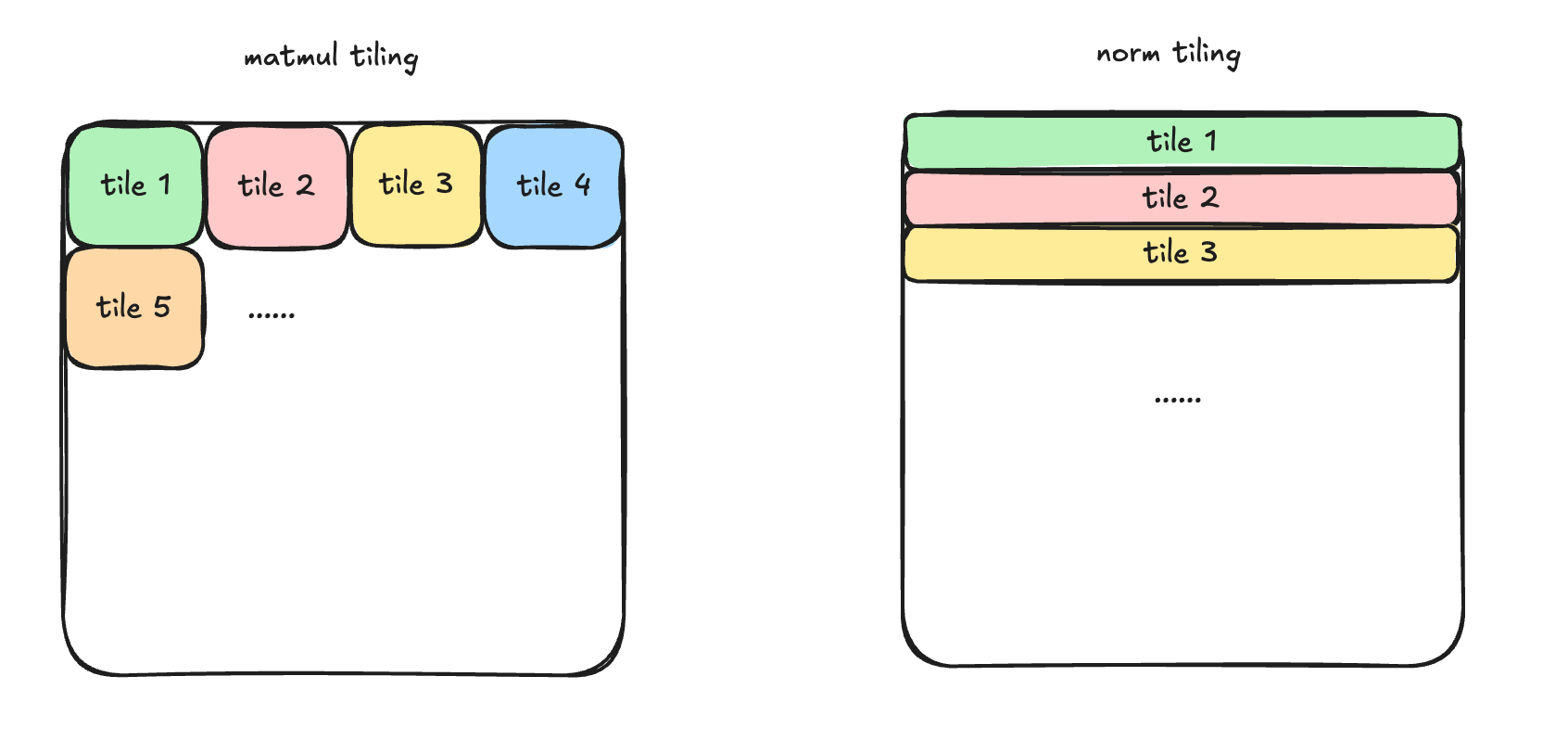
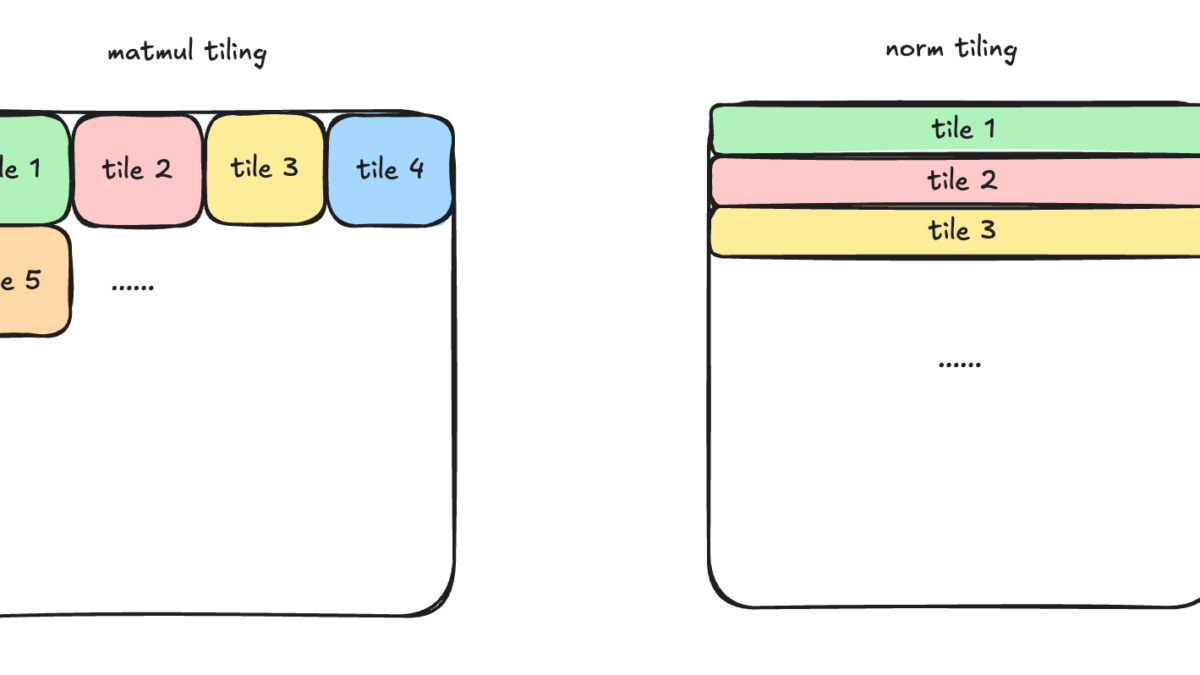
PyTorch contrasts the 2D tiling used for matrix multiplies with the 1D strip tiling used for normalization — the mismatch is the whole problem. (Source: pytorch.org)
The problem is the bus, not the math
A matrix multiply (GEMM) and a normalization layer look like neighbors in a model diagram, but they have opposite shapes in memory. GEMM is a 2D problem: you chop a big matrix into square tiles and stream them through fast on-chip memory (SRAM) a tile at a time. Normalization is a 1D problem: you compute a mean and variance over one axis of a tensor and split it into horizontal strips.
When these two sit next to each other in a transformer block, the naive execution puts a full round-trip to slow off-chip DRAM between them. The GPU finishes the matmul, writes the whole result back to DRAM, then reads it all back so the norm can compute its statistics, then writes it out again. Most of the norm’s wall-clock time is that memory traffic, not the arithmetic. The PyTorch team measured this directly and found the normalization kernel’s latency is dominated by IO in exactly this way.
The fix the blog pursues is “free normalization” — schedule the norm’s work inside the neighboring GEMM or attention kernel so the data never leaves fast memory. The hard part is that the two operations want different tilings, so you can’t just bolt them together.
Three ways to make the norm free
The post walks through a progression of fusion techniques, each building on the last.
Lazy Pre-Norm. Instead of fully normalizing a tile before the matmul, you defer part of the normalization and fold it into the linear layer’s epilogue. The post reports this and the next technique can hide as much as 90% of a normalization kernel’s latency by fusing it with the GEMMs around it.
Multi-CTA Norm. CTA is CUDA-speak for a “Cooperative Thread Array” — basically one thread block. Multi-CTA norm fusion lets several blocks cooperate so the post-norm can be fused with linear layers as an epilogue, spreading the work instead of serializing it. The reference implementation lives in Meta’s ads_model_kernel_library under multi_cta_norm_fusion.
FlashNormAttention. This is where it pays off most visibly. By applying fusion to the multiple normalizations sitting around an attention kernel (the team cites the GDPA formulation), they reach up to 35% kernel speedup on attention. The implementation builds on Dao-AI-Lab’s flash-attention and the gdpa_megakernel from the same Meta kernel library.
The throughline: each step reduces memory-IO overhead on kernels that are already memory-bound, which is why the wins show up as kernel-level speedups rather than arithmetic tricks.
Why “free” is also a warning
The blog is unusually honest about the downside, and that honesty is the most useful part for anyone who actually tries this. Fusing a norm into a GEMM kernel changes the kernel’s structure, and once you distort the base GEMM algorithm to make room for the norm, the benefit of saving memory IO gradually gets overshadowed by the harm of a worse matmul. You are trading a clean, well-optimized multiply for a custom fused kernel that is harder to maintain and easier to regress.
That trade is acceptable when the norm is genuinely the bottleneck. It is not free when the matmul is the bottleneck — there, fusion just makes your GEMM worse for no gain. The post’s framing (“Towards Free Normalization,” not “Free Normalization Achieved”) is the tell: this is a toolkit and an analysis, not a drop-in win.
The tooling that makes it reachable
Two things make this more than a research curiosity. First, the code is real and public — the multi_cta_norm_fusion and gdpa_megakernel repos, plus the flash-attention project it extends. Second, the post situates the work inside the current compiler stack: Triton, the DSL that gives you lower-level, hardware-aware control of GPU execution, and Helion, the higher-level DSL that trades some control for developer velocity.
That matters because fusion used to mean hand-writing CUDA. The whole point of layers like Triton and Helion is to make “fuse the norm into the matmul” a schedulable intent rather than a from-scratch kernel. The PyTorch piece is essentially a tour of how far that intent has come for exactly this pattern.
What to actually do with this
If you run inference or training on transformers and you have not profiled where your time goes, the takeaway is not “go fuse your norms tomorrow.” It’s “profile first.” The 90% and 35% numbers are real but conditional — they apply when normalization or attention IO is the bottleneck, which a profiler will tell you in about ten seconds.
For the people already writing custom kernels, the post is closer to a reference design: here is the tiling mismatch, here are three fusion patterns that work, here is the reference code, and here is the exact point where fusion stops helping. The arXiv references the post cites (including the GDPA/Megakernel line of work) are the deeper reading if you want the formalism. The practical ceiling is the one the title implies — we are towards free normalization, not at it, because the moment the matmul dominates, the free lunch closes.
Sources:
– Towards Free Normalization — PyTorch blog (July 10, 2026)
– multi_cta_norm_fusion — Meta ads_model_kernel_library
– gdpa_megakernel — Meta ads_model_kernel_library
– flash-attention — Dao-AI-Lab
– GDPA / FlashNormAttention reference — arXiv:2602.10016