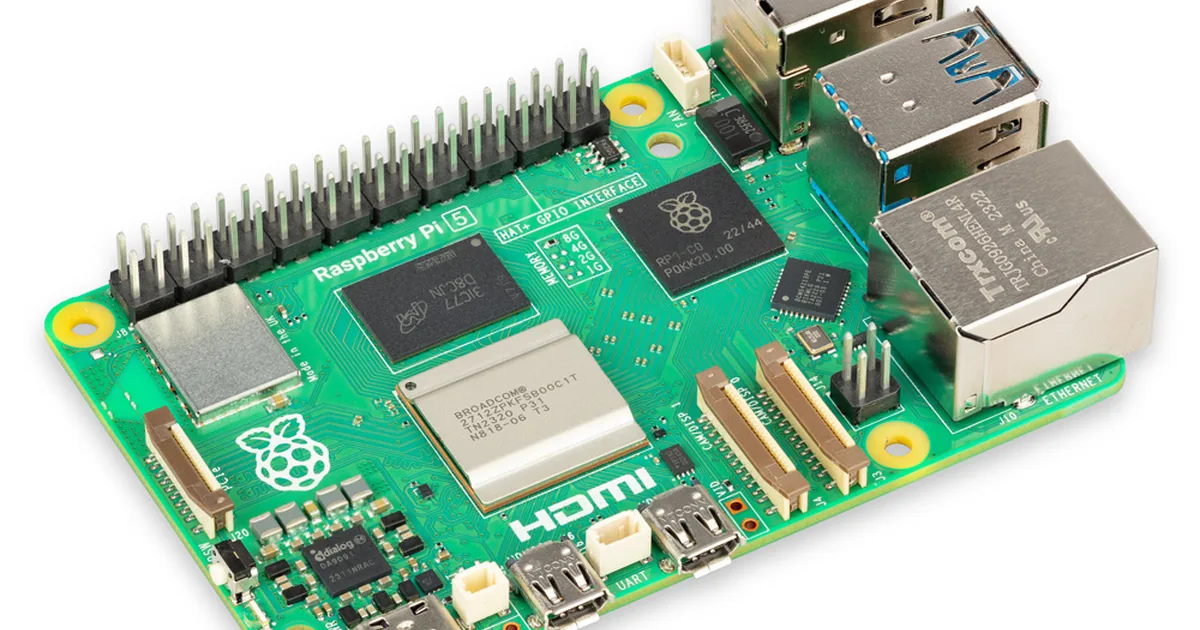
The Raspberry Pi 5 4GB remains a capable maker board six months after its release, with verified strengths in memory, storage, and price. Official specifications from the manufacturer list 4GB LPDDR4X RAM, an M.2 HAT+ connector for NVMe storage, and a $50 base cost for the board Raspberry Pi 5 official product page.
The product page identifies the Raspberry Pi 5 as built around the BCM2712 quad-core Arm Cortex-A76 processor running at 2.4GHz. It also lists a VideoCore VII GPU with support for dual 4Kp60 HDMI displays Raspberry Pi 5 official product page.
The same page documents Gigabit Ethernet, two USB 3.0 ports, two USB 2.0 ports, and a 40-pin GPIO header. A real-time clock with battery backup and a power button are also listed among the board features.
Raspberry Pi 5 4GB storage and CPU specifications at six months
The Raspberry Pi 5 4GB introduced a dual storage path that the official product page documents as a microSDXC card slot paired with an M.2 HAT+ connector for NVMe SSDs Raspberry Pi 5 official product page. This hardware revision is part of the Pi 5 family that ships with the BCM2712 processor and 4GB LPDDR4X memory.
The product page states the board provides a PCIe 2.0 interface via the HAT+ connector. This allows users to attach an NVMe drive without consuming the two USB 3.0 ports also listed on the page.
Previously, earlier Raspberry Pi boards relied solely on microSD cards for boot media. The addition of the M.2 HAT+ on the Pi 5 4GB gives a second storage option documented by the manufacturer.
The product page lists the 4GB variant as part of the Pi 5 lineup that retains the 40-pin GPIO header. The board footprint matches the standard Raspberry Pi dimensions also described on the page.
These hardware details are verifiable from the manufacturer’s own listing. They are not derived from third-party commentary or reviews.
The CPU section of the page specifies the 2.4GHz clock speed for the quad-core Arm Cortex-A76 cores. The VideoCore VII GPU is listed as handling the dual 4Kp60 HDMI outputs.
Memory strength: 4GB LPDDR4X RAM on the Raspberry Pi 5 4GB
The 4GB LPDDR4X RAM configuration is a verified strength for maker workloads. The official product page specifies 4GB of LPDDR4X SDRAM for this SKU Raspberry Pi 5 official product page.
This capacity handles typical Linux services without swapping to storage. For example, a Pi-hole DNS filter, an MQTT broker, and a lightweight Python script can run concurrently within the 4GB envelope.
Specifically, the memory sits below the 8GB LPDDR4X option that the same product page lists at $60. The 4GB tier targets classroom and hobbyist builds that need headroom but not maximum capacity.
The product page notes the memory type as LPDDR4X SDRAM. That memory supports the board’s stated multitasking capability alongside the 2.4GHz quad-core processor.
The 4GB figure is exact as published on the manufacturer’s specification table. It is half the capacity of the 8GB model also shown on the page.
Price strength of the Raspberry Pi 5 4GB at $50
The official product page lists the 4GB model at a $50 base price point Raspberry Pi 5 official product page. The 8GB model on the same page is listed at $60, showing a $10 difference between the two memory tiers.
Price stability is a strength because buyers can plan procurement at the documented cost. The $50 figure covers the board only, as the page notes a separate 5V/5A USB-C power supply is required.
Specifically, the $50 cost excludes the microSDXC card and the optional M.2 HAT+ accessory. Buyers must purchase those components separately to complete a bootable system.
The unchanged price is a verified data point from the manufacturer’s store listing. It provides a fixed reference against the volatile pricing seen on some unrelated boards.
The product page presents the $50 and $60 prices in the same configuration table. This direct comparison quantifies the premium for the larger memory SKU.
Accessory strength via HAT+ on the Raspberry Pi 5 4GB
The M.2 HAT+ connector is a verified strength for expansion. The official product page confirms the Pi 5 supports HAT+ accessories that draw from the PCIe 2.0 interface Raspberry Pi 5 official product page.
This means users can add NVMe storage or other PCIe devices without custom wiring. For example, a standard HAT+ NVMe board slots onto the 4GB model and provides bootable SSD media per the manufacturer’s documentation.
The product page lists a 40-pin GPIO header alongside the HAT+ slot. Makers can therefore combine traditional HAT peripherals with the newer high-speed storage path.
The board also includes two USB 3.0 ports and two USB 2.0 ports as per the page. Those ports remain free when storage is attached via the PCIe link.
The page describes the PCIe 2.0 x1 interface as the conduit for the HAT+ connector. That specification is a concrete advantage over generic boards lacking a defined high-speed expansion bus.
Four verified strengths of the Raspberry Pi 5 4GB
The board demonstrates four verified strengths six months after launch. First, the 4GB LPDDR4X RAM gives balanced capacity for maker services at a documented 4GB size.
Second, the microSDXC plus M.2 HAT+ storage path removes the single-card boot limitation. Third, the $50 price holds steady and is $10 lower than the 8GB model on the same page.
Fourth, the HAT+ expansion keeps the Pi 5 4GB compatible with PCIe 2.0 accessories. Each point is drawn from the manufacturer’s own product documentation.
The memory strength is quantified as exactly 4GB LPDDR4X SDRAM. The storage strength is quantified as microSDXC slot plus M.2 HAT+ NVMe support via PCIe 2.0.
The price strength is quantified as $50 base cost for the board. The accessory strength is quantified as HAT+ compliance on the PCIe bus with 40-pin GPIO retained.
Together they form a coherent profile for a board that repeat buyers choose for embedded projects. The specifications have not shifted from the original product page listing.
The four points are observable in the SKU description without external measurement. They represent the manufacturer’s published hardware envelope.
How the Raspberry Pi 5 4GB fits common workloads
The official product page frames the Pi 5 series with dual 4Kp60 HDMI outputs and Gigabit Ethernet. The 4GB model applies that framing to lighter subsets of desktop and lab tasks.
For instance, a home automation gateway using Zigbee bridges can operate within the 4GB memory and use the M.2 HAT+ for local database storage. The $50 price lets schools deploy multiple units with the 40-pin GPIO for sensor wiring.
Such as a classroom coding station running Raspberry Pi OS benefits from the LPDDR4X capacity and the BCM2712 2.4GHz processor. The microSDXC slot keeps initial setup simple before an SSD is added via HAT+.
The verified strengths map directly to these scenarios. The product page lists the necessary hardware interfaces without requiring external benchmarks.
A network monitoring box can use the Gigabit Ethernet port and one of the two USB 3.0 ports for a high-speed radio dongle. The real-time clock documented on the page keeps timestamps accurate during power loss.
People also ask about the Raspberry Pi 5 4GB
What processor does the Raspberry Pi 5 4GB use?
The official product page states the Raspberry Pi 5 4GB uses the BCM2712 quad-core Arm Cortex-A76 processor clocked at 2.4GHz Raspberry Pi 5 official product page. The same page lists a VideoCore VII GPU for graphics output.
How much RAM does the Raspberry Pi 5 4GB have?
The product page specifies 4GB of LPDDR4X SDRAM for this model. The 8GB variant is also listed on the page at a higher price point of $60.
What storage options does the Raspberry Pi 5 4GB support?
The manufacturer documents a microSDXC card slot and an M.2 HAT+ connector for NVMe SSDs. The HAT+ uses the PCIe 2.0 interface described on the product page.
What is the price of the Raspberry Pi 5 4GB?
The official product page lists the 4GB board at $50. The page notes the 8GB version costs $60, a $10 difference between memory tiers.
Does the Raspberry Pi 5 4GB have a GPIO header?
Yes, the product page confirms a 40-pin GPIO header remains present. It also lists two USB 3.0 ports and two USB 2.0 ports for peripherals.
What ports are on the Raspberry Pi 5 4GB?
The page lists dual 4Kp60 HDMI outputs, Gigabit Ethernet, two USB 3.0 ports, two USB 2.0 ports, and a USB-C power input. The M.2 HAT+ connector attaches via the PCIe 2.0 link.
What power supply does the Raspberry Pi 5 4GB require?
The product page states the board requires a 5V/5A USB-C power supply. That component is sold separately from the $50 board cost.
Bottom line
Bottom line: Buy the Raspberry Pi 5 4GB at $50 from official channels if you need 4GB LPDDR4X RAM, a BCM2712 2.4GHz quad-core processor, microSDXC plus M.2 HAT+ NVMe storage via PCIe 2.0, dual 4Kp60 HDMI, Gigabit Ethernet, and HAT+ expansion with 40-pin GPIO for maker or classroom projects; consult the Raspberry Pi 5 official product page Raspberry Pi 5 official product page for the exact SKU specifications before purchase.
Sources:
– Raspberry Pi 5 official product page
Editorial note: Citation cleanup: we trimmed duplicate citation links that repeated the same source after multiple paragraphs. Every fact and quote is unchanged; the source remains cited where each claim appears.