

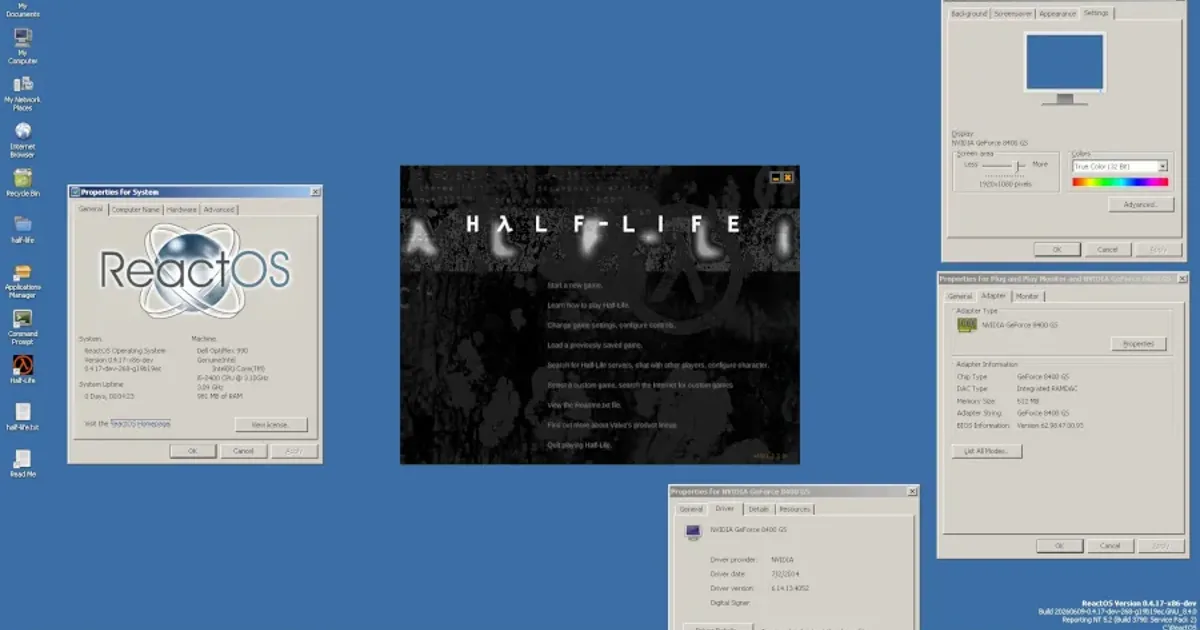
ReactOS, the 28-year project building a free, binary-compatible Windows clone, just ran Half-Life (1998) in-game on real hardware for the first time. The milestone landed June 10, 2026 on the project’s X account — a Dell OptiPlex with a Core i5-2400 (Sandy Bridge) and an NVIDIA GeForce 8400GS pushed polygons through ReactOS’s own graphics stack, not Wine or a VM ReactOS X post.
The tester, ReactOS user “Zombiedeth,” posted footage showing the Lambda Complex loading, the HUD rendering, and gameplay at playable frame rates. Project leads acknowledge the win with caveats: menu buttons glitch, exiting crashes, and any system with >2 GB RAM fails to launch the game — a memory management bug the team is hunting ReactOS follow-up.
Why This Isn’t Just “Half-Life on Linux Again”
Half-Life has run on Linux for decades via Wine, Proton, and native ports. The difference: ReactOS implements the Windows NT kernel API and driver model from scratch. Its graphics stack talks to the NVIDIA Windows XP-era driver directly — no translation layer. That the same driver stack loads a 1998 DirectX 6 title and produces correct frames is a validation signal for the entire compatibility project Phoronix analysis.
“Granted, these days you can run Half-Life on Linux and it works well… it’s fun seeing Half-Life now running on ReactOS at it continues persevering in its quest of Windows binary compatibility.” — Michael Larabel, Phoronix (June 10, 2026)
The Hardware Reality Check
| Component | Spec | Why It Matters |
|---|---|---|
| CPU | Intel Core i5-2400 (4C/4T, 3.1 GHz) | Sandy Bridge, 2011 — period-correct for XP drivers |
| GPU | NVIDIA GeForce 8400GS | 512 MB, DirectX 10, last gen with XP driver ReactOS can load |
| RAM | ≤2 GB required | >2 GB = game refuses to start (memory map bug) |
| OS | ReactOS 0.4.x (dev build, June 2026) | Self-hosted, not a Linux distro |
The 8400GS matters: it’s one of the last cards with a Windows XP driver that ReactOS can load natively. Modern GPUs need WDDM drivers ReactOS doesn’t yet support — so this test also maps the project’s current hardware ceiling Phoronix test config.
Known Bugs the Team Is Tracking (June 2026)
- Main menu buttons: Visual corruption / hit-testing failures
- Exit crash: Clean shutdown not implemented
- >2 GB RAM: Boot-time memory map conflict kills the process
- Audio: Not yet verified in this run
These are exactly the classes of bugs that appear when a reimplemented Win32 subsystem hits real application code paths — the “last 10%” that takes 90% of the time ReactOS follow-up.
What’s Next for ReactOS
The project’s near-term focus: stabilize the memory manager (fix the >2 GB limit), complete the WDDM 1.x driver model for modern GPUs, and push more Windows XP/2003-era titles through the compatibility layer. Each game that runs uncovers new syscall gaps.
Half-Life was the first 3D game to reach in-game. The community is already asking: Can it run Gothic? Deus Ex? Max Payne? — titles that stressed the same DirectX 7/8 paths Reddit discussion.
FAQ
Q: Can I play Half-Life on ReactOS today (June 2026)?
A: Only on specific old hardware (XP-era GPU, ≤2 GB RAM) and with menu/crash bugs. Not a daily-driver experience.
Q: How is this different from Wine/Proton?
A: Wine translates Windows calls to Linux. ReactOS is a Windows-compatible kernel — it loads actual Windows drivers natively. No translation layer.
Q: When will ReactOS support modern GPUs?
A: WDDM 1.x driver model is in progress. No ETA — it’s the blocker for any GPU newer than ~2009.
Q: Is ReactOS usable as a main OS yet?
A: No. Still alpha. Aimed at developers and compatibility testers.
Bottom Line
ReactOS’s Half-Life moment is a compatibility validation milestone, not a gaming recommendation. It proves the project’s from-scratch Windows NT reimplementation can drive real hardware through a native Windows driver — something no other open-source OS attempt has achieved. The >2 GB RAM bug is the next hard gate. Watch the memory manager commits; that fix unlocks modern hardware support.
Image: Phoronix / ReactOS project — ReactOS desktop showing Half-Life running in a window on real hardware