- May 1, 2026 → GitHub PR #525 — bw-solana opened the formal SIMD-0525 proposal
- February 20, 2026 → GitHub Discussion #469 — public slot-time reduction discussion opened
- July 10, 2026 → Solana — leader-handoff chart measurements begin
The contributor who publishes as bw-solana opened the formal proposal to halve Solana’s block interval from 400 milliseconds to 200 milliseconds on May 1, 2026 GitHub PR #525, according to the Solana write-up Solana.
The proposal sits inside a broader push to tighten Solana’s latency; our Solana ecosystem roundup tracks the surrounding moves Solana ecosystem roundup.
A tighter clock shrinks the monopoly window
SIMD-0525 does not flip a switch. It would lower the network’s target slot time in four feature-gated stages — 350, 300, 250, and finally 200 ms — shrinking the four-slot window a single leader controls from 1.6 seconds to 800 milliseconds, the Solana write-up explains Solana. The plan is the latency half of the network’s “Increase Bandwidth, Reduce Latency” push, built to dovetail with Alpenglow, which is designed to pull consensus finality toward roughly 150 ms. The same document warns that shorter intervals thin out stale-price arbitrage against external venues, yet the gain shows up mainly when fee bands sit wide against short-horizon volatility.
The same document calls sandwich MEV “not sign-definite,” since faster windows leave more slippage for the quickest attackers while narrowing the window a slow leader can hold.
The engineers wanted proof, not promises
The idea did not arrive finished. bw-solana opened a public discussion on February 20, 2026 GitHub Discussion #469 to surface the open questions first. “Everybody wants to reduce slot times to IBRL the chain,” the Maintainer said, “but there are questions around how exactly we do this.” A Firedancer Engineer noted the need for evidence over assurances: “Instead of stating the obvious (a change should be tested), it would be nice to just include the actual test vectors and fixtures with the SIMD.”
The cost lands on the smallest validators
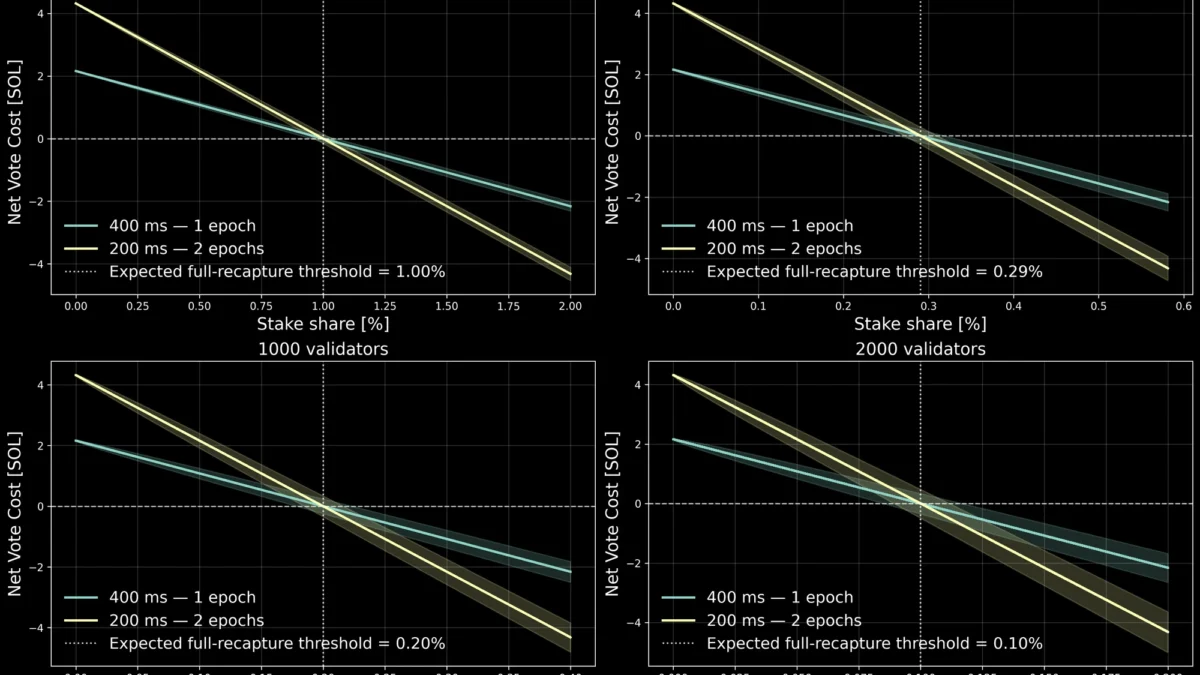
Faster blocks are not free. At 200 ms, validators cast roughly twice as many votes per unit of wall-clock time, and the Solana analysis notes that the higher absolute voting cost lands hardest on smaller operators, with its empirical case resting on mainnet leader-handoff measurements gathered from July 10, 2026 onward Solana. Model a third of leader windows as deliberately slow, the document shows, and halving the slot compresses a worst-case stale-execution run from 14.4–19.2 seconds at 400 ms to just 7.2–9.6 seconds at 200 ms.
Solana has not merged the proposal; the pull request remains open GitHub PR #525. Until it does, 200 ms stays a model and an unanswered question: whether validators running on thinner margins will foot the bill for everyone else’s quicker chain.
Editorial note: Citation cleanup: we trimmed duplicate citation links that repeated the same source after multiple paragraphs. Every fact and quote is unchanged; the source remains cited where each claim appears.