If you have ever tried to withdraw crypto from an exchange and been stopped by a form demanding the recipient’s name, the receiving platform, or proof that a wallet belongs to you, you have met the Travel Rule. It is the single piece of global crypto regulation most likely to interrupt an ordinary user’s transaction — and after the FATF’s seventh implementation report card landed on July 16, it is about to get harder to avoid, because regulators are being told to stop passing laws and start enforcing them.
Here is what the rule actually says, where it came from, and what its next phase means for anyone moving coins between platforms.
A 1996 banking rule that followed the money into crypto
The Travel Rule was not invented for crypto. Its ancestor is a U.S. Bank Secrecy Act regulation described in a January 1996 FinCEN advisory: when a funds transfer passes through more than one financial institution, certain identifying information about the sender must “travel” with it to the next institution. That is the whole idea in one sentence — the payment and the identity move together, so investigators can follow a chain of transfers without subpoenaing each link blind.
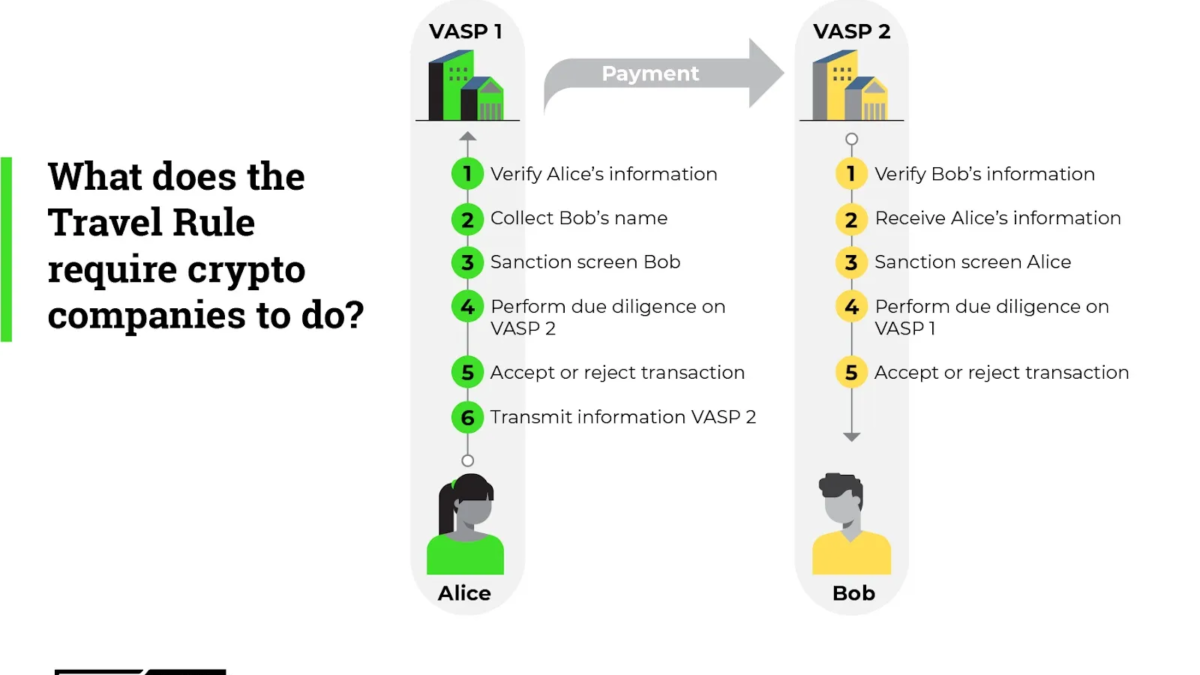
In 2019, the Financial Action Task Force — the intergovernmental body that writes the world’s anti-money-laundering playbook — extended that logic to virtual assets. Its Recommendation 16 now requires virtual asset service providers, or VASPs (exchanges, custodians, brokers; the EU calls them CASPs), to collect and transmit originator and beneficiary information alongside crypto transfers. FATF recommendations are not themselves law, but member jurisdictions are graded on adopting them, and the grades have teeth: poor ratings can land a country on watchlists that raise its cost of doing business with the global banking system.
What actually gets collected, and when
The FATF-recommended trigger threshold for crypto transfers is USD/EUR 1,000, per Notabene’s Travel Rule reference; the United States applies its legacy $3,000 threshold. Above the line, the originating VASP must collect and transmit:
- Sender: name, account or unique transaction reference, and one of: physical address, national identity number, customer ID number, or date and place of birth.
- Recipient: name and account number or transaction reference.
Two details in the fine print matter more than the headline threshold. First, aggregation: several smaller transfers that appear linked — say, four quick $300 withdrawals — count as one transaction if they total over the threshold. Structuring a withdrawal into small chunks does not route around the rule; it is precisely the pattern the rule was written to catch. Second, record-keeping: institutions typically must retain the transmitted data for at least five years, which is why closing your account does not make the paper trail disappear.
Since 2020 the industry has largely standardized how this data moves between platforms. The IVMS101 messaging format, developed by the interVASP Joint Working Group and adopted in May 2020, defines a common data model so that an exchange in Singapore and a custodian in Germany can exchange customer records without mangling names, scripts, or field formats. Virtually every Travel Rule messaging protocol now uses it or has committed to it.
What this looks like from the user’s side
For a compliant exchange’s customer, the Travel Rule shows up in four ways:
- Withdrawal questionnaires. Sending above-threshold amounts to another platform means naming the beneficiary and often the destination VASP. If the receiving platform cannot or will not exchange Travel Rule data, your withdrawal can be delayed or refused outright.
- Self-hosted wallet checks. Transfers to your own hardware or software wallet are treated differently by different jurisdictions — some require a simple declaration, others demand ownership proof such as a signed message or a micro-deposit test.
- Counterparty screening. Your exchange is expected to evaluate the platform on the other side of a transfer — where it is incorporated, whether it is licensed, how robust its KYC is. Transfers to poorly regulated venues attract friction even when your own account is spotless.
- Sub-threshold scrutiny. Even below $1,000, providers are expected to apply due diligence when transactions look suspicious, so the threshold is a reporting line, not a privacy guarantee.
None of this touches genuinely peer-to-peer transfers between two self-hosted wallets. The rule binds intermediaries, not the protocol layer — though the moment funds touch a regulated platform, the platform’s obligations kick in.
The 2026 report card: laws exist, enforcement doesn’t — yet
The FATF’s 7th Targeted Update, released July 16 and analyzed by Chainalysis on July 23, shows how unevenly the rule has landed. Of 147 surveyed jurisdictions, 83% have now passed Travel Rule legislation, up from 73% a year earlier. But 60% of the jurisdictions with legislation on the books have taken no supervisory or enforcement action on it at all. When the FATF graded countries on preventive anti-money-laundering controls — the measures meant to stop illicit flows before they move — only 13 of 139 jurisdictions, fewer than 10%, fully met the standard.
The gap runs through licensing too: 73% of jurisdictions require VASP licensing, but only 58% have actually issued a license. And 23% now prohibit VASPs entirely, up from 11% in 2023 — prohibitions the FATF notes are largely unenforced, which pushes activity into unregulated channels rather than eliminating it.
Chainalysis reads the report’s message as unambiguous: “the grace period for paper-only compliance is over.” For exchanges, that means the years of checkbox legislation are giving way to inspections and enforcement actions — among the 95 jurisdictions with licensing regimes, 81% now conduct supervisory inspections and 71% have taken enforcement action, both up meaningfully year over year. For users, it means the Travel Rule prompts that some platforms still treat as optional theater are likely to become strict, standardized, and harder to click past.
The report also flags where the cat-and-mouse goes next: criminal networks have begun issuing their own freeze-resistant stablecoins, marketed specifically as immune to the asset-freezing controls regulators rely on. The FATF calls this a “significant and emerging risk” — and it is a preview of the argument that will define the rule’s next revision, as compliance pressure concentrates on the fiat rails and asset issuers that remain within reach.
The practical takeaway
The Travel Rule is neither a surveillance dragnet aimed at individuals nor a formality you can ignore. It is plumbing: identity data moving alongside value between regulated intermediaries, on a standard the industry has already built. Expect withdrawal forms to get more consistent rather than fewer, expect self-hosted wallet transfers to require proof more often, and expect platforms in loosely regulated jurisdictions to become harder to transact with from compliant ones. The rule’s text has barely changed since 2019 — what changed in 2026 is that regulators are finally being graded on using it.