Confidential computing is moving from theory to production. AMD SEV-SNP and Intel TDX now let organizations run virtual machines that encrypt data while it is processed, not just when it is stored or transmitted. Ubuntu 26.04 LTS already ships integrated host and guest support for both technologies, making confidential computing a native part of the Ubuntu virtualization offering.
But the next wave of features—live migration for confidential VMs, trusted device assignment, accelerator support, improved attestation flows, and the TEE Device Interface Security Protocol (TDISP)—will not arrive in a single package. They require coordinated changes across the kernel, KVM, QEMU, libvirt, OVMF firmware, and surrounding tooling. That cross-layer dependency is exactly why a traditional LTS cadence struggles.
Why the old model breaks down
Enterprise Linux distributions have long balanced stability and innovation by releasing a new LTS every two years. That model works when updates are isolated to a single subsystem. Virtualization is not isolated. A new CPU feature might need a kernel interface before QEMU can model it, and libvirt needs new abstractions before administrators can configure it without hand-written command lines. OVMF firmware and attestation components often mature last.
For confidential computing, that sequencing matters. Regulated workloads, sovereign clouds, financial services, and AI infrastructure all need the latest hardware capabilities, but they also need the predictability of an LTS release. Canonical’s release of Ubuntu 26.04 LTS, codenamed “Resolute Raccoon,” illustrates the tension: the distribution delivers long-term security maintenance while also trying to keep pace with silicon advances.
Before Ubuntu 26.04 LTS, Ubuntu already had a Hardware Enablement model for the kernel. That covered CPU feature enablement, memory-management changes, and the low-level interfaces confidential VMs depend on. The kernel is only one layer, though. If QEMU, libvirt, or firmware lag behind, users remain blocked even when the kernel supports the new capability.
Introducing the virtualization HWE stack
Ubuntu 26.04 LTS answers that gap with a new virtualization HWE stack. The idea is simple: remain on Ubuntu LTS, but opt into newer virtualization components as they become available and validated.
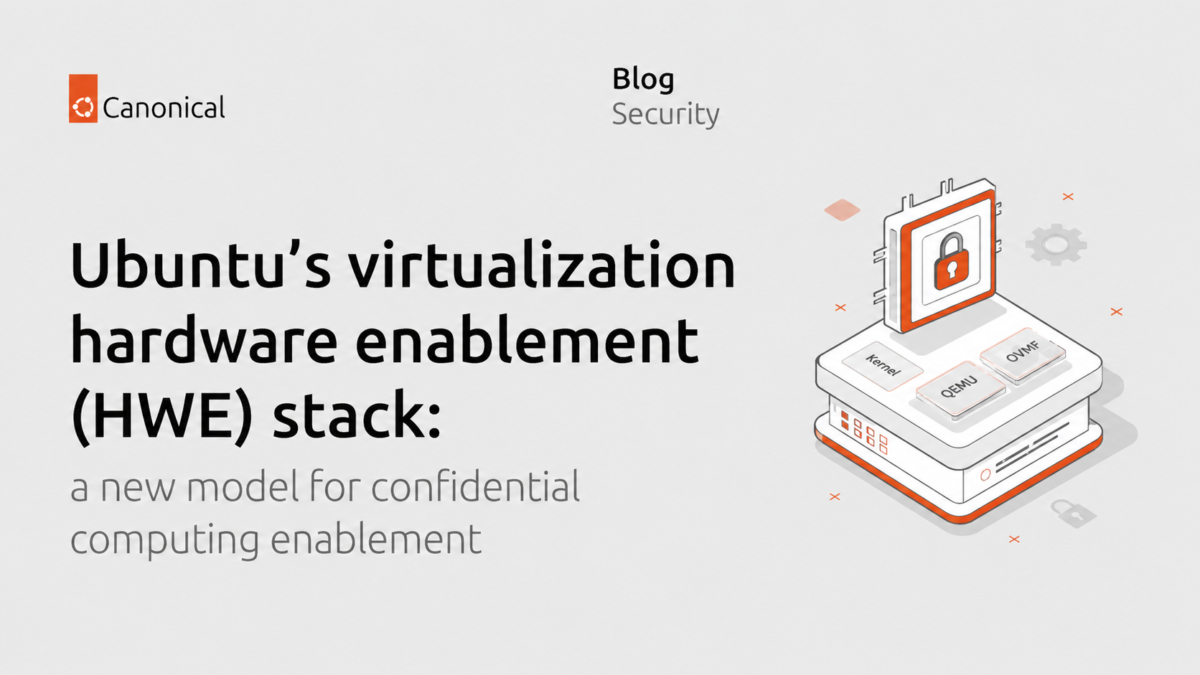
The stack includes four packages:
- qemu-hwe — hypervisor and system emulation
- libvirt-hwe — virtualization management
- edk2-hwe — OVMF firmware for UEFI support
- seabios-hwe — BIOS firmware compatibility
These packages extend HWE beyond the kernel. Instead of exposing newer hardware through a single subsystem, Ubuntu can now advance the full virtualization stack as a unit. According to Ubuntu’s announcement, the model works as a rolling enablement window inside the LTS lifecycle. During the first two years, the stack upgrades every six months to match the latest upstream versions supported in Ubuntu.
That timing is deliberate. New versions first appear in interim releases, where they are exercised in real deployments before reaching LTS users. The result is operational confidence plus a supported path to newer hardware capabilities.
Opt-in, not opt-out
The virtualization HWE stack is opt-in. Existing systems keep the base virtualization stack unless an administrator explicitly switches. That preserves the minimal-change posture for organizations that value stability above all.
To prevent incomplete states—where only one component moves forward and leaves the system inconsistent—Ubuntu also provides the ubuntu_virt_helper tool. It treats the stack as a single unit, updating the hypervisor, management layer, firmware, and BIOS compatibility layers together. Ubuntu’s documentation makes clear that switching only one component can leave a system in an incomplete or inconsistent state.
Who benefits
The HWE stack matters most for users building confidential computing environments. Confidential VMs with AMD SEV-SNP or Intel TDX require the entire stack to support attestation, memory encryption, and trusted execution. Regulated workloads in financial services and healthcare need stronger isolation while keeping within the support and patch-commitment windows their organizations require. AI workloads that run confidential inference or use accelerators depend on up-to-date firmware and hypervisor support. Private and sovereign cloud platforms need the same capabilities at scale.
Sovereign clouds in particular must consider the entire data lifecycle. Data residency is not the same as sovereignty. If plaintext is visible in memory, registers, or GPU memory during computation, protection depends entirely on operator behavior. Confidential computing closes that gap by encrypting data in use inside Trusted Execution Environments that the hypervisor and host operating system cannot inspect. For organizations evaluating these controls, confidential computing and the regulatory focus on data in use provides additional context on how policy and architecture intersect.
The ubuntu_virt_helper tool helps organizations adopt these capabilities without leaving the LTS support window. It removes the need to choose between platform stability and access to new hardware features.
Why this positions Ubuntu ahead
Confidential computing will continue evolving. Live migration for confidential VMs, trusted I/O, trusted device assignment, accelerator enablement, attestation, orchestration, and operational tooling all need time to mature upstream. Ubuntu’s virtualization HWE model gives Canonical a structured mechanism to bring those capabilities to LTS users as the stack matures, rather than forcing a jump to interim releases.
For technology power users and infrastructure teams, that means staying current with hardware innovation while preserving the maintenance, security, and certification investments tied to Ubuntu LTS. The model does not turn the LTS into a rolling release; it carves out a supported, validated window for the virtualization components that change fastest. As platform vendors advance integrated AI and infrastructure tooling—see Microsoft Build 2026: Web IQ Search Stack, MAI Model Family for a comparable push toward unified AI-ready stacks—Ubuntu’s approach offers a blueprint for how operating-system maintainers can keep pace without destabilizing the base layer. For infrastructure teams evaluating long-term road maps, the HWE stack offers a concrete example of how open-source maintainers can reconcile rapid hardware innovation with enterprise support contracts. It also signals to hardware vendors that the Ubuntu ecosystem is ready to absorb new capabilities as soon as upstream kernels and hypervisors expose them.
What administrators should plan for
Every six months during the first two years of Ubuntu 26.04 LTS according to Ubuntu, updated qemu-hwe, libvirt-hwe, edk2-hwe, and seabios-hwe packages become available.. That cadence is slower than an interim release cycle but faster than a full LTS refresh. Teams should test new HWE components in a staging environment before promoting them to production confidential VMs. The ubuntu_virt_helper tool can help operators compare the base and HWE stacks, but planning for reboot windows, attestation policy updates, and firmware validation remains essential.
Canonical’s broader release of Ubuntu 26.04 LTS also highlights the ecosystem momentum behind confidential computing. Native NVIDIA CUDA and AMD ROCm support, TPM-backed full-disk encryption, and Rust-based memory-safe utilities show that hardware-level security and AI acceleration are converging on the same platform. For infrastructure teams, that convergence reduces the number of operating-system variants they must support.
Because the HWE stack is backed by Canonical’s support agreement, organizations can treat it as a production-grade path rather than an experimental branch. Documentation, security patches, and bug fixes flow through the same channels as the base LTS packages, ensuring consistent supportability.
The practical takeaway
Ubuntu 26.04 LTS with the virtualization HWE stack lets organizations run confidential computing, AI inference, and sovereign-cloud workloads on a stable base. They can adopt newer hardware capabilities as they arrive, without waiting for the next LTS or abandoning long-term support.
If you are evaluating confidential computing for regulated or AI workloads, the HWE stack removes the most common adoption blocker: the false choice between stability and hardware currency. Stay on Ubuntu 26.04 LTS, opt into the HWE stack when your hardware or workload demands it, and use ubuntu_virt_helper to keep the virtualization components moving as a coherent whole.