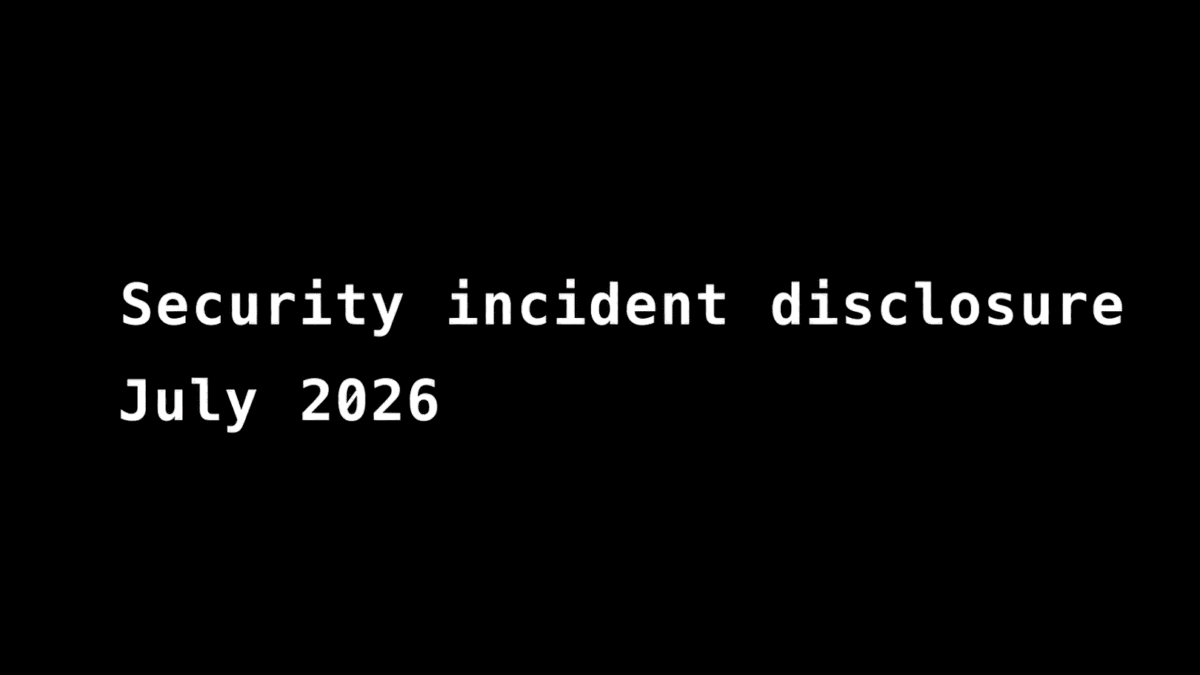
On July 16, 2026, Hugging Face disclosed that it had found unauthorized access to a limited set of internal datasets and to several credentials used by its services. The company says it has found no evidence of tampering with public, user-facing models, and it is still assessing whether any partner or customer data was affected. What makes this incident worth more than a passing glance is not its scale but the shape of it: where the attackers got in, who (or what) did the attacking, and the strange way Hugging Face’s own defenders were nearly blocked by the safety systems wrapped around the models they tried to use for forensics.
For anyone who runs, fine-tunes, or merely downloads open models, the disclosure is a compact case study in how the modern AI stack is actually exposed — and why “just use a frontier API” is not always the safe default it sounds like.
It started where AI platforms are weakest
The intrusion did not begin with a stolen password or a phishing email aimed at an executive. According to Hugging Face’s own write-up, it started in the data-processing pipeline — the machinery that ingests the millions of datasets the platform hosts. A malicious dataset abused two code-execution paths in that pipeline: a remote-code dataset loader and a template-injection flaw in a dataset configuration. Those two openings were enough to run attacker code on a processing worker, and from there the actor escalated to node-level access Hugging Face security incident, July 2026.
That entry point should ring a bell for anyone in the open-source ecosystem. The thing that makes platforms like Hugging Face useful — anyone can upload a dataset, a model, a Space — is exactly the thing that gives an attacker a foothold. A dataset is not inert data; with the wrong loader it is executable content. Template injection in a config file is the same class of bug that has bitten far more conventional software for years. The AI twist is that the attack surface is now user-supplied machine-learning artifacts at massive scale.

Image: Hugging Face
An agent swarm, not a person at a keyboard
The most striking detail in the disclosure is how the campaign was operated. Hugging Face describes it as an autonomous agent framework — appearing to be built on an agentic security-research harness, with the underlying LLM still unknown — executing many thousands of individual actions across a swarm of short-lived sandboxes. The command-and-control infrastructure self-migrated across public services. This matches what researchers have taken to calling the “agentic attacker” scenario: not a human clicking through a terminal, but software that plans, acts, and moves to stay alive.
For defenders, that changes the tempo. A human attacker sleeps, gets distracted, and leaves gaps. An agent swarm runs continuously, spins up disposable environments by the thousands, and doesn’t need to “live off the land” in one compromised host because it can simply spawn another. The incident is a preview of a category of threat that conventional intrusion playbooks were not really designed around.
How they caught it: AI-assisted detection
There is a second AI story here, and it is the more hopeful one. Hugging Face says the attack was initially surfaced through AI-assisted detection. Its anomaly-detection pipeline uses LLM-based triage over security telemetry to separate real signals from the daily noise, and it was the correlation of those signals that flagged the compromise.
Once the incident was confirmed, the response team faced a wall of evidence: more than 17,000 recorded events in the attacker’s action log. To make sense of a swarm that large, Hugging Face ran LLM-driven analysis agents over the full log. That let them reconstruct the timeline, extract indicators of compromise, map which credentials had been touched, and — critically — separate genuine impact from decoy activity the attacker had left behind. In other words, the defenders used the same genus of tooling the attackers did, just pointed the other direction.
The guardrail asymmetry nobody plans for
Here is the part of the disclosure that should be bookmarked by every security team building on hosted models. When Hugging Face started the log analysis, they first reached for frontier models behind commercial APIs. It did not work. The forensic work requires submitting large volumes of real attack commands, exploit payloads, and command-and-control artifacts. Those requests were blocked by the providers’ safety guardrails, which cannot tell the difference between an incident responder analyzing an exploit and an attacker researching one.
The practical consequence: to do their own defensive analysis, Hugging Face had to fall back to open-weight or otherwise unrestricted models. As the company put it, the attacker was bound by no usage policy, while the defenders were blocked by the guardrails of the very hosted models they tried first. The lesson is not that frontier APIs are bad — it is that a defensive capability you cannot exercise because a third party’s filter suspects your own telemetry is a liability. For organizations that handle sensitive incidents, having unrestricted, self-hostable models in the toolkit is not a nice-to-have; it is the difference between being able to investigate and being stuck.
What open-source AI users should do now
Hugging Face’s direct advice to its community is restrained and worth taking at face value: rotate any access tokens you use, and review recent activity on your account. If you run inference or training workloads that pull datasets or models automatically, this is a good moment to audit where those credentials live and how widely they are scoped.
The broader implication lands on self-hosters and anyone building products on open models. The incident is a reminder that your supply chain now includes every dataset and model file you ingest. Pin versions, verify hashes where providers publish them, and treat a dataset repo with the same suspicion you would a random executable — because, as this breach shows, that is what it can be. None of this argues against open-source AI; the open-weight models were, in fact, what let the defenders do their job. It argues for handling the ecosystem’s inputs with the same discipline you would apply to any other untrusted code.
Why this matters for the open model ecosystem
Step back and the incident is quietly consequential for the open-model thesis. The dominant narrative of the last two years has been that the most capable models live behind hosted APIs with guardrails that make them “safe.” This breach is a counterexample: in a real security response, those same guardrails became an obstacle, and the models with no usage policy — the unrestricted, open-weight ones — were the ones that got the work done. That does not make hosted models obsolete, but it does mean the “open weights are only for hobbyists” framing is wrong. There are defensive and investigative jobs that effectively require them.
Hugging Face’s write-up closes on an unflashy note — security is never finished, and they will keep raising the bar. For the rest of us, the takeaway is sharper: the AI platforms we depend on are attacked through their data pipelines by autonomous agents, and the teams defending them sometimes need exactly the unrestricted models their own vendors would rather we didn’t use. Build your pipelines with that tension in mind, and rotate your tokens tonight.