- preview opened in May 2026 → AWS Machine Learning blog — AgentCore payments first launched in preview with Coinbase and Stripe
The wall agents kept hitting
Idan Raman watched his AI agents stall at the worst possible moment.
His company, Anchor Browser, fields millions of requests a day from AI agents that are good at the hard parts — reading a paywalled page, deciding they need it. What they could not do was hand over a few cents to buy it. “Anchor Browser is one of the leading cloud-based browser automation platforms for enterprises with millions of traffic per day, purpose-built for AI agents,” said Raman, the company’s CEO and co-founder AWS Machine Learning blog. His team wired Amazon’s new payments service in so the agents could clear that wall themselves.
Behind the feature is a quieter shift in how software gets priced. Service and content providers are moving away from human-centric subscriptions toward pay-per-use, per-execution models where a single call might cost a few cents. Agents are good at reasoning and choosing tools, but they have historically fallen apart the moment money had to change hands — the one step that still demanded a human at the keyboard.
Raman’s verdict on the build was pragmatic rather than breathless. “The integration was smooth, and it offers a secure way to handle agentic transactions with built-in payment limits,” he said, pointing to the spending caps as the feature his customers cared about most.
From one protocol to a hard spending cap
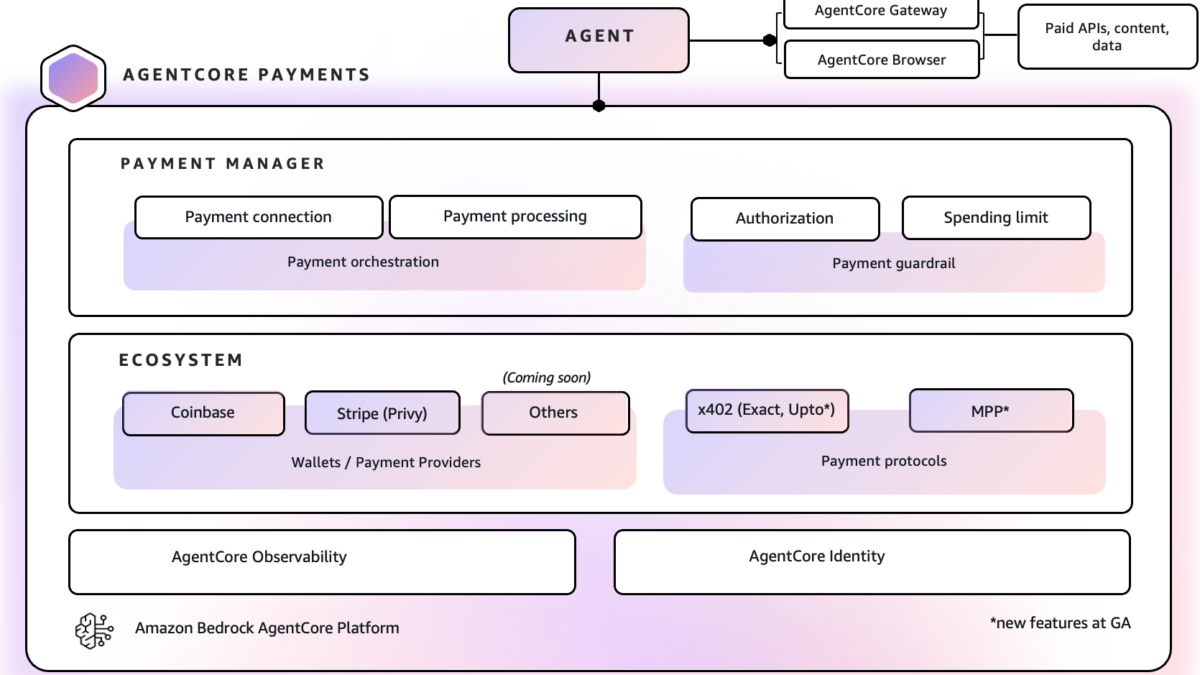
Amazon Web Services said AgentCore payments is now generally available, after a preview that opened in May 2026 AWS Machine Learning blog. At preview it spoke only the x402 protocol; general availability adds the Machine Payment Protocol, co-authored by Stripe and Tempo, so an agent can pay any compatible service without writing new integration code. A new “upto” option bills for exactly what an agent consumed — per token, per call — instead of a fixed price. To keep non-deterministic agents from overspending on a confused retry, every transaction runs inside a scoped payment session with a hard spend cap and expiry that the infrastructure checks before signing.
That last part is the whole point.
Finding something to pay for is its own problem. AgentCore exposes pay-per-use x402 endpoints from Coinbase as an MCP server through AgentCore Gateway, and the curated list now ranks endpoints by social proof, metadata richness, and description quality rather than dumping every registered URL on the agent.
Who is already wiring it up
Cloudflare and travel platform Travala show the demand on the other side of the transaction. Stephanie Cohen, Cloudflare’s chief strategy officer, said its Monetization Gateway already lets asset owners charge agents per request over x402, and AgentCore payments means those agents can pay on day one AWS Machine Learning blog. Juan Otero, Travala’s CEO, said the integration lets customers book from 2.2 million properties conversationally inside a single chat, without a human copying a card number mid-conversation. Elsa AI and Heurist AI use the same plumbing to deliver financial research over pay-per-use APIs.
Cohen put the stakes plainly: “Cloudflare sits in front of a significant share of the world’s content, APIs, and MCP servers,” and its gateway lets owners of those assets charge agents directly, per request, at a price they set.
Pay-per-inference is the use case that has builders most excited. SpreadX built the feature into Incarna, its AI product, to pay for inference through BlockRun, a routing and payment layer where agents settle per call over x402. “We’re thrilled to collaborate with AgentCore payments, which offers a managed service that makes it easy for agents to securely access and pay for BlockRun’s pay-per-use endpoints, unlocking a whole new pay-per-inference use case,” said Vicky Fu, founder and CEO of BlockRun.
The appeal of pay-per-inference is that an agent can route between models mid-task, paying only for the tokens it actually burns instead of carrying a subscription to every provider. BlockRun acts as the routing and payment layer; AgentCore payments handles settlement so the agent never holds a long-lived credential. For SpreadX, the managed service meant it could ship Incarna without building its own wallet and ledger plumbing first.
The early use cases cluster into three buckets. One is unlocking paywalled web content for browser-automation and agentic search providers. Another is pay-per-inference, where an agent routes between models and pays per token. The third is consumer and research tasks — booking travel or pulling financial analysis — handled conversationally through an MCP server.
A wallet the agent can’t actually see
Under the hood, an agent gets a stablecoin wallet from Coinbase or Stripe’s Privy, and a human must explicitly delegate spending rights to it — the same delegated-authentication model Privy documents for its integrations Privy authentication docs. Raw credentials live in a secrets manager; the agent only ever sees short-lived tokens derived from them, never the keys themselves. End users fund the wallet with a card or USDC and decide how much autonomy to grant.
Watching the money move
Once agents start spending, operators need to see it. AgentCore payments emits one span per payment call and metrics such as OperationSuccess and SpendAmount into CloudWatch and X-Ray, building an audit trail of who paid what AgentCore payments observability docs. Prebuilt dashboards surface transaction success rates and average values across agents and payment sessions, so a runaway agent shows up as a spike before the bill does.
Turning it on without rewriting your agent
The payments layer sits on a stack that already runs production agent workflows. Teams wiring n8n to Bedrock have shipped transacting agents on the same foundation Run production AI agents in n8n with Amazon Bedrock AgentCore. For developers, Amazon ships a coding-assistant skill that points Claude Code, Kiro, or Codex at the service and scaffolds a payment-enabled agent from credential setup to first transaction.
An AgentCore CLI does the same from the terminal, scaffolding, configuring, and deploying a fully transacting agent in a few commands rather than a few days. On the console, a Quick Create option provisions Coinbase credentials without leaving the payments screen, while Stripe’s Privy still requires grabbing keys from the Privy dashboard. The service also plugs into open-source frameworks through a Strands Agents plugin, a LangGraph middleware, and an OpenClaw plugin, so the payment loop drops into an existing agent with minor code changes.
AWS frames developer choice as the design principle, not an afterthought: a console for clicks, a CLI for scripts, a coding-assistant skill for agents building agents, and framework plugins for teams with an existing stack. The point is to meet a builder where they already are rather than force a rewrite.
Cost control is becoming a first-class agent concern in its own right, with dedicated FinOps agents now shipping faster on Bedrock nOps ships FinOps agents 75% faster on Amazon Bedrock. AgentCore payments closes the loop by making each agent’s spend observable and capped, not just faster to deploy — the finance team gets the receipt, not just the engineer who shipped the agent. That visibility is what turns an experiment into something a controller will actually sign off on.
The unease that comes with autonomous spending
Autonomous spending is also where the unease lives. An agent that can pay is an agent that can err, and a confused retry can look exactly like permission to pay twice. The payment session and spend cap are AWS’s answer, enforced at the infrastructure layer rather than left to the model’s judgment — but a cap is only as good as the budget a human sets for it.
There is also the question of who eats the cost of a bad transaction. A session budget limits the damage, but it does not resolve disputes between an agent and a merchant over whether a call was worth what it charged. Those are the unglamorous problems that determine whether finance teams trust agents with a live wallet.
None of this makes an agent infallible. A budget caps the blast radius; it does not guarantee the agent spent wisely. The honest framing is that AgentCore payments moves agentic commerce from impossible to bounded — a meaningful step, but one that still leaves judgment, and therefore risk, in the loop.
The bigger question is whether the open web wants to be paid by machines. Publishers already block agent traffic, and the intermediaries who would have to flip that default are the CDNs — Cloudflare and Amazon CloudFront among them. The plumbing is ready; the commercial relationships are not, and those will decide how many agents ever actually reach a checkout.
Step back and the release is a bet on a specific future: one where AI agents do not just reason and act but transact, settling tiny payments for tiny pieces of work the way APIs once settled on human-driven subscriptions. The infrastructure to make that boring — safe, observable, capped — is what AWS is selling.
The bet is that payments stop being the one thing an agent cannot do alone.
If the guardrails hold, the next awkward pause in an agent’s task will not be a paywall — it will be a three-cent transaction it settles before you finish reading this sentence.