
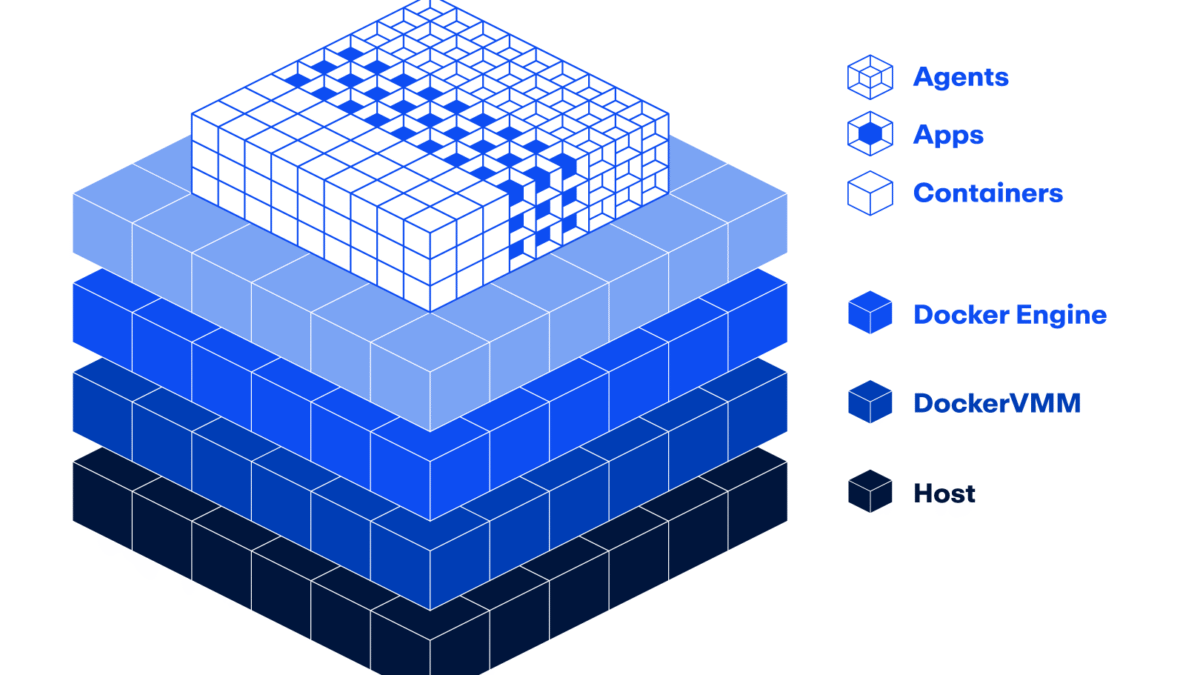
Docker is taking direct control of the software layer that quietly runs every container on a developer’s Mac or Windows machine. In a public beta that began shipping with Docker Desktop 4.86, the company replaced the third-party virtual machine monitor it had always depended on with Docker VMM, a hypervisor built in-house and tuned specifically for containers Docker announcement.
The change matters because the virtual machine monitor — the program that creates and manages the Linux VM Docker runs inside on non-Linux hosts — is the part developers feel most when it misbehaves. When it is slow to start, leaks memory, or stumbles on file sharing, the whole edit-compile-test loop suffers. By owning the full stack, Docker says it can tune each layer for container workloads and ship fixes on its own schedule rather than waiting on an outside dependency Docker announcement.
The measurable claims are the ones worth watching. Docker says container startup is faster across first launches, project switches, and restart recovery; file sharing between the container and host is “significantly faster”; and the new hypervisor returns memory to the host when containers sit idle instead of holding RAM in reserve Docker announcement. On Windows, this is the first time the VMM is built and maintained by Docker itself, bringing performance and stability work that previously landed unevenly across platforms.
The Docker Desktop 4.86 release notes confirm the beta ships for Mac and Windows with Docker’s “own container-optimized hypervisor,” alongside engine components such as Docker Engine v29.7.2 and Docker Buildx v0.36.0 Docker release notes. Linux support is planned for general availability rather than this beta.
Turning it on is deliberately frictionless. On Mac, users already opted into Docker VMM in Settings are moved to the new engine automatically when they upgrade to 4.86. On Windows, a new “Docker VMM” toggle appears under Settings > General. There is no feature flag and no waitlist; any 4.86 user can switch today.
The same engine also powers Docker Sandboxes, and Docker frames this as the first step toward a unified runtime spanning laptop, cloud, and on-prem. The beta runs through the fall, with general availability targeted for the end of October 2026, when Docker VMM becomes the default engine for new installs across Mac, Windows, and Linux Docker release notes.
For developers already on a public beta track, the pattern is familiar: opt in, measure the difference, and report back. Docker is collecting feedback through in-product prompts, community Slack, and support channels Docker feedback. If you want a walkthrough of running a consumer public beta safely, see our guide to installing the macOS 27 public beta.