
On 28 April 2026, the European Union reached the final line of a charger policy it started mapping in 2022: every new laptop sold inside the bloc must now be capable of charging through a USB-C port. It is the last device class to fall under the EU’s common charger rules, and it quietly closes the book on a decade of proprietary laptop power bricks on the continent. If you buy a laptop in the EU this spring, the unlikely shape of its power connector is now decided by Brussels, not the manufacturer.
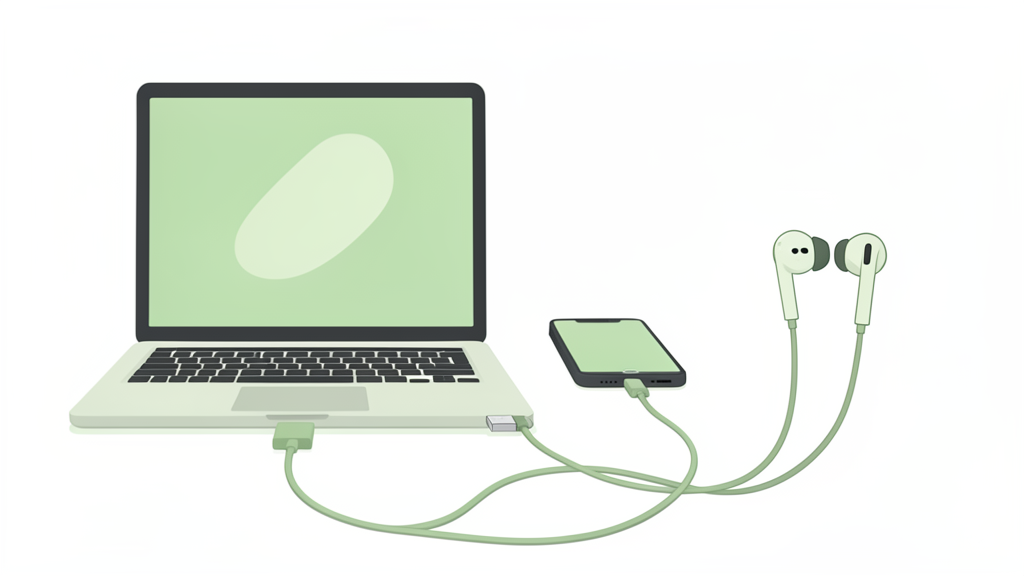
Editorial illustration: one USB-C charger for laptop, phone, and earbuds. Source: European Commission common charger guidance.
The timeline most people missed
The rule did not appear overnight. The underlying law is Directive (EU) 2022/2380, which the Council of the EU approved in October 2022 as an update to the 2014 Radio Equipment Directive. It set a staggered schedule so manufacturers had time to redesign hardware:
- From 28 December 2024, the mandate covered phones, tablets, digital cameras, headphones, headsets, handheld video-game consoles, e-readers, mice, keyboards, portable speakers, and earbuds. All of those had to ship with or support USB-C.
- From 28 April 2026, laptops joined that list.
That second date is the one that just passed. The European Commission’s own guidance, published 28 December 2024, states plainly that “the same requirements apply to laptops as of 28 April 2026.” The two-and-a-half-year gap was the grace period the industry asked for, because re-engineering a laptop’s power delivery is a bigger lift than swapping a phone port.
What “must support USB-C charging” actually means
The law does not force a laptop to arrive in the box with a specific brick, and it does not ban other ports. What it mandates is the capability: a laptop sold in the EU has to accept charging over a USB-C connector that meets the USB Power Delivery spec. In practice that means a 2026 EU-spec laptop can be topped up by the same charger you use for your phone.
Two related requirements travel with the port rule. First, fast-charging must be harmonized: if a device supports charging above 5 volts, it has to use the USB Power Delivery standard so that any compliant charger can deliver the faster rate. Second, the Commission’s rules let consumers buy the device without a charger where that option is offered, on the theory that most households already own a compatible brick. The point is interoperability, not forcing a charger into every box.
Why laptops were last
Laptops were the hardest class to fold in, which is exactly why they got the longest runway. Phones and earbuds draw tens of watts; laptops pull far more and have tighter thermal and battery-management constraints. A thin ultrabook and a 150-watt gaming laptop have very different power needs, yet both now have to speak the same connector language. The 28-month delay was the compromise that let OEMs rework their firmware, cooling, and charger ecosystems without a hard cutover that could have stranded inventory.
It also reflects politics as much as engineering. The EU framed the whole directive around e-waste and consumer convenience: fewer orphaned chargers in drawers, and one cable that works across a household’s devices. Laptops were always the end goal, but the low-power categories were the safe first step.
What it does not change
A few things are worth separating from the hype. The rule applies to new devices placed on the EU market; it does not recall or retrofit machines already on shelves or in users’ bags. It governs charging, not data, and it does not mandate a single cable length or wattage. And it is an EU regulation — laptops sold in markets without an equivalent law can still ship with proprietary connectors, so global product lines now tend to standardize on USB-C simply to avoid building two versions.
It also does not touch the larger question of right-to-repair or battery replaceability. USB-C uniformity is a narrow, single-issue win: one fewer cable type to lose.
The practical upshot for buyers
For anyone shopping in the EU in 2026, the change is mostly invisible and entirely welcome. A new laptop will charge from the USB-C brick already sitting next to the bedside table. Travelers can carry one charger for phone, tablet, and laptop. Businesses standardizing fleets can provision a single spare brick type.
The deeper effect is on the secondary market and e-waste. Chargers that were useless the moment a laptop brand changed its barrel-plug shape now have a longer, more universal life. The Commission’s bet — backed by years of consultation — is that this slowly shrinks the pile of discarded chargers, which by the EU’s own estimates ran into the billions of units across the bloc.
Why the deadline was easier than feared
One reason the 28 April 2026 cutoff arrived with little consumer disruption is that most premium laptops had already migrated to USB-C charging years earlier. Thin-and-light ultrabooks, in particular, had adopted the connector well before the EU mandate, so for many brands the rule formalized an existing design choice rather than forcing a redesign. The holdouts were mostly legacy product lines and a few gaming machines that still shipped barrel plugs or proprietary bricks — exactly the devices the grace period was meant to give time to rework.
That gap matters for the secondhand market too. A laptop bought in 2023 keeps its original charger; the law only governs new units placed on the EU market from the deadline onward. Over the next few years, though, the installed base of USB-C-chargeable laptops will dominate, and the orphaned proprietary bricks will quietly age out of circulation.
When did the laptop USB-C rule take effect?
28 April 2026, the final phase of Directive (EU) 2022/2380.
Do I have to buy a new charger?
No. The rule requires the laptop to accept USB-C charging; it does not force a bundled brick, and you can often buy the device without one.
Are non-EU laptops affected?
Only if they are sold inside the EU. Devices marketed elsewhere can keep proprietary connectors, though most makers now standardize globally to simplify production.
Does it cover fast charging?
Yes. Devices that fast-charge must use the USB Power Delivery standard so any compliant charger can deliver the faster rate.
Bottom line: as of 28 April 2026, USB-C is the law for laptop charging in the EU, the last and hardest piece of a charger mandate that began with phones and earbuds in December 2024. For buyers it means one fewer cable to juggle; for the environment it is a slow, steady cut in charger waste.