
French startup Genesis AI, backed by former Google CEO Eric Schmidt, has unveiled Eno — a general-purpose robot that rejects the conventional humanoid silhouette in favor of a wheeled, foldable chassis designed around human capability rather than human appearance The Verge report. The company plans to begin production and targeted customer deployments by the end of 2026, starting with manufacturing, laboratories, and logistics before expanding to hospitals, hotels, and consumer settings. (genesis.ai)
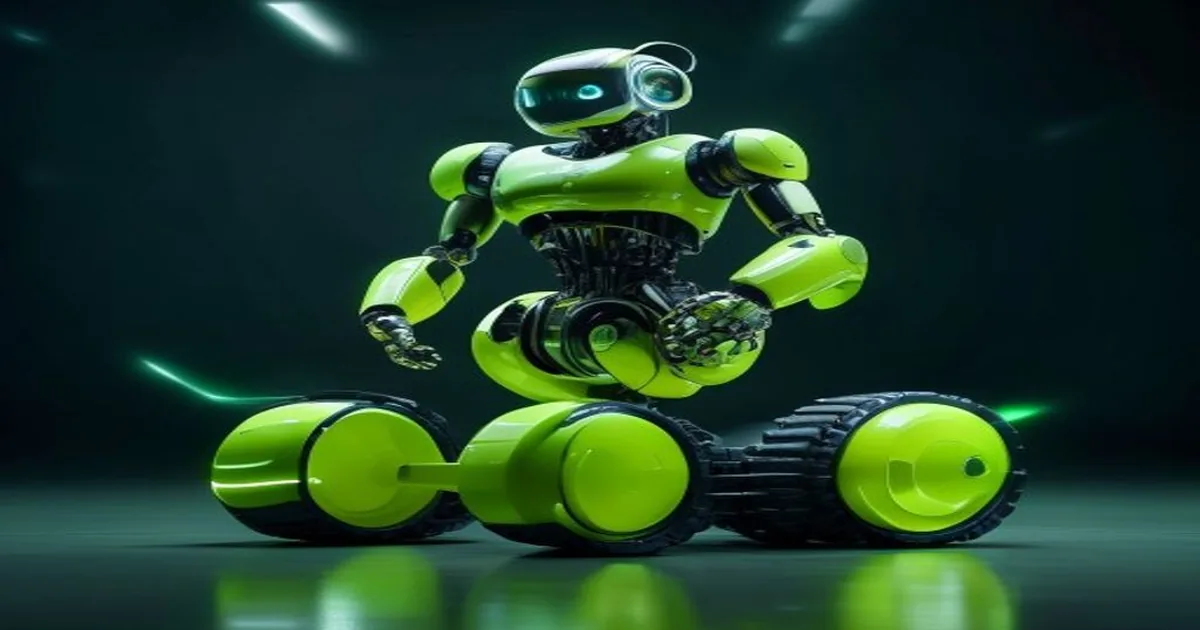
Eno answers the question of what a humanoid robot looks like when engineers prioritize function over form: it may lack a head, lack legs, and sit on a wheeled base that folds down like a deck chair, yet its hands are engineered to exactly match the form and function of human hands so the robot can use tools and objects already built for people.
Genesis describes the machine as fully general-purpose rather than optimized for a single task such as folding laundry, and says additional embodiments are in development.
Design philosophy shifts from mimicry to capability
Most humanoid projects from Tesla’s Optimus to Figure’s 01 and Boston Dynamics’ Atlas replicate the human body plan — two legs, a torso, two arms, a head — because the world is built for that shape. Genesis AI takes a different bet: the world is built for human hands, not human legs.
By mounting anthropomorphic hands on a stable wheeled platform that can fold for transport or storage, Eno sidesteps the unsolved balance and power-density problems of bipedal locomotion while retaining the ability to manipulate the same door handles, power tools, and lab equipment that people use daily.
The company’s phrasing — “humanoid robots don’t need to look human” — signals a broader industry inflection. Agility Robotics’ Digit and Apptronik’s Apollo have already demonstrated that wheeled or digitigrade bases can navigate warehouses faster than bipeds. Genesis pushes that logic further by decoupling the manipulation subsystem entirely from the mobility subsystem, a modular approach that could let customers swap bases for different floor conditions without redesigning the hand interface.
Human-matched hands as the primary interface
Genesis says Eno’s hands “exactly match the form and function of human hands,” a claim that implies five-fingered, tendon-driven architecture with force sensing and tactile feedback comparable to the Shadow Hand or the latest Unitree H1 grippers. If validated, this would let Eno operate existing tooling — torque wrenches, pipettes, surgical instruments — without custom end-effectors or fixture redesign.
That compatibility is the single largest lever for reducing integration cost in brownfield factories and labs where retrofitting workcells for proprietary grippers often exceeds the robot’s purchase price.
The hand-first strategy also aligns with the emerging “embodied AI” paradigm where foundation models for manipulation train on human demonstration data. A hand that moves like a human hand generates data distributions that transfer directly from teleoperation datasets, potentially accelerating the sim-to-real pipeline for new skills. Developers building on platforms like zbrandco’s robotics SDK coverage should watch whether Genesis publishes an API for hand trajectory streaming or exposes a ROS 2 interface compatible with MoveIt 2.
Deployment timeline and target verticals
Genesis targets end-of-2026 for production start and initial customer deployments across three verticals: manufacturing, laboratories, and logistics. These environments share structured floors, repeatable tasks, and high labor costs — conditions where a wheeled base with 8–12 hour battery swap cycles outperforms bipeds that still struggle with shift-long uptime. Hospitals and hotels follow in a second wave, where navigation around people and compliance with medical-device regulations add complexity. Consumer deployment comes last, reflecting the higher safety bar and unstructured home layouts.
The phased rollout mirrors the playbook of companies like GrayMatter Robotics and Plus One Robotics, which proved value in controlled cells before expanding to dynamic zones. For operations leaders evaluating pilot programs, the key metric will be mean time between interventions (MTBI) during the first 90 days — a figure Genesis has not yet disclosed but which will determine whether Eno clears the “lights-out” threshold for unattended shifts.
Strategic backing and competitive landscape
Eric Schmidt’s involvement — confirmed by The Verge — places Genesis in a small cohort of robotics ventures with direct ties to Alphabet-era AI infrastructure. Schmidt’s investment vehicle, Hillspire, has previously backed applied AI firms but rarely hardware platforms with this degree of mechanical novelty. The capital likely funds the low-volume tooling for hand actuation and the compute stack for on-device inference, areas where bill-of-materials costs spike before economies of scale arrive.
Competitors include 1X Technologies’ NEO (bipedal, home-focused), Figure’s 02 (bipedal, factory-focused), and Tesla Optimus Gen 2 (bipedal, vertical integration). Genesis differentiates by rejecting bipedalism entirely, a move that reduces mechanical degrees of freedom from ~50 to ~25 and cuts peak power draw during locomotion by an estimated 60–70 percent based on comparable wheeled platforms. That efficiency gain translates directly to longer operational windows per charge — critical for logistics sorting lines that run 20 hours daily.
Implications for robotics developers and integrators
For engineers building workcell automation, Eno’s architecture suggests three practical shifts. First, gripper standardization: if Genesis publishes the hand’s kinematic and dynamic parameters, integrators can design fixtures once and deploy across any Eno embodiment.
Second, simulation fidelity: the wheeled base simplifies physics simulation (no contact-implicit dynamics for footfalls), letting teams train policies in Isaac Sim or MuJoCo with higher sim-to-real transfer rates.
Third, fleet management: a homogeneous hand interface across heterogeneous bases (warehouse trolley, lab bench mount, hospital cart) enables a single orchestration layer — something zbrandco’s fleet orchestration analysis identified as a 2026 adoption accelerator.
The company has not released SDK documentation, pricing, or safety certification status (ISO 13482 for personal care robots, ISO 10218 for industrial). Those details will determine whether Eno enters proof-of-concept budgets this year or slips to 2027. Genesis says “additional embodiments are in development,” hinting at a product line rather than a single SKU — a strategy that could amortize hand R&D across form factors from tabletop manipulators to mobile manipulators with vertical reach.
Bottom line: Genesis AI’s Eno bets that human-matched hands on a wheeled, foldable base will reach commercial viability in 2026 faster than bipedal alternatives, offering integrators a manipulation-first platform that fits existing tools and workcells without waiting for locomotion breakthroughs.