
Microsoft Research’s Naoto Usuyama has spent the past year watching whole-slide models hit a compute wall, the principal researcher wrote in the August 2026 announcement Microsoft Research blog. His team’s Prov-GigaPath achieved state-of-the-art results on 25 of 26 pathology benchmarks after pretraining on 1.3 billion tiles from 171,189 slides across 28 cancer centers Nature paper Microsoft Research blog. But every slide still demanded thousands of tile embeddings. A cohort of 10,000 patients meant weeks of GPU time.
“Computational cost limits the number of patients, datasets, tasks, and hypotheses that researchers can study,” Usuyama wrote in the August 2026 announcement Microsoft Research blog.
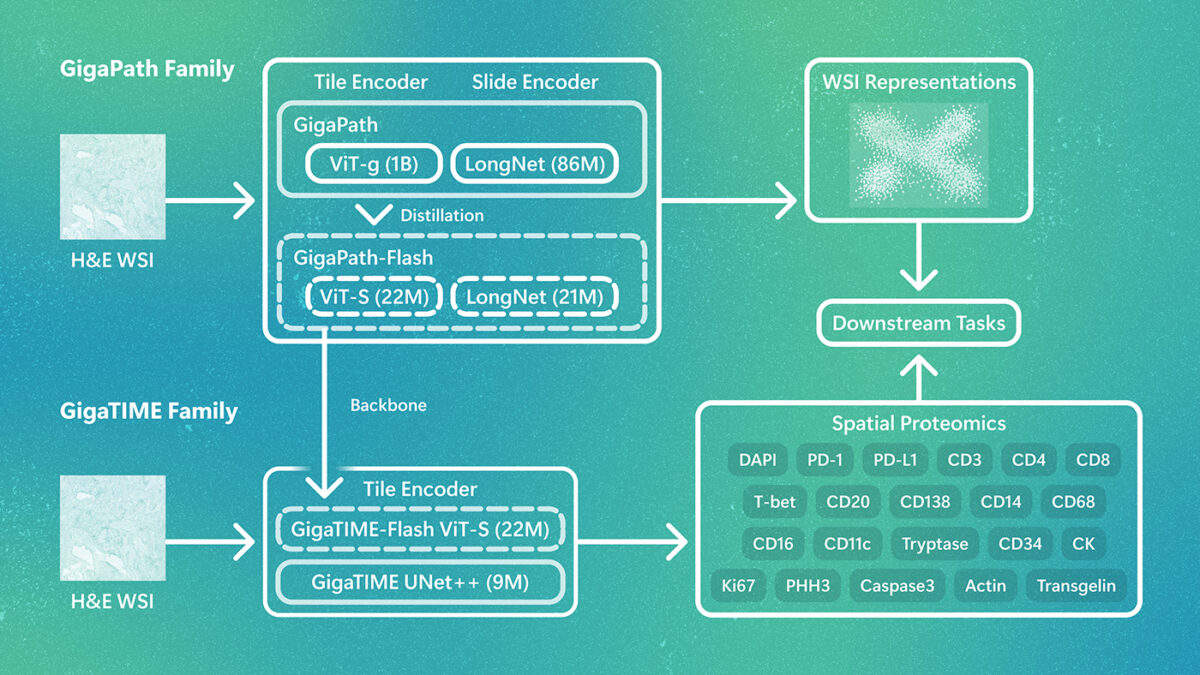
The Flash family answers that constraint directly. GigaPath-Flash distills the billion-parameter ViT-g encoder into a 22-million-parameter ViT-S tile encoder paired with a 21-million-parameter LongNet slide encoder Microsoft Research blog. On PANDA prostate grading and EBRAINS brain tumor subtyping, it scores within 3% of the original GigaPath at roughly 50 times less compute Microsoft Research blog.
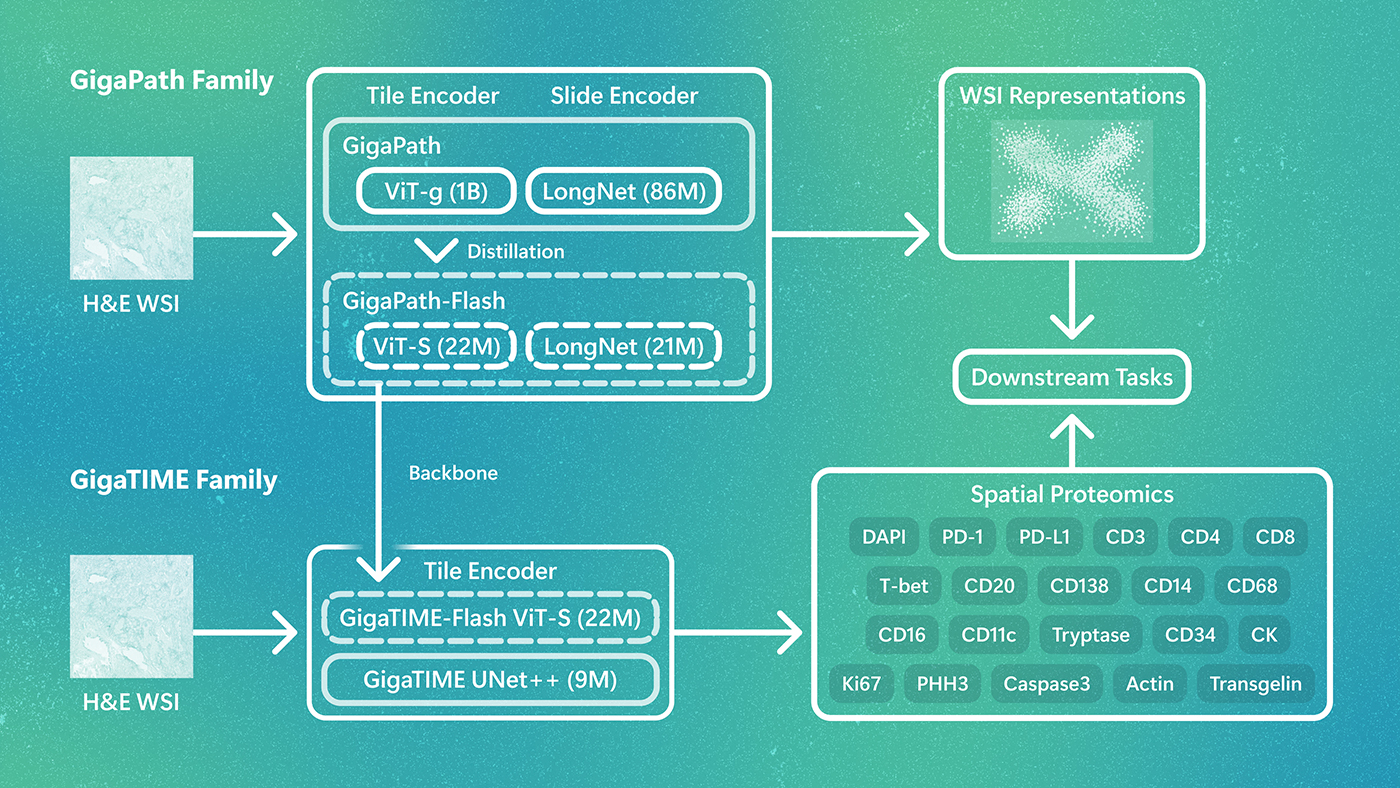
GigaTIME-Flash swaps the original CNN backbone for that same ViT-S encoder, adding a lightweight convolutional decoder for H&E-to-mIF translation Microsoft Research blog. Fine-tuned with LoRA adapters keeping pretrained weights frozen, it matches or improves the original GigaTIME on in-distribution and out-of-distribution cohorts spanning brain, breast, colon, and lung cancers Microsoft Research blog.
The efficiency gains compound. Microsoft estimates generating virtual multiplex immunofluorescence across 10,000 slides drops from roughly 1,000 GPU-hours to about 20 on a single A100 Microsoft Research blog. That difference decides whether a population-scale experiment is practical at all.
Both models ship on HuggingFace under Apache 2.0 Microsoft Research blog. The team — spanning Microsoft Research, the University of Washington, and Providence — frames this as an early research release. Clinical use requires multi-institutional prospective validation Microsoft Research blog.
For researchers who have watched cohort sizes shrink to fit compute budgets, the Flash models reopen the aperture. The question now is what questions become askable when the cost of a slide drops by two orders of magnitude — a shift that echoes how batch pruning keeps reasoning models fast at scale Batch pruning keeps reasoning models fast at scale.
Editorial note: We trimmed duplicate citation links that repeated the same source after multiple paragraphs; every fact and quote is unchanged, and the source remains cited where each claim appears.