- No specific calendar dates, day names, or relative dates appear in this article body, so this date-source map has zero entries.
A legal team’s quiet bottleneck
A media company that licenses shows across a dozen jurisdictions sits on thousands of signed agreements. Ask one question — which deals expire this quarter, and what are the renewal terms — and a small legal team can lose a full afternoon to the search. Contracts are not blog posts. A single agreement can run dozens of pages where the same term means different things in different sections, and a missed qualifier changes who owes what. The contracts are scanned, indexed, and theoretically searchable, but the answer almost never lives in a single sentence. It hides in a clause three pages deep, governed by a law that changes by state.
This is the problem Amazon Web Services is targeting with a solution it calls AI-Driven Annotation, or AIDA, built on Amazon Bedrock Knowledge Bases AWS Machine Learning blog. The pitch is not that AI reads contracts for you. It is that AI, paired with the right metadata, stops hiding the clauses you actually need.
Why plain semantic search leaves clauses behind
Retrieval-augmented generation changed how enterprises query documents. You ask a question, the system finds the closest matching text, and a model writes an answer. For casual questions that works. For contracts it breaks, and the reason is structural.
A single query such as “identify expired licensing agreements under California law and explain how they renew” can match hundreds of text chunks across many documents AWS Machine Learning blog. Bedrock’s semantic search returns the top candidate chunks, but the system is designed to cap that list at 100. Everything filtered out might still hold the context that decides the answer. A renewal clause in a California agreement behaves differently from the same clause under a different governing law, so a pile of near-misses is worse than no answer at all.
The cost is not only time. When a clause is missed, the decision built on top of it can be wrong in ways that surface only months later, after the signatures are exchanged.
The two-stage filter that narrows the pile
AIDA’s core idea is to filter before it searches. The first stage applies metadata conditions automatically — effective-date ranges, contracting parties, jurisdiction — before any vector similarity runs AWS Machine Learning blog. Only then does semantic search run inside that smaller, cleaner set. The retrieved documents are both contextually relevant and aligned with the business question.
The second filter is explicit, enforced at the application layer regardless of what a user types. A company can hard-code rules such as “European users only see EU-governed contracts” or “return only documents active in the last two years.” AWS shows a sample filter that combines a region check with a confidentiality level, so a query can never drift outside a boundary the business set. Think of it as a fence around the search rather than a hope that the model stays inside one.
Enriching chunks with the contract’s own metadata
Filtering narrows the candidate set. It does not, by itself, tell the model what a chunk actually belongs to. That is the second half of the technique, and it is where the design gets interesting.
After ingestion, AIDA groups chunks by source document and attaches the document’s metadata — contract type, governing law, effective date, expiration date, parties — once, rather than repeating it on every chunk. Without that context, a retrieved clause alone cannot tell the model whether the agreement is a license, whether California law applies, or whether it has already lapsed. With it, the model reasons from a richer frame and returns answers that track the specific contract in front of it.
This is where the broader field of legal AI evaluation matters. The Atticus Project’s CUAD dataset, a corpus of more than 13,000 expert-labeled annotations across 510 commercial contracts, was built precisely because generic models miss the clause types that carry legal weight CUAD dataset. The dataset catalogs 41 clause categories — from non-compete terms to confidentiality — and was accepted at NeurIPS 2021. Its technical advisors include researchers such as Dan Hendrycks, a sign the work drew serious scrutiny from the ML-safety community CUAD dataset.
Lawyers who built the dataset spent hours labeling each contract by hand, which is exactly the manual labor AIDA is meant to shrink.
The Atticus Project argued that off-the-shelf models overlook the exact provisions lawyers care about, which is why CUAD leans on annotations produced under the supervision of experienced attorneys.
How the pieces fit: from upload to cited answer
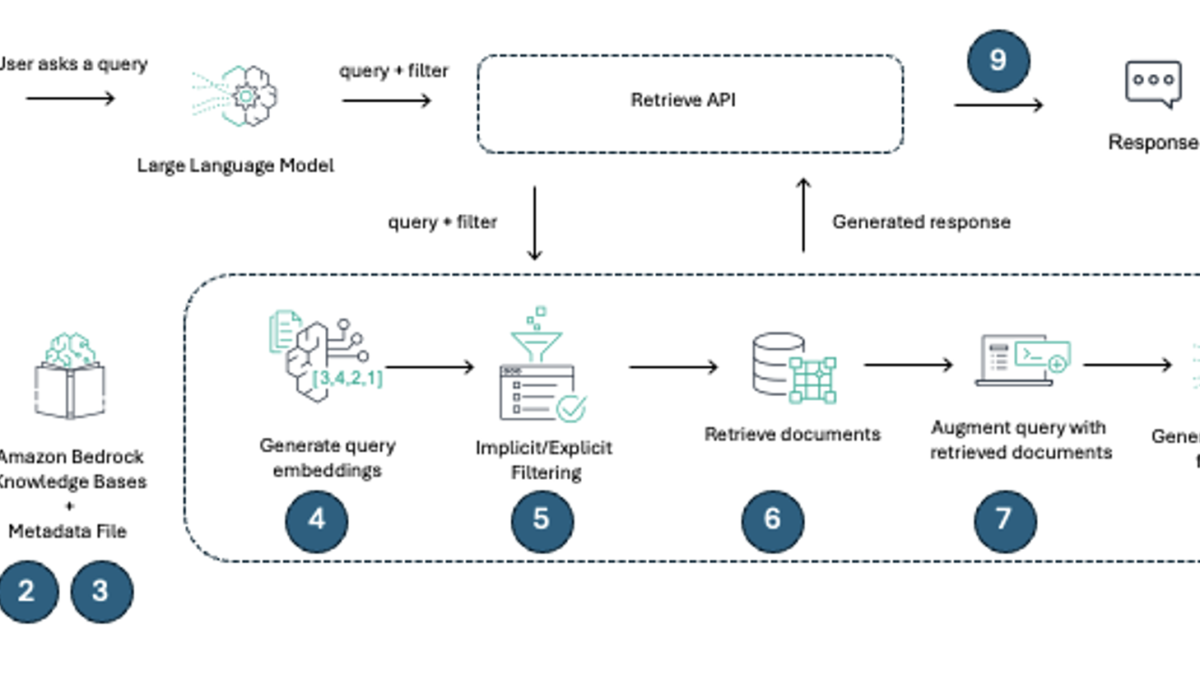
The reference architecture strings several Bedrock capabilities into one pipeline. Contracts are first synced into a Bedrock Knowledge Base alongside a structured metadata file that records parties, effective dates, termination dates, and jurisdiction Amazon Bedrock Knowledge Bases documentation. The knowledge base then breaks each contract into semantically meaningful segments, a chunking step that keeps enough context in every slice to stay useful without becoming unwieldy.
Those chunks are turned into vector embeddings and stored in a vector database, with encryption at rest enabled and access governed by AWS Identity and Access Management policies. When a user asks a question, the system first converts the query into embeddings, then applies the implicit and explicit filters, then runs semantic search only on the surviving subset. The retrieved chunks are assembled into a prompt with their metadata, passed to a model through Bedrock, and returned with a traceable pointer back to the source document.
That traceability is the quiet selling point. Every answer can be walked back to the specific clause it came from, which is what separates a decision-support tool from a black box.
Guardrails and the limits of metadata
AWS wraps the query path in Bedrock Guardrails, which screen for prompt injection and data leaks before a search even begins, then apply content filtering and sensitive-information safeguards on the way out. Access itself is role-based, enforced at the application layer, so a given user sees only the contracts their project scope allows. Transits use HTTPS with TLS 1.2 or higher, and CloudWatch logging keeps an audit trail for compliance teams.
However, the quality of the filtering depends entirely on the metadata an organization chooses. Queries that map cleanly onto fields such as jurisdiction or effective date benefit the most. Questions that do not align with any captured attribute gain far less, because there is nothing to filter on. The tool sharpens retrieval; it does not invent structure a team never recorded. Careful design of those metadata fields is the difference between a system that finds the right clause and one that merely looks busy.
The human still holds the pen
For all the filtering and enrichment, AWS is explicit that the system is decision support, not a substitute for counsel. The AWS Machine Learning blog noted, “AI-generated contract interpretations should always be reviewed by qualified legal professionals before being used for business decisions.”
That caution is not boilerplate. Legal language is dense, and a model that surfaces the right clause can still misread how two clauses interact. AIDA’s design keeps a traceable path back to the source document for every answer, which reduces hallucination but does not remove the need for a person who understands the deal. AWS describes AIDA as augmenting legal expertise rather than replacing it — a narrower, more defensible claim than the sweeping automation some vendors promise.
What this means for teams drowning in contracts
AIDA is not a product you buy off a shelf. It is a reference architecture — a documented pattern for wiring Bedrock Knowledge Bases, guardrails, and metadata into a contract query system. Organizations still have to decide which attributes to capture and how to enforce their own boundaries. The pattern is deliberately portable: a team that already stores contracts in a Bedrock Knowledge Base can adopt the filtering without moving its data.
The move fits a wider pattern on Bedrock. AWS has been opening more first-party model and grounding options to the platform; our coverage of OpenAI’s Daybreak cyber models landing on Bedrock shows how quickly the catalog is broadening OpenAI Daybreak cyber models land on AWS Bedrock. For teams already on Bedrock, AIDA is a template for getting more from data they already store.
The same retrieval discipline applies well beyond contracts. Our guide to enabling web search grounding on Amazon Bedrock walks through another way to keep model answers tied to verifiable sources How to enable web search grounding on Amazon Bedrock. The mechanism differs, but the goal is the same: stop the model from answering from memory when the truth is sitting in a document.
Bedrock Knowledge Bases remain the substrate underneath all of this, handling ingestion, embedding, and retrieval so builders can focus on the filtering logic that makes answers precise Amazon Bedrock Knowledge Bases documentation. AIDA’s contribution is showing how a thin metadata layer, applied before and during search, changes which clauses survive to the final answer.
The contracts are not getting simpler. The teams reading them are not getting larger. Tools like AIDA will not replace the lawyer who signs off, but they can turn a lost afternoon into a five-minute lookup — if the metadata behind them is built with the same care the law demands.