
When an autonomous agent spends real money, the expensive question isn’t whether the payment cleared. It’s whether anyone can later prove the payment was authorized. A startup called Solv Labs, working with policy-verification partner ICME Labs, has published a reference workflow that answers that question at the moment of the transaction rather than after the fact, using Amazon’s managed agent infrastructure.
The pattern runs on Amazon Bedrock AgentCore payments, a service Amazon introduced in May 2026 with Coinbase and Stripe as launch partners that lets agents pay for APIs, content, and other agents through stablecoin and the x402 protocol Amazon’s announcement of the Solv Labs workflow. The core problem it targets is governance overhead: most agent systems leave no durable record tying a specific payment to the policy that approved it.
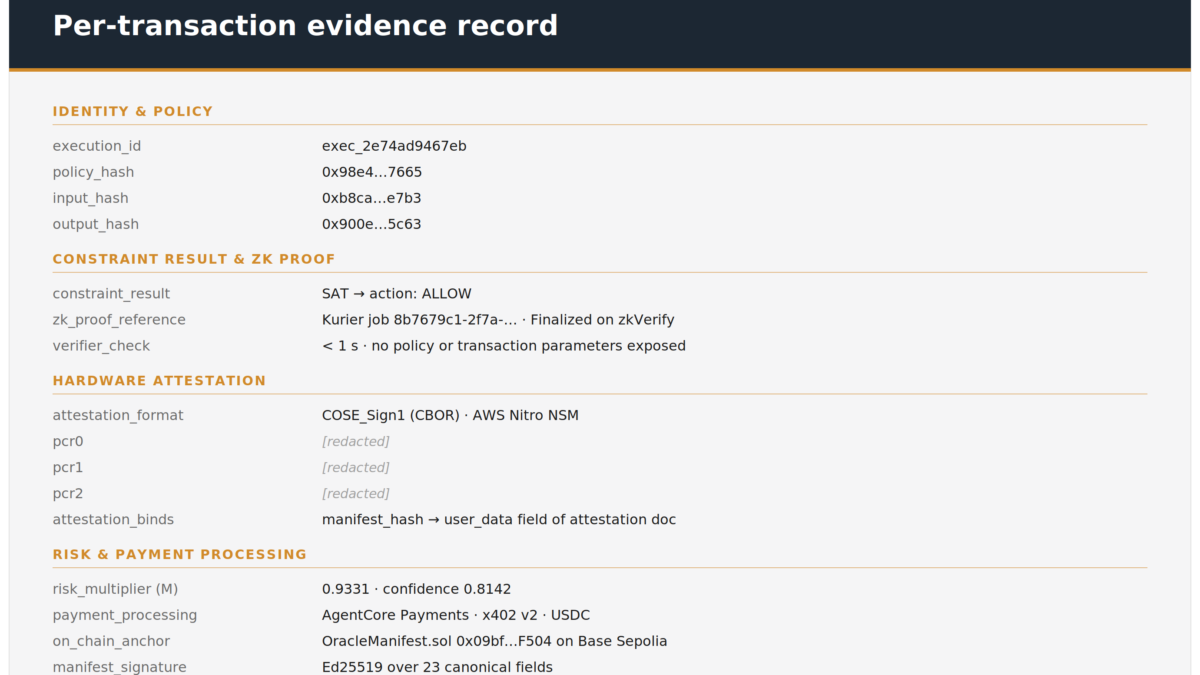
Solv’s design wraps every payment in four gates that must all pass before any money moves. A policy engine called ORACLE returns an ALLOW or REVIEW verdict before settlement, and a DENY path produces a signed refusal when configured constraints are violated the same AWS walkthrough. ICME’s PreFlight layer then emits a small, privacy-preserving proof of that check that a third party can verify without seeing the policy itself.
Hardware backs the next layer. An integrity service running inside an AWS Nitro Enclave signs the execution record in a hardware-isolated environment, binding the signing key to the specific enclave image through PCR measurements the Solv Labs announcement. A risk engine then attaches a deterministic multiplier to each transaction, so the governance record prices the risk a payment carried rather than treating every transfer as identical.
The economics explain why this matters now. Agent-to-service calls are often worth only cents, but traditional card rails impose a fixed fee around USD $0.30 per transaction, which makes high-frequency microtransactions uneconomic AgentCore payments documentation. Stablecoin settlement and x402 remove that floor, which is why Amazon built the service as a preview rather than waiting for general availability Amazon’s announcement of the Solv Labs workflow.
End to end, Solv reports each governed payment finishes in under four seconds, with governance overhead under one second, and settles on-chain through Coinbase on the Base network the Solv Labs walkthrough. Every decision, attestation, and risk price is visible through standard AgentCore Observability on CloudWatch.
For enterprises in regulated industries, the payoff is an audit trail produced at execution instead of reconstructed afterward. When an auditor or counterparty asks why a payment was permitted, the answer is a verifiable artifact on a public anchor, not an organizational assertion. The same evidence model is being extended toward higher-volume agentic commerce workloads.
The approach also joins a wider shift on the same platform. Amazon has shown how teams track model token usage inside Bedrock AgentCore, and builders are assembling specialized agents such as a Bedrock AgentCore due-diligence agent for M&A work — both of which assume agents can act and spend under observable controls AWS shows how to track Qwen tokens inside Bedrock AgentCore and How to build a Bedrock AgentCore M&A due diligence agent.