
- (none — this article cites no specific calendar, day-name, or relative dates)
A 13M-parameter language model can now tell a coherent children’s story using almost none of the parts researchers normally bolt onto a transformer. The result, Wiola 13M, is not a bigger model doing less. It is a small model rebuilt from the layer up, and the rebuild is the story.
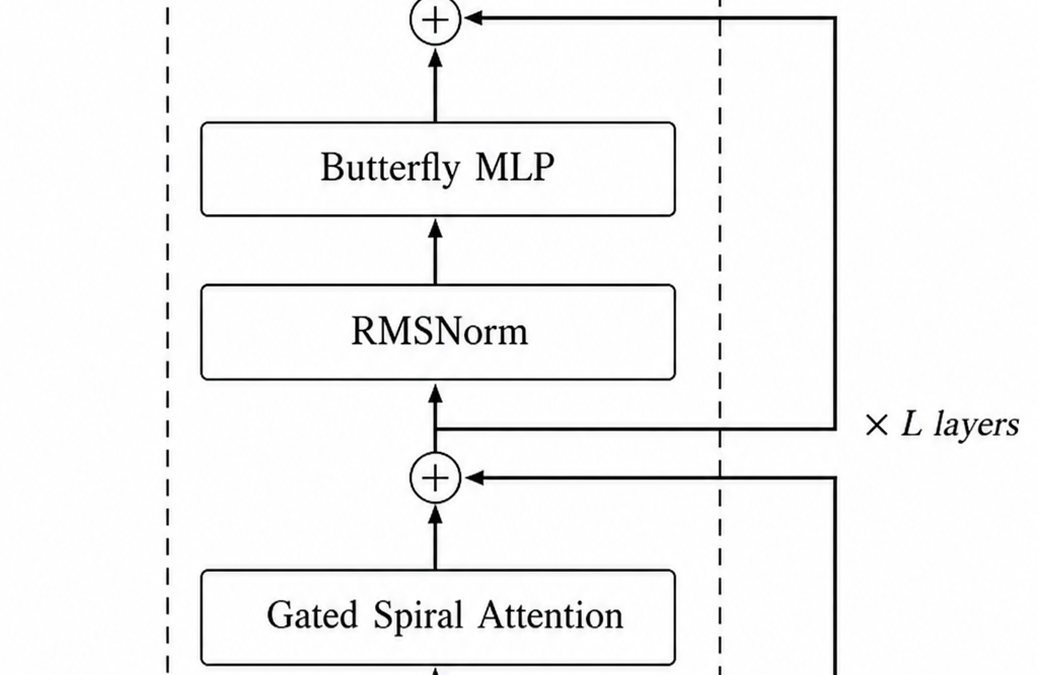
Wiola noted that the architecture’s novelty is “concentrated in three drop-in components of every layer” arXiv paper. That sentence is the whole bet: instead of shrinking a large design until it fits a phone, the authors reworked the smallest building block a model repeats hundreds of times.
Why does the smallest regime get its own architecture? Small language models in the ten to one hundred million parameter range have become a quiet battleground arXiv paper. They are cheap enough to run on a phone, small enough to experiment on a laptop, and contained enough to study scientifically. Most of them, Wiola argues, still reuse the standard transformer block without adapting it to that tiny scale — so the savings come from size, not from a design that earns it.
The first twist: spiral rotary positions
The first change attacks positional encoding, the mechanism that tells a model where each word sits in a sequence. Standard rotary position embedding rotates query and key vectors by a fixed frequency per dimension, which works but treats every position the same way regardless of context.
Wiola described this as perturbing those frequencies with a slowly growing per-dimension factor so the phase trajectories fan outward rather than circle in place arXiv paper. Fanning the trajectories means distant tokens become easier to tell apart, and the gain costs nothing extra: no new weights, no new memory, just a different rotation schedule.
Long-range discrimination is exactly the weakness that hurts tiny models most. With few layers to spare, a small model that confuses word order across a sentence has nowhere to recover. A positional scheme that separates distant positions without adding parameters is a direct answer to that constraint, not a generic flourish.
A gate that picks which heads matter
The second component is where the architecture gets its name. Gated Spiral Attention adds a scalar gate per head, derived from a running, causal statistic of the query stream. Think of it as the model learning, mid-sentence, which attention heads deserve more say.
Wiola described the gate as content-adaptive rather than fixed, so the same layer can behave differently depending on whether the text in front of it is a list, a quote, or a fragment of code. It is a soft, differentiable form of head selection that costs almost nothing, because the gate is computed from information the model already tracks rather than from an extra sub-network bolted on top.
Head selection normally forces a hard choice: prune heads and risk losing signal, or keep them all and pay for capacity a small model does not have. A learned scalar that quietly down-weights the wrong heads sits between those extremes, and it scales with the query stream instead of with hand-tuned rules.
The butterfly feed-forward swap
The third piece replaces the familiar expansion-then-contract feed-forward block that sits inside every transformer layer. The Butterfly block uses a multiplicative interaction plus a bypass path inside the layer, which Wiola said matches the parameter count of a block four times the size of a standard gated linear unit while improving gradient flow in shallow stacks.
That claim matters because small models are usually shallow. A handful of layers means the gradient signal has few places to hide, and poor flow silently caps what the model can learn. A block that helps gradients move is not a cosmetic tweak for a 13M model; it is the difference between training that converges and training that stalls.
The multiplicative interaction is the part worth noticing. Where the usual block expands, transforms, and squeezes, the butterfly mixes signals by multiplication and lets some pass straight through. On a shallow stack that bypass can keep an early layer’s signal alive long enough to reach the last one.
The proof that inference lies flat
Wiola’s most interesting promise is not a speed number but an equivalence. The authors prove that their gated attention admits an exact, numerically verified match between full-sequence training and cached autoregressive decoding DOI record. In plain terms: nothing the model learns in bulk training is lost or approximated when it generates one token at a time on a device.
Wiola argued this one does not trade training faithfulness for inference speed the way most efficiency tricks do. If the proof holds under independent reproduction, it removes a common excuse for skipping the architecture on resource-limited hardware, because the on-device behavior is the same mathematics the researchers trained.
Flat inference is the property that makes a small model trustworthy to ship. When cached decoding drifts from training, the gap shows up later as odd phrasings or dropped context that no one can easily trace. An exact match means the device is running what was validated, not a faded copy of it.
Reproducible by design, or just claimed
The paper describes a training and evaluation protocol on a standard tiny-story corpus, and the reference implementation ships as an open-source package with ready-to-publish weights DOI record. The preprint is also cataloged in Google Scholar’s arXiv index for discovery Google Scholar index.
Wiola argued that reproducibility is where small-model papers live or die. A result you can rebuild from a public repo and a fixed corpus is a result the field can actually build on, not a slide in a venue. The tiny-story corpus is narrow, but a narrow, shared evaluation set is exactly what makes a claim checkable by someone who was not in the room.
Where the spiral idea bumps into reality
The design is not free of trade-offs. A bespoke block is harder to swap into existing tooling than a dropped-in standard layer, and “drop-in” here means inside Wiola’s own stack, not yours. But the gains are measured on a narrow story-generation corpus, not on the messy, multi-domain tasks that decide whether a model is useful in production.
Yet none of this lets a 13M model punch at the weight of a frontier release. OpenAI has argued that even small GPT-class models can now run agents OpenAI small models can run agents, and PP-OCRv6 shipped OCR weights between 1.5M and 34.5M parameters for on-device reading PP-OCRv6 on Hugging Face. Wiola sits in the same crowded, pragmatic corner: small, specific, and judged by whether it runs where big models cannot.
The small-model corner is getting crowded
Wiola’s real contribution may be less the spiral math than the discipline of treating the small regime as its own problem. For years the default was to shrink a large architecture and hope the behavior survived. A purpose-built block, a flat inference proof, and a reproducible corpus suggest the field is starting to design down instead of cut down.
The open question is whether spiral attention generalizes past nursery stories. If it does, the modest 13M model could become the template a generation of on-device assistants is built from — not because it is large, but because it was never meant to be.