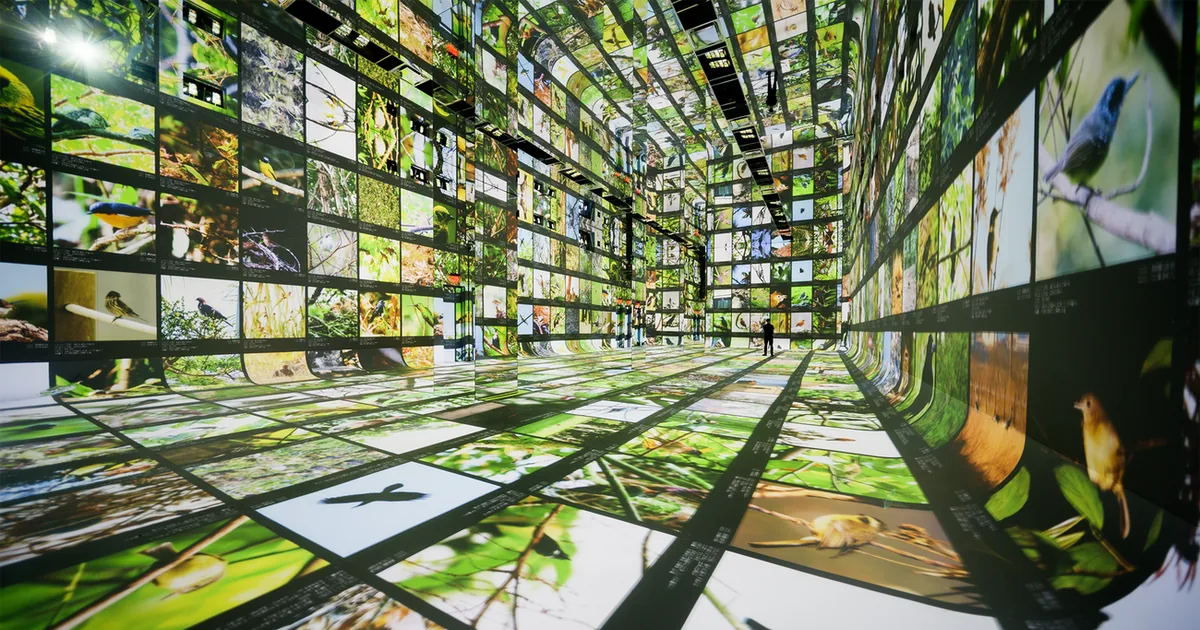
The world’s first AI arts museum, Dataland, opens to the public June 20 in Los Angeles’ Frank Gehry-designed The Grand LA mixed-use development. The 25,000-square-foot omni-sensory venue uses generative AI to create real-time, visitor-responsive art installations that shift based on audience interaction.
Dataland is a joint project between media artist Refik Anadol and Google, which serves as the initiative’s technology and creative partner. The collaboration builds on a decade of shared work, including a 2025 immersive installation of the Large Nature Model and Gemini at Google’s Mountain View campus that transformed regional ecosystem data into a shifting digital landscape.
The museum’s opening exhibition, Machine Dreams: Rainforest, runs on the Large Nature Model, a foundational AI system trained on curated natural world datasets. It translates environmental inputs into 1.2 billion pixels of adaptive generative visuals. Google’s official announcement of the Dataland opening
Dataland’s generative system runs on 87% carbon-free Google Cloud infrastructure
All of the museum’s real-time generative output runs on this infrastructure, with the Gemini Enterprise Agent Platform and Compute Engine coordinating generative adversarial networks, diffusion models, and Gemini to produce visuals, soundscapes, and algorithmically augmented scents. Unlike static generative art installations that run pre-trained models on fixed loops, Dataland’s setup treats the entire gallery as a co-creative space. Audience movement and detected emotion directly shape output in real time, with no pre-determined sequence of content.
Residency program funds 4 emerging AI artists with $25,000 grants each
Tied to the museum’s launch, Google Arts & Culture is funding a six-month Dataland AI Artist Residency for four emerging creators. Each resident receives a $25,000 grant, mentorship from Refik Anadol Studio, and direct access to Google Cloud’s advanced machine learning tools, eliminating the high cost barrier that typically limits enterprise-grade AI art tools to well-funded studios. Work produced during the residency will be featured on Dataland’s platform and the Google Arts & Culture website later in 2026, giving residents direct access to a global audience for AI art.
Bottom line: Dataland’s June 20 opening establishes a working proof of concept for large-scale, sustainable AI-powered cultural spaces, while its residency program addresses a critical equity gap in the generative art ecosystem by providing funded access to enterprise AI tools for creators without existing institutional backing.