
You have probably used a technology all day without ever hearing its name. Auracast is the quiet engine behind a handful of features that are starting to appear on 2026 phones, televisions and earbuds: tap a venue’s audio and it flows to everyone’s earbuds at once, or point your earbuds at a silent screen and hear the soundtrack with no pairing dance. It is not a product so much as a capability, and whether your next gadget supports it is quickly becoming a detail worth checking.
Auracast is a broadcast audio profile built on top of Bluetooth LE Audio, the lower-power audio architecture the Bluetooth SIG finalized in the early 2020s. Where ordinary Bluetooth sends sound from one source to one listener, Auracast flips that: a single transmitter streams to an unlimited number of receivers within range, all at the same time and without any of them having to pair. That one-to-many shift is the whole story, and it unlocks uses that classic point-to-point Bluetooth simply cannot do.

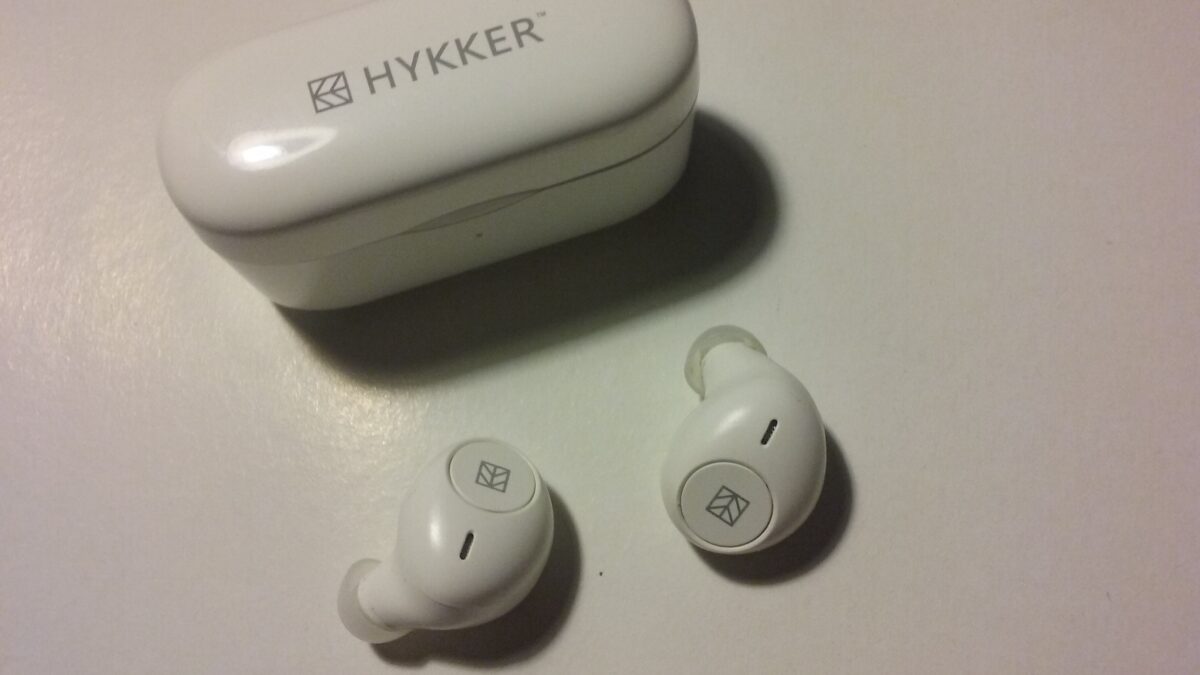
Image: wireless earbuds, via Wikimedia Commons (CC).
Why it beats ordinary Bluetooth for sharing
Normal Bluetooth audio is a private channel: your phone talks to your headphones, and that is the end of it. Want a friend to hear the same podcast? You either hand over a bud or start a fragile daisy-chain. Auracast replaces that with a broadcast model. The transmitter — a phone, a TV, a venue’s sound system, a tour guide’s microphone — simply advertises an audio stream, and any compatible earbuds or hearing aid in range can join, leave, and rejoin freely. Technically this rides on LE Audio’s isochronous (timed, synchronized) channels, which is what lets many listeners stay in lockstep instead of each negotiating a private link.
The practical upshot is the end of “pairing friction” for shared listening. There is no host device brokering connections and no ceiling on how many people can tune in.
Where you will actually meet it
The clearest deployments are public and assistive. Venues — airports, gyms, houses of worship, silent discos, conference halls — can broadcast their audio so anyone with Auracast earbuds hears the feed without renting hardware. Televisions can do the same: instead of a blasted speaker or a clumsy headphone jack, a viewer points earbuds at the set and gets the audio privately, no menu-hunting required. Assistive listening is the quietly important one: Auracast is designed to replace older induction-loop and infrared systems that help people with hearing aids follow a speaker in a noisy room, with better speech intelligibility and far less fixed infrastructure. Tour guides can speak once and have a whole group listen through their own devices. Even desktop operating systems have started exposing it — Windows 11, for example, added Bluetooth LE Audio-based audio-sharing that can send to multiple listeners at once.
Why it matters beyond convenience
Two things lift Auracast above a party trick. The first is accessibility: for the large population that uses hearing aids or assistive listening, a standardized broadcast means one venue system works with many devices, rather than a patchwork of proprietary loops. The second is power: because it sits on Bluetooth LE Audio, the transmitter and receivers sip energy compared with classic streaming, which matters for battery-starved earbuds and for always-on venue beacons.
None of this requires a carrier or a cloud. Like the rest of LE Audio, Auracast is a local radio capability, which keeps it private and resilient — the audio you broadcast stays in the room.
What to check on 2026 gear
This is the part buyers should not skip, because support is new and uneven. Auracast is not the same as “has Bluetooth.” A product can ship Bluetooth 5.x for headphones and still lack LE Audio and its broadcast profile entirely. When you are shopping in 2026, verify four things. First, does the device explicitly list Bluetooth LE Audio (not just “Bluetooth 5.2/5.3/5.4”)? LE Audio is the foundation Auracast needs. Second, does it name Auracast or “broadcast audio” by name — phone, earbuds, TV and venue gear all need it on both the transmit and receive side for a given use. Third, for assistive use, check that the hearing aid or receiver lists Auracast rather than only legacy loop compatibility. Fourth, remember the roles are separate: a TV can be a transmitter while your earbuds are the receiver, so confirm both ends of the experience you actually want.
A phone that broadcasts but earbuds that cannot receive gets you nowhere, and vice versa — Auracast only delivers when the whole chain agrees.
Bottom line
Auracast will not be a marketing banner the way “5G” or “megapixels” were; it is plumbing. But it is the plumbing that makes shared, assistive and screen-to-ear audio feel effortless instead of fiddly, and it does so with lower power and better accessibility than the systems it replaces. If you buy audio gear in 2026, treat LE Audio and Auracast support as a quiet checkbox — one that, a year from now, you will be glad you confirmed on the devices that matter to you.
Sources:
– Auracast — Wikipedia
– Bluetooth — Wikipedia
– Bluetooth Special Interest Group — Wikipedia