
First Orion, a branded communications company whose software sits in front of hundreds of millions of phone calls across carriers in the United States, Canada, the United Kingdom, and Germany, has shortened its software testing cycle by putting an AI agent in charge of QA Amazon Web Services. Instead of writing brittle test scripts, its analysts now describe what to verify in plain English and let Amazon Nova Act drive the browser.
The shift matters because First Orion’s engineering teams were outrunning their own testers. As the company moved from a single web portal to a decentralized, product-specific architecture and pushed deeper into the small-business market, the number of web apps and the device-and-browser combinations to test exploded Amazon Web Services. Traditional Selenium and Playwright scripts broke every sprint as element IDs and classes changed, and new features often shipped before tests existed for them. Release velocity stalled and regressions ate engineering time.
First Orion became a pre-release adopter of Nova Act in March 2025 after its AWS account team introduced the tool Amazon Web Services. The key difference from older frameworks is that Nova Act reasons about what it sees on screen — labels, layout, and context — rather than relying on fixed selectors. An instruction such as “log into the portal, navigate to billing, and verify the invoice total” runs autonomously, dismissing pop-ups and recovering from errors without a human in the loop.
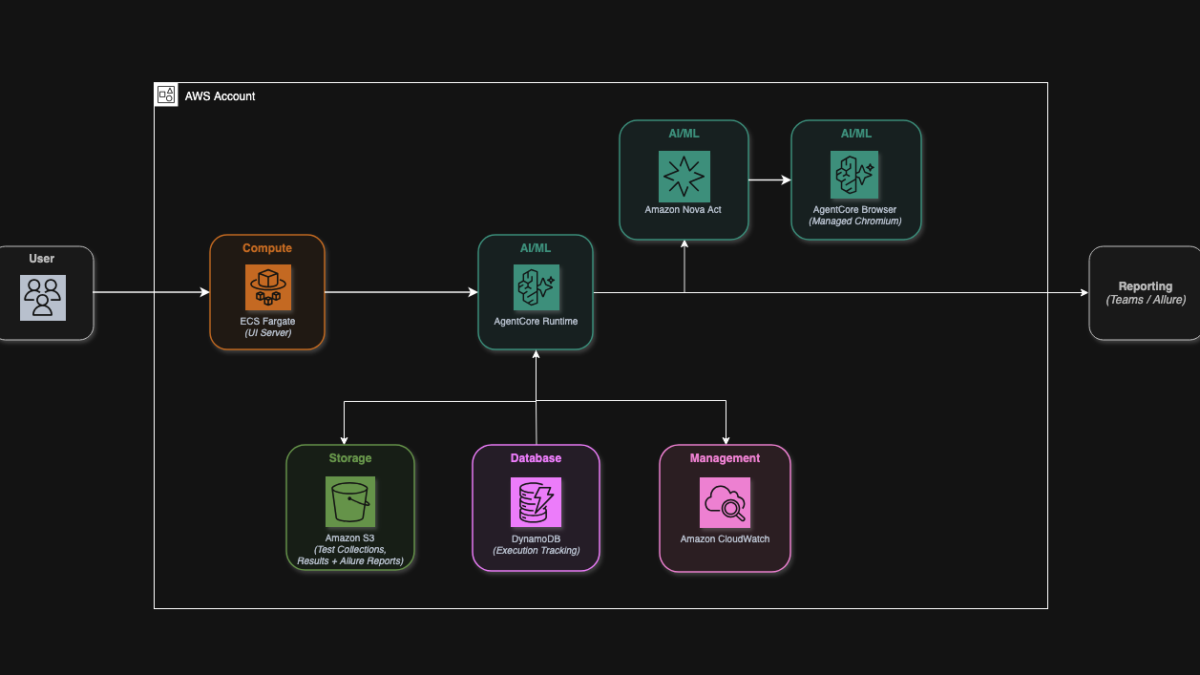
Under the hood, a React authoring interface lets QA analysts write English test cases that are stored as JSON in Amazon S3 Amazon Web Services. A Python runner on Amazon ECS with AWS Fargate hands execution to Amazon Bedrock AgentCore Browser, which provisions managed browser sessions and records them for debugging, while an Allure dashboard with a Microsoft Teams hook reports results. First Orion says the same English test case that once took an automation engineer days to script now runs within minutes.
The measurable payoff is early but concrete: First Orion reports a 20–25 percent reduction in QA cycles for the test types it has moved to the agent, and it estimates that Nova Act frees 25–30 percent of engineering time that used to support QA, while pushing test coverage up as much as 15 percent in some modules Amazon Web Services. Catching regressions against every build, instead of waiting on manual QA, is the part the company says changes how it ships.
First Orion is not a small trial customer. It signed a Boost Mobile branded-calling agreement in April 2026 and launched the service with Vodafone in the United Kingdom in May 2026, extending its carrier footprint well beyond its US base First Orion. The Nova Act work shows how that same communications vendor is now applying agentic automation to its own software delivery.
Amazon has been widening the Nova model family’s reach into enterprise pipelines beyond QA; its Nova Forge service lets teams train custom reinforcement-learning reward functions inside their own cloud environment zBrandco. For shops staring at the same selector-rot sprawl First Orion hit, the takeaway is that natural-language test authoring is moving from demo to production.