
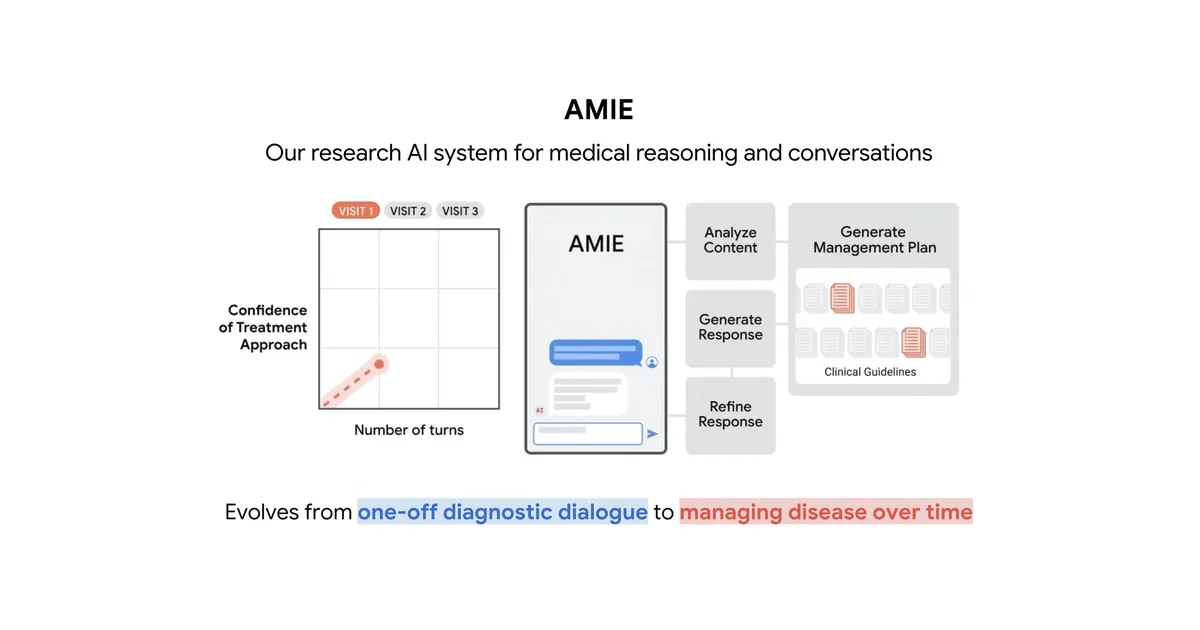
Google researchers have extended the Articulate Medical Intelligence Explorer, or AMIE, from one-off diagnostic conversations toward disease management across multiple visits. In a randomized, blinded virtual examination study, specialist physicians judged AMIE non-inferior to participating primary-care doctors on management reasoning. AMIE also received stronger ratings for the preciseness of treatment and investigation recommendations and for alignment with clinical guidelines Towards conversational artificial intelligence for disease management.
Those results are notable, but the setting matters as much as the scores. The research used simulated patients and remote text conversations, not real patients receiving routine care. It measured the quality of plans and conversations under study conditions. It did not show that AMIE improves health outcomes, reduces clinician workload, prevents harm, or is ready to make autonomous decisions in a clinic.
What the researchers tested
The study compared AMIE with 21 primary-care physicians across 100 multivisit case scenarios, with three visits in each scenario. The cases covered five medical specialties and were designed around guidance from the UK National Institute for Health and Care Excellence and BMJ Best Practice. Patient actors and specialist physicians evaluated the interactions Google Research’s AMIE disease-management overview.
AMIE combined two roles. A dialogue agent handled the real-time conversation, while a management-reasoning agent used patient history, retrieved clinical guidelines, and drug-formulary information to develop a structured plan. The system used the long-context capabilities of Gemini models to reason over the material available for the scenario.
This structure addresses a different problem from diagnosis alone. Disease management may require interpreting how symptoms change, deciding what to investigate, monitoring response to treatment, adjusting a plan, and considering medication details over time. A plausible diagnosis at the first visit is only one part of that work.
What “matched clinicians” means here
The headline result is about ratings in this virtual study. Specialists found AMIE’s management reasoning non-inferior overall. Across the visits, AMIE was frequently rated more appropriate and more precise, and its recommendations were more often aligned with or explicitly grounded in the supplied guidelines. The study also reports domains in which differences were small or not statistically significant; “matched” should not be read as “better at every task.”
Medication reasoning was tested separately with RxQA, a benchmark derived from US and UK drug formularies and validated by pharmacists. Both AMIE and physicians benefited from access to external drug information. AMIE performed better on the pharmacist-rated higher-difficulty subset, while no significant difference was found on the lower-difficulty subset. Even the strongest medication result remained below 75%, leaving meaningful room for error Nature study results and discussion.
The result therefore supports continued research into guideline-grounded management reasoning. It does not justify using a consumer chatbot to select, start, stop, or change medication.
Important evidence limits
The physicians were based in Canada and India, while much of the case guidance came from UK sources. They could access the supplied guideline corpus, but familiarity with those guidelines may differ from everyday local practice. Real care also includes physical examination, incomplete records, local formularies, staffing constraints, insurance rules, non-text signals, and consequences that a simulated examination cannot reproduce.
The authors describe confabulation as a considerable clinical risk and call for more work before real-world translation. Guideline alignment is valuable only when the retrieved guidance is current, applicable to the patient and location, and interpreted with clinical judgment. A system can produce a detailed plan that is still wrong for an individual case.
Google’s public summary uses appropriately cautious language, saying AMIE “could someday support medical care.” It also points to separate efforts exploring feasibility in clinical settings and a nationwide randomized virtual-care study Google’s AMIE research announcement. Those follow-up studies should be evaluated on their own protocols and results; their existence does not convert this simulation into deployment evidence.
How this fits into the wider health-AI landscape
The study evaluates a purpose-built research system, not the general health-answering behavior of ChatGPT or another consumer product. zbrandco’s coverage of GPT-5.5 Instant health intelligence concerns a different model, evaluation program, and use context. Its production factuality monitoring cannot be used as evidence for AMIE’s clinical performance.
Likewise, open-source tooling for medical research solves different problems. The NVIDIA GPU medical-physics simulation framework is about computational simulation, not conversational disease management. Grouping every health-related AI result into one claim would erase the boundaries that make each result interpretable.
The practical takeaway
AMIE’s Nature study shows that a guideline-grounded conversational system can produce strong management plans across linked simulated visits and can compare favorably with physicians under a blinded evaluation. The most credible interpretation is narrower than “AI can manage chronic care”: the architecture and evaluation are promising enough to justify carefully controlled real-world research.
Before any clinical authority is considered, future studies need representative patients, local guidance, privacy and security controls, prospective safety monitoring, clinician workflow integration, subgroup analysis, and measured patient outcomes. Until that evidence exists, AMIE remains a research system and qualified clinicians remain responsible for diagnosis and treatment decisions.