LendingTree deployed a production multi-agent mortgage assistant on Amazon Bedrock that combines a supervisor agent with two specialized workers to handle borrower education and personalized lender matching. The system went live in late 2025 and processed roughly 1,960 conversations and 12,100 messages through Q1 2026, averaging 6.2 messages per exchange, according to the company’s internal production analytics reported by the LendingTree engineering team.
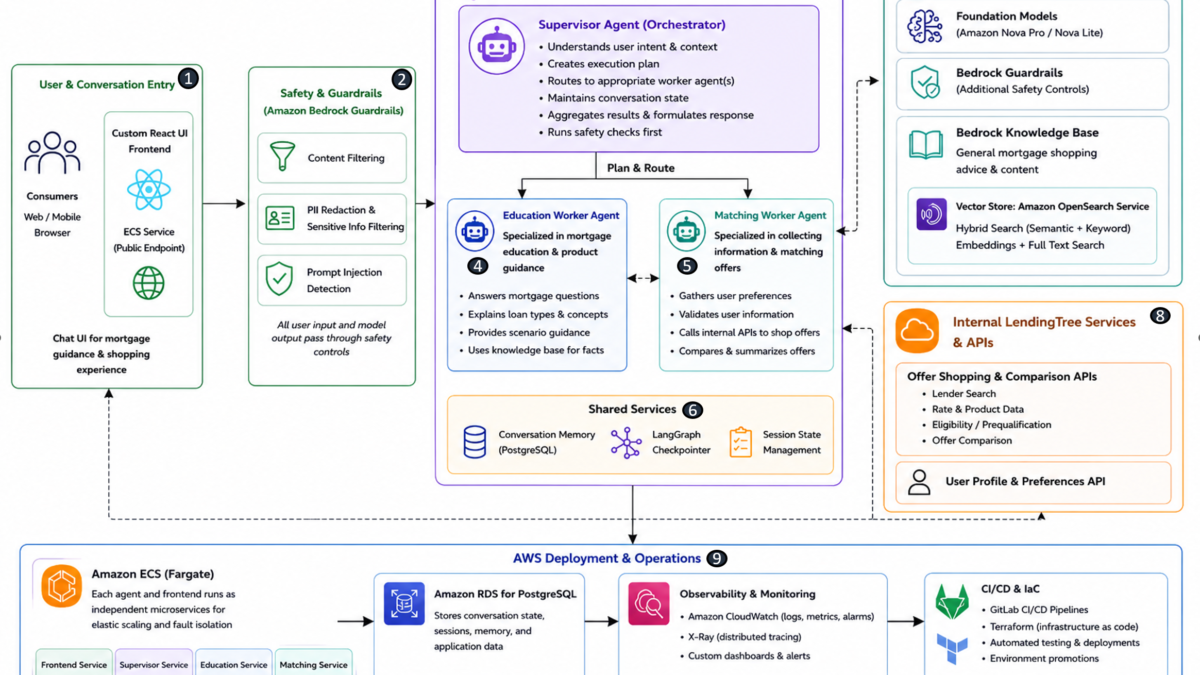
The architecture uses three independent agents coordinated through LangGraph and the Model Context Protocol. A Supervisor agent built as a state machine analyzes user intent with Amazon Nova Pro, then routes requests to either an Education worker or a Matching worker over MCP. The Education worker runs its own LangGraph workflow backed by Amazon Bedrock Knowledge Bases and Amazon OpenSearch Service to explain mortgage concepts and product differences. The Matching worker calls LendingTree’s internal offer, eligibility, and rate APIs to deliver personalized lending options.
Amazon Bedrock Guardrails screens every user input and model output for hate speech, profanity, and PII, while a separate LLM-based safety classifier enforces LendingTree’s conversational policy. The two safety checks run concurrently so compliance does not add latency. A business-logic layer handles operational rules, routing complex issues to human support and redirecting off-topic conversations.
The multi-model routing strategy assigns Amazon Nova Pro to complex reasoning and critical classification tasks, while Amazon Nova Lite handles conversational responses and lightweight classification. All agents run containerized on Amazon ECS with AWS Fargate, with conversation memory persisted through a LangGraph PostgreSQL checkpointer on Amazon RDS so users can pause and resume without losing context.
Operational metrics show the system evolving from education to transaction. Early in the rollout, 75% of conversations were educational. Over 50% of recent conversations now involve rate comparisons, lender matching, or prequalification. The assistant handled over 97% of interactions end-to-end without human escalation, and only about 3% of users explicitly requested a live agent. LendingTree credits semantic chunking for knowledge base retrieval improvements and domain-based filtering to resolve conflicts between internal and external mortgage resources.
For teams building similar regulated multi-agent systems, the case demonstrates how shared MCP contracts, standardized deployment through Terraform and GitLab CI/CD, and separate scaling per agent let organizations evolve from single-agent prototypes to coordinated multi-service workflows. The project also illustrates that agent design problems—inter-agent context passing, query rewriting, and guardrail tuning—matter more than the underlying runtime choice. Agent Skills for Automated Reasoning policies in Amazon Bedrock covers related policy enforcement patterns on the same platform.