For over a year, Alphabet’s earnings calls have carried the same undertone: analysts asking, with escalating politeness, when the company’s staggering AI infrastructure bill would start producing returns. This quarter, Google finally brought a chart that answers the question.
Google Cloud revenue jumped 82% year-over-year to $24.8 billion in Q2 2026, TechCrunch reports — a dramatic acceleration from last quarter’s already-strong 63% growth to $20 billion, and comfortably above the $22.46 billion Wall Street expected. The growth engine, per the company, is enterprise AI: businesses buying Google’s AI solutions and the infrastructure to run them.
The forward-looking number is arguably bigger news than the revenue itself. Alphabet’s cloud backlog — contracted work not yet converted into revenue — has climbed to $514 billion. That is more than half a trillion dollars of committed future cloud business, and it functions as a rough proxy for how long the current AI build-out has left to run: enterprises don’t sign obligations of that size for workloads they intend to abandon.
The quarter by the numbers
The rest of the report, detailed in Alphabet’s investor filings, was similarly emphatic. Total revenue grew 24% year-over-year to $119.8 billion, the company’s twelfth consecutive quarter of double-digit growth. Google Services — search, YouTube, subscriptions — rose 15% to $94.5 billion, a reminder that the legacy business is compounding rather than eroding while the cloud story develops. Profit landed at $112.1 billion, an enormous swing from $28.1 billion in the year-ago quarter (a figure that suggests substantial one-off gains alongside operations — investors will want to read the fine print on investment revaluations before treating it as a run rate).
Gemini, Google’s consumer AI app, reached 950 million monthly active users, up from 750 million reported in Q4 2025 — adding roughly 200 million users in about two quarters. Whatever one thinks of chatbot engagement metrics, that trajectory keeps Gemini firmly in the top tier of consumer AI products and feeds the same Google Cloud infrastructure flywheel the enterprise numbers reflect.
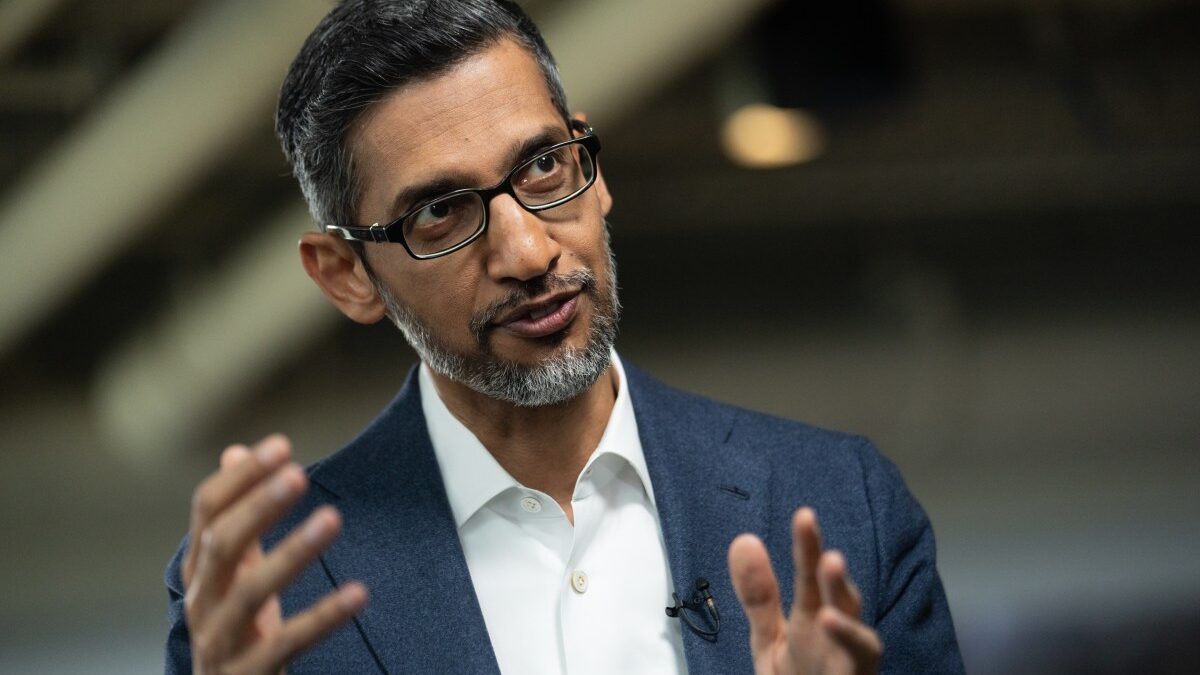
“Our AI investments are redefining what’s possible across every part of our business,” CEO Sundar Pichai said on Wednesday’s call. “We have exciting momentum across the board.”
The capex question hasn’t gone away
None of this makes the spending small. Alphabet’s capital expenditures — data centers, chips, power, networking — are estimated at $180 billion to $190 billion for the year, a figure that would have been unthinkable for any single company three years ago. Analysts pressed Pichai on when those investments pay off, and his answer was notably specific: “I think our compute capacity investments in ’27,” he said, pointing to strong demand indicators including long-term deals. “If anything, the dynamics look healthier than where we were about a year ago, so that’s what gives us the confidence to undertake those investments.”
That framing matters for the whole sector. Alphabet is effectively arguing that AI capex should be judged like utility construction: you spend years ahead of demand you can already see contracted. The $514 billion backlog is the evidence exhibit — it converts the “is AI a bubble?” debate into a more boring, more answerable question about execution and data-center delivery timelines.
Why this lands beyond Mountain View
The competitive read-through is straightforward. An 82% cloud growth rate at Google’s scale puts real pressure on AWS and Microsoft Azure ahead of their own reports, because it suggests enterprise AI workloads are still land-grab territory rather than a settled market. For enterprise buyers, the takeaway cuts the other way: capacity remains tight enough that hyperscalers are signing multi-year commitments at record volume, which is worth remembering the next time a procurement negotiation stalls on GPU availability.
For the AI industry at large, this is the quarter the “show me the revenue” argument got its clearest rebuttal so far — not from model benchmarks or user counts, but from audited cloud income driven by businesses paying to run AI in production. The spending race isn’t slowing; Alphabet just told the market it plans to be paid back starting in 2027, and produced half a trillion dollars in signed contracts as collateral for the claim.
The stakes for next quarter are correspondingly higher. When you guide the street to a 2027 payoff with $190 billion of annual capex on the line, an 82% growth rate stops being a triumph and becomes the new baseline to defend.