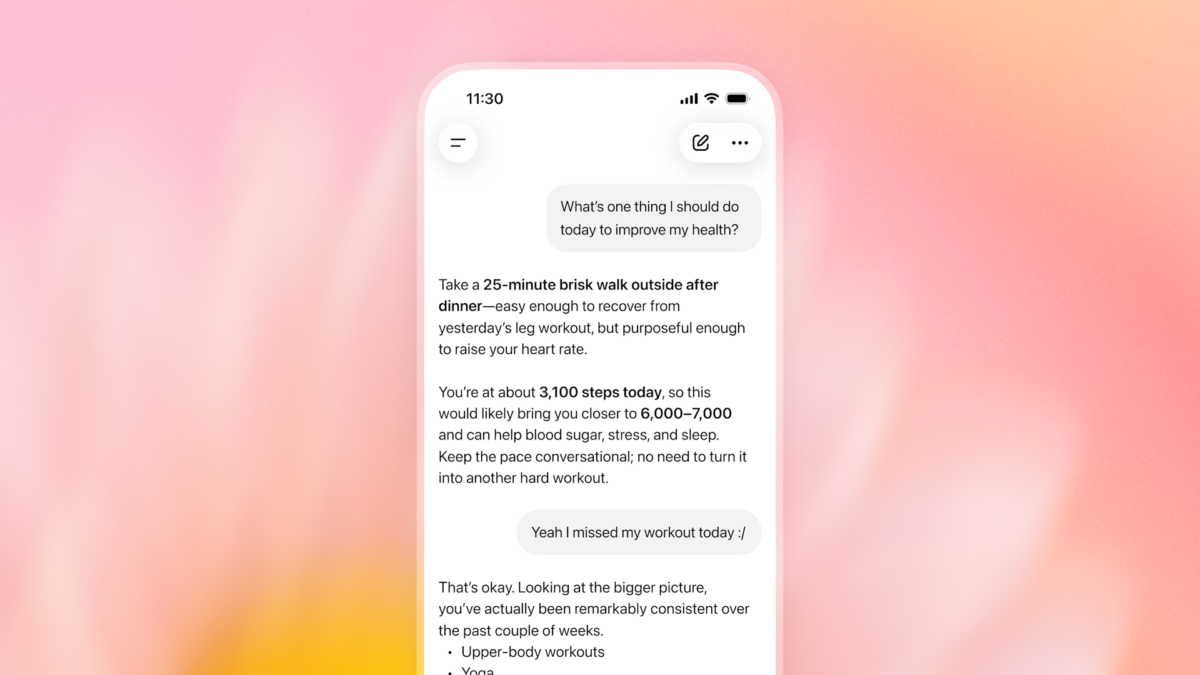
OpenAI has started switching on one of the most consequential — and most sensitive — features ChatGPT has ever shipped. Health in ChatGPT began rolling out on July 23 to logged-in U.S. users aged 18 and over, on web and iOS, across the Free, Go, Plus, and Pro plans. The pitch: connect Apple Health and supported medical records, and ChatGPT stops answering health questions in a vacuum and starts answering them against your actual labs, medications, visits, sleep, and activity data.
The scale of the bet is spelled out in OpenAI’s own numbers. The company says more than 300 million people ask ChatGPT health-related questions every week — decoding lab results, prepping for appointments, translating what a doctor said. What those conversations have always lacked is context, because the relevant records sit scattered across patient portals, wearables, and hospital apps. Health is OpenAI’s answer to that fragmentation: with permission, ChatGPT can compare a new result against prior tests, summarize what changed since the last appointment, or connect sleep and workout patterns to the goals a user describes.
The dedicated health tab flopped — so OpenAI dissolved it
The more interesting story is what OpenAI learned from the first version. Earlier this year the company gave a limited group of users a dedicated health experience — a separate space inside ChatGPT built specifically for medical conversations. Usage data killed that design: among people with access, more than 70% of health-related conversations happened outside the dedicated area. People asked about food allergies while planning dinner, or about a knee injury while organizing a weekend hike. Walling health off in its own tab just added a step nobody wanted.
So the launched version inverts the design. Health remains a home base in the sidebar for connecting accounts, browsing synced records, and reviewing trends — but the connected data now follows the user across ordinary conversations. Ask for restaurant suggestions and ChatGPT can quietly account for a dietary restriction; plan family activities and it can factor in a recent injury. Users can also force the issue by typing @Health in any message to explicitly pull health context into a reply.
That cross-conversation reach is exactly what makes the permission model matter. By default, ChatGPT asks before it uses connected medical records or Apple Health data to personalize a response, and users can approve per-request or grant always-on access under Settings > Plugins > Health.
What connects, and what happens to the data
At launch, users can link Apple Health, medical records from supported U.S. hospital systems, One Medical, and Function Health — TechCrunch notes fitness services like MyFitnessPal flow in via Apple Health sharing as well. Anything a wearable or nutrition app publishes to Apple Health becomes available once sharing is on, though proprietary scores may not transfer.
OpenAI is leaning hard on privacy commitments to make the sale. Connected health information — and the conversations that use it — are excluded from foundation-model training and ad targeting regardless of a user’s normal data-control settings. Health data gets additional encryption on top of ChatGPT’s standard at-rest and in-transit protection. Disconnecting an account deletes its synced data from OpenAI’s systems within 30 days. And memories, ChatGPT’s cross-session personalization layer, are never created directly from connected records — only from the conversations themselves, which users can suppress with Temporary Chat.
There’s a notable guardrail for agentic scenarios too: before ChatGPT takes an action in another connected plugin that could disclose health information — say, sending a training plan built on Apple Health data to a running partner — additional checks confirm the sharing matches what the user actually asked for. OpenAI says it red-teams these flows specifically. One deliberate omission: Health is not available in Codex.
The model story underneath
The launch rides on OpenAI’s recent model work. GPT-5.5 Instant brought what OpenAI calls frontier-level health reasoning to free users, with gains in flagging when urgent care is needed and explaining uncertainty. Paid users get GPT-5.6 Sol, which OpenAI describes as its strongest health model yet; the company says every GPT-5.6 model outperformed GPT-5.5 on HealthBench Professional, an evaluation built with hundreds of physicians using rubrics that grade accuracy, safety, escalation judgment, and communication.
The physician framing is doing double duty: it is both a quality claim and a liability shield. OpenAI repeats throughout the announcement that ChatGPT “supports, not replaces” professional care, can still make mistakes, and that users should verify important details against original sources — a synced medication list, for instance, may still show a drug the patient stopped taking.
The rollout lands in a market where consumer health data has historically moved through closed ecosystems — Apple’s Health app, MyChart portals, insurer dashboards. A chat interface that aggregates across all of them, on the free tier, is a genuinely new distribution model for personal health information. Whether 300 million weekly health questions convert into connected accounts will depend less on the model quality than on whether users trust the privacy story. OpenAI has now put that story in writing; the U.S. rollout is the test.