
Most open-world RPGs measure your progress in checkmarks. Clear the marker, collect the reward, move to the next glowing dot. The Blood of Dawnwalker, the debut game from Rebel Wolves — the studio founded by veterans of The Witcher 3 — measures it in something scarcer: daylight. In a PlayStation Blog breakdown published on July 7, 2026, the studio detailed a quest structure built around a clock that refuses to move until you make it.
The setup is deliberately claustrophobic. You play Coen, a young man in the tiny village of Laslea, in a plague-stricken corner of a 14th-century-inspired dark fantasy world ruled by vampires called the vrakhiri. On the day the game opens, your mother is too sick to attend the Blood Mass, the fortnightly ritual where every adult must give blood to the region’s overlord, Knyaz Brencis. The village gates are sealed. You have one day to find a way out of the problem.
The clock only ticks when you commit
Here is the mechanic that makes it interesting. Between dawn and sunset, the day is divided into eight parts, and those parts are the real currency of the game. But time does not drain automatically. As Rebel Wolves puts it, as long as you are “wandering, watching, listening, never intervening, the sun will stay high in the sky.” You can talk to a grieving old woman by an unearthed grave, practice swordplay on animals in the woods, read Latin with the local herbalist, or go hunting for an escaped pig for as long as you like. The Blood Mass will not arrive. To move time forward, you have to choose — to actually intervene in something that matters.
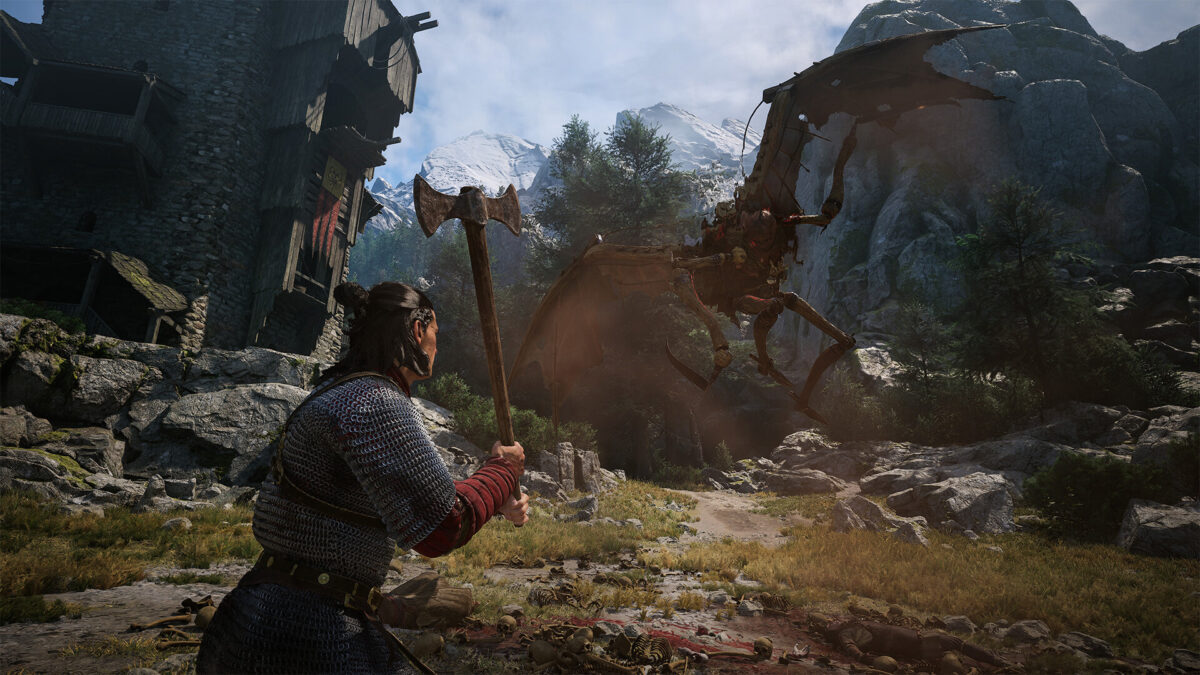
That inverts the usual pressure of a time-limited quest. Games with day/night timers, from Majora’s Mask to Pathologic, typically punish you for lingering; the meter runs whether you engage or not. Dawnwalker instead makes exploration free and commitment expensive. The moment you decide to help the weaver recover a stolen tapestry, or throw a punch at one of the giant ram-like Uriash enforcing Brencis’s rule, or begin quietly assembling a revolt, the day burns forward. You can pursue almost anything in Laslea — but the blunt warning in the studio’s own words is that “you may not be able to do it all.”

Screenshot: Rebel Wolves / Bandai Namco (via Steam)
Authored beats inside the sandbox
A pure sandbox risks feeling weightless, so Rebel Wolves anchors it with events that are explicitly outside your control. There is, the studio says, “no combination of actions and words at Coen’s disposal that can stop the Blood Mass once the sun sets.” Some tides cannot be resisted — grief, fear, revenge run their course regardless of how carefully you played the preceding hours. The opening day ends badly no matter what, Coen is turned into a vampire scion by Brencis, and his surviving family is marked for sacrifice at the overlord’s coronation in 30 days.
That fixed spine matters as much as the flexible time economy around it. It signals that Dawnwalker is not promising you can optimize your way out of every consequence; it is promising that the choices genuinely available to you carry weight because the ones that aren’t are honestly walled off. This is the “narrative sandbox” framing Rebel Wolves keeps returning to — freedom inside authored boundaries, rather than the illusion of infinite agency.
Why the day/night twist fits the fantasy
The transformation is also the game’s headline hook: Coen becomes a Dawnwalker, a being who keeps a human’s daytime freedom — the sun no longer burns him — alongside a vampire’s nocturnal power. Per the game’s Steam listing, that human-by-day, monster-by-night duality is the core of an open-world action RPG where the story bends to your actions. Marrying that identity to a quest system where daytime is a resource you spend deliberately is a tidy piece of design: the fiction and the mechanics are describing the same thing.
The Blood of Dawnwalker is developed by Rebel Wolves and published by Bandai Namco Entertainment, with a listed release date of September 2, 2026. Whether the eight-part day holds up across an entire campaign is the open question — sustaining “time only moves when you decide it should” for dozens of hours is far harder than nailing it in a reveal. But as a statement of intent, it is a refreshing argument that an RPG’s most interesting resource might not be gold or XP. It might just be the hours you have left before dark.