Health plans still govern prior authorization through static PDFs and Word documents. That manual process affects hundreds of millions of patients annually, and the rules trapped in those documents resist automation. AWS source
Cohere Health, a clinical intelligence company, addressed this by building Cohere Policy Studio on Amazon Bedrock AgentCore. The system digitizes prior authorization policies into structured, machine-readable data using standard terminologies, replacing the PDF-driven workflow that creates version sprawl and disconnected review cycles. Cohere Health Policy Studio
Regulatory pressure makes the transition urgent. Under Centers for Medicare & Medicaid Services (CMS) regulations, health plans must support API-based electronic prior authorization by January 2027. Separately, America’s Health Insurance Plans (AHIP) commitments require health plans to achieve 80 percent real-time approvals for electronic prior authorization submissions. AWS source
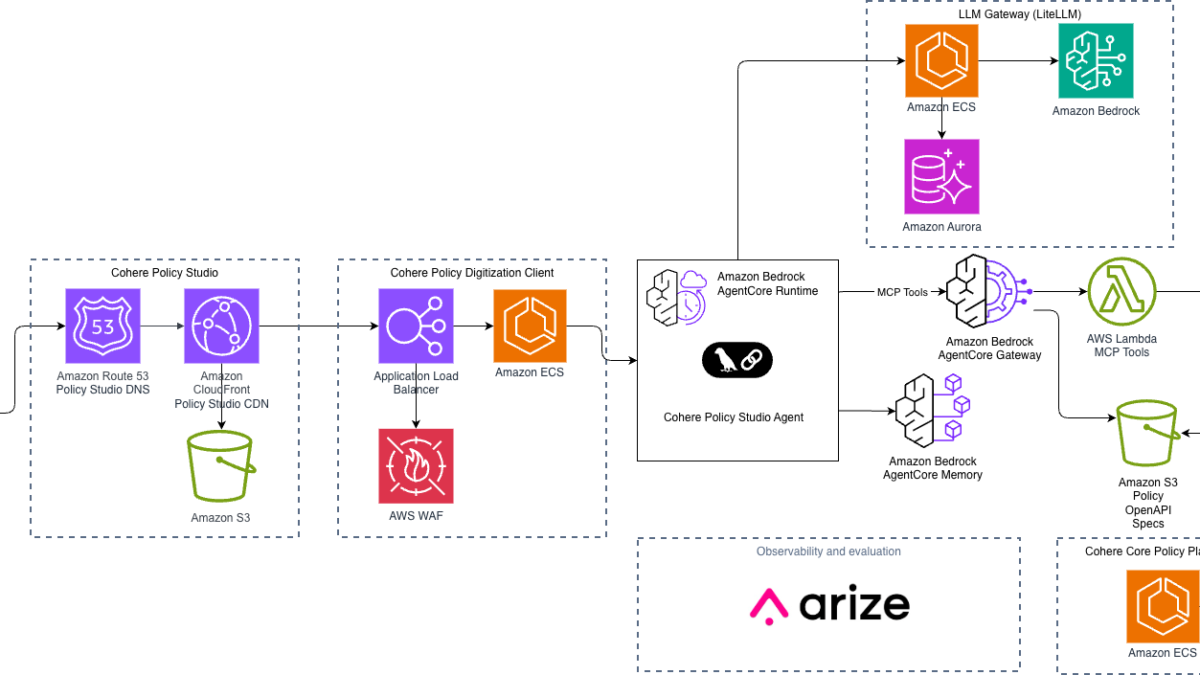
To meet these requirements, Cohere Health deployed a multi-tenant agentic architecture using AgentCore Runtime, AgentCore Gateway, and AgentCore Memory. The architecture runs on the Agent Skills open standard and uses LangChain. AgentCore Runtime provides secure MicroVM isolation with dedicated compute, memory, and filesystem resources per session. AgentCore Gateway consolidates multiple tool types—AWS Lambda functions, internal APIs—behind a single authenticated endpoint so teams add new tools without redeploying the agent. AWS Bedrock AgentCore Runtime
The digitization efficiency gains are measurable. Overall time spent on policy digitization dropped by 30 percent, from 2 hours 15 minutes to 1 hour 35 minutes per policy. AWS source The system has digitized thousands of policies to date using manual and semi-automated workflows. The agent-based framework targets further time reduction as it scales across the existing policy library. AWS source
Deployment velocity improved as well. Full agent deployments in the product decreased from 3–4 months to 2–6 weeks. The team achieved this through reusable Amazon ECR base images and a modular skills framework that lets teams ship new capabilities without rebuilding the agent runtime. AWS source
Clinical policy analysts work alongside machine learning engineers in a governed, human-in-the-loop process. Skills move through semantic versioning in git and Amazon S3 object versioning for deployment history, with evaluation suites testing accuracy, completeness, and consistency before production approval. AWS source
The same AgentCore patterns apply beyond healthcare. For teams exploring multi-tenant agentic systems, Amazon Bedrock AgentCore now includes temporal policies and rate limits to control agent behavior and cost. Control agent behaviors and cost
Cohere Health’s implementation shows how agentic architecture can compress operational timelines while preserving version control and human oversight. Health plans facing CMS and AHIP deadlines now have a reference architecture for turning static policy documents into structured, actionable assets.
Editorial note: Citation cleanup: we trimmed duplicate citation links that repeated the same source after multiple paragraphs. Every fact and quote is unchanged; the source remains cited where each claim appears.