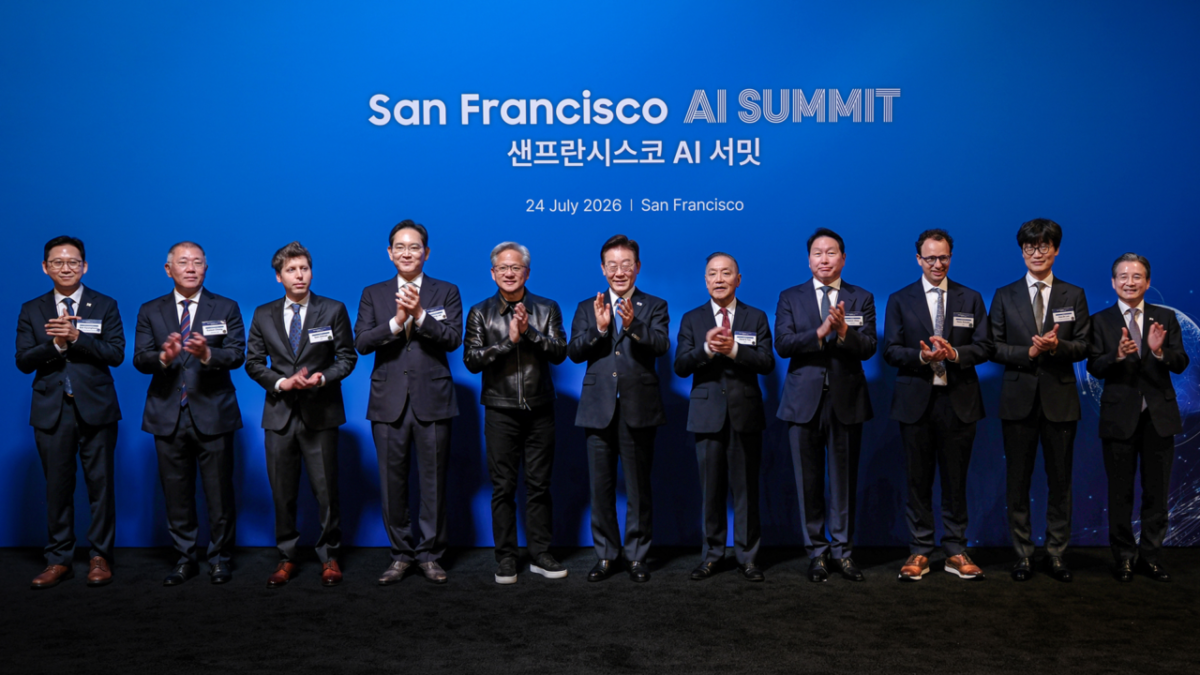
South Korean President Jae Myung Lee flew to San Francisco this week with the chairmen of Samsung, SK, Hyundai and NAVER in tow — and left having committed the country to one of the largest coordinated AI infrastructure programs any nation has announced. The occasion was an AI Summit where, per NVIDIA’s running summit coverage, Korea’s government, its industrial giants and its top universities stacked announcement on announcement across compute, chips, robots and research.
The headline number is hard to ignore: SK Group and NVIDIA announced plans for a comprehensive partnership NVIDIA describes as “$500-billion-plus” to build AI infrastructure for surging global compute demand. It broadens plans the two companies first sketched in June, and it puts SK hynix’s HBM4 memory underneath NVIDIA’s Vera Rubin platform — a pairing Jensen Huang framed as historically loaded. “If not for the invention of HBM memory in Korea,” he told the summit audience, “NVIDIA wouldn’t have been able to invent the supercomputers that power AI today.”
NAVER’s AI factory triples before it’s even finished
The most concrete buildout news came from NAVER. Together with Brookfield and NVIDIA, the Korean internet company will expand its NVIDIA DSX AI factory at the GAK Sejong data center to 200 megawatts — roughly 100,000 GPUs on the Vera Rubin platform. That is more than triple the initial buildout NAVER announced in June, a revision that says as much about demand signals as any earnings call.
Hyundai Motor Group used the summit to lay out a physical AI strategy: a robot reference platform developed with NVIDIA, an extension of a compute buildout that now counts 50,000 NVIDIA Blackwell GPUs, and integration of the NVIDIA DRIVE Hyperion autonomous-vehicle stack — DRIVE AGX in-vehicle computing running the safety-certified DriveOS operating system — into Hyundai’s own vehicle platforms.
The university track may matter most long-term
Compute deals grab headlines, but the research commitments are the structural story. NVIDIA and KAIST announced a joint AI research lab at the KAIST Kim Jaechul Graduate School of AI in Seoul, dedicated to agentic AI and built specifically for the Korean language and local industry. NVIDIA says it is the first joint AI lab between a Korean university and any global technology company, and it comes with a multiyear commitment to fund and train Korean researchers using NVIDIA’s Nemotron open models and NVIDIA AI Cloud partner computing.
Two more academic centers are planned on top of that: an NVIDIA AI Technology Center with KAIST’s Department of Mechanical Engineering focused on physical AI, and another NVAITC with Seoul National University spanning foundation models, accelerated computing, physical AI and AI for science — with work tapping both Nemotron and NVIDIA’s Cosmos world foundation models.
A declaration, a fried-chicken joke, and a 25-year arc
The summit’s set piece was a panel at the Midway in San Francisco’s Dogpatch, moderated by Stanford’s Soh Kim, that put President Lee on stage alongside Huang, OpenAI’s Sam Altman, Broadcom’s Hock Tan and Anthropic’s Dario Amodei — plus Samsung Electronics Chairman Jay Y. Lee, SK Group Chairman Chey Tae-won, Hyundai Executive Chair Euisun Chung and NAVER founder Hae-jin Lee. President Lee opened with what he called his “San Francisco AI Declaration,” drawing a line from the city’s rebirth after the 1906 earthquake to Korea’s postwar rise, and pitched a multitrillion-dollar national push into AI semiconductors, hyperscale data centers and physical AI, comparing AI’s emergence to “humanity discovering fire anew.”
The personal beats were warmer. Meeting Huang at the Fairmont ahead of the summit, Lee joked that he had seen reports of Huang eating beer and fried chicken in Seoul — and that he had hoped to join. Huang, whose company has worked with Korean partners for over 25 years — a relationship that deepened during his Seoul visit in June — called the moment “truly the beginning of a golden age for Korea.” Lee’s reply: “I hope this is only the beginning.”
What to watch
Korea’s bet is unusually full-stack: memory (SK hynix HBM4), compute (Vera Rubin factories at NAVER and SK), applications (Hyundai’s robots and vehicles) and talent (KAIST and SNU labs) are all moving in the same announcement cycle. The open questions are execution-shaped — how fast 200MW at GAK Sejong actually energizes, what the $500 billion figure translates to in signed deployments, and whether the agentic-AI lab produces Korean-language models the local industry adopts. But as national AI strategies go, few countries have put this many named institutions and this much silicon behind one week of announcements.