
Microsoft Research has built CARE-X, a chest X-ray vision-language model that pairs narrative report writing with calibrated diagnostic scores and, in a sibling experiment, hands exact measurements to external calculation tools. The result is a research system that treats radiology as both a language task and a quantitative one — and its validation on real Indian hospital data shows where the measurement approach pays off.
Microsoft Research describes the architecture as a SigLIP2-so400M vision encoder linked to a Phi-4-mini-instruct 3.8B language model through a lightweight adapter, with extra auxiliary heads for classification and visual grounding (Microsoft Research blog). One forward pass yields both an autoregressive answer and a structured prediction with a confidence score, so a clinician can shift between high-sensitivity screening and high-specificity confirmation without rerunning the model.
Microsoft Research reports that on the ReXVQA benchmark of 41,007 question-answer pairs, CARE-X reaches 94% overall accuracy, six points above the next-best public model, and sits first on the ReXrank RexVQA leaderboard as of August 2026 (Microsoft Research blog). The same work reports that the auxiliary grounding head lifts anatomical localization on Chest ImaGenome by +28.2 percentage points mAP and +6.2 mIoU over generative decoding alone.
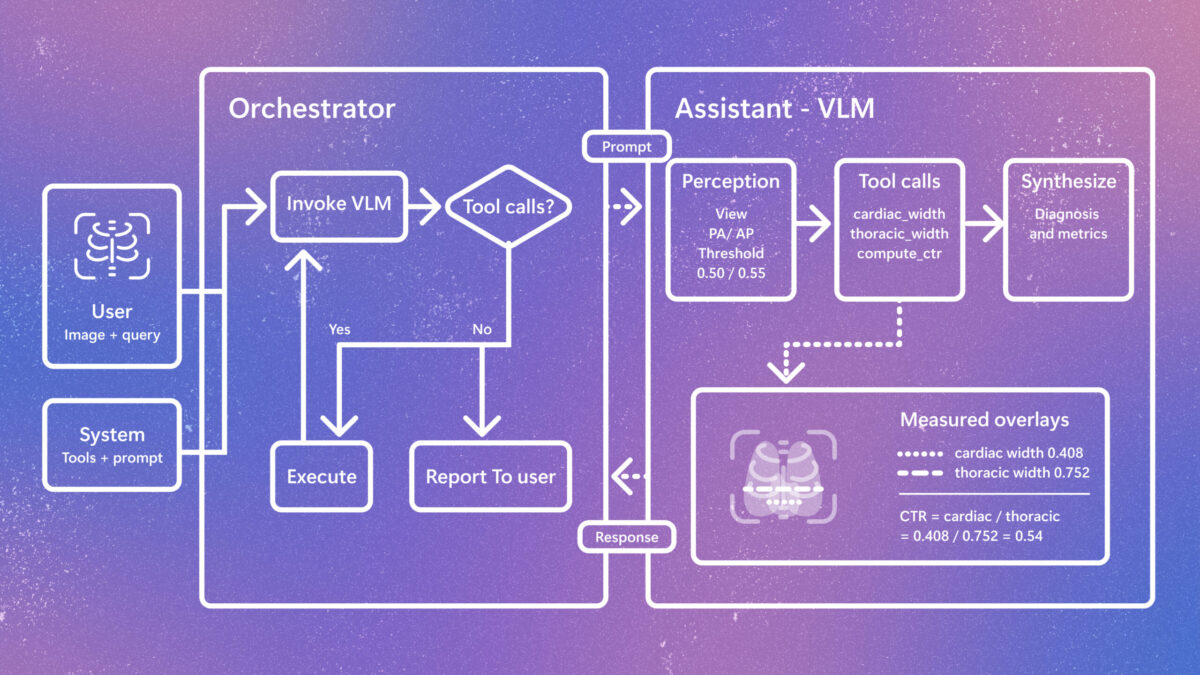
In a separate measurement study, Microsoft Research paired Qwen3-VL-4B-Instruct with deterministic tools, letting the model alternate between viewing the image and computing quantities such as the cardiothoracic ratio (Microsoft Research blog). Microsoft Research reports that across 122 CT-confirmed enlargement cases, the tool-augmented variant hit 94.26% recall, a +10.65-point gain over the best perception-only baseline. For mild aortic dilation — rarely quantified on chest X-rays — the measurement-driven method caught 40 of 43 CT-confirmed cases (93% sensitivity) where initial radiology reads found only 5 of 43.
Microsoft Research tested CARE-X on 1,047 de-identified chest radiographs from Narayana Health covering five rare ICU conditions with 2.6% to 5.2% prevalence, under institutional ethics approval (Microsoft Research blog). The work is led from Microsoft Research India by Mercy Ranjit, a Principal Research ML Engineer specializing in multimodal radiology AI (Mercy Ranjit profile).
The authors are blunt about limits: these are recall numbers, not a full accuracy picture, and a study with CT-confirmed negative cases is underway. CARE-X itself is a research model, not a cleared medical device, and the measurement gains come from an experiment that needed no task-specific training. Microsoft circulates findings like this through its Research Newsletter. For broader Microsoft platform news, see Microsoft Edge Begins MV2 Extension Sunset in August 2026.
Editorial note: Citation cleanup: we trimmed duplicate citation links that repeated the same source after multiple paragraphs. Every fact and quote is unchanged; the source remains cited where each claim appears.