Published August 8, 2026.
Microsoft Research has released Orchard, an open-source framework designed to make agentic AI research more scalable and reproducible. The project centers on Orchard Env, a Kubernetes-native environment service that provides reusable, isolated components for running and building agents at scale — from collecting training data to reinforcement learning rollouts and evaluation.
The core problem Orchard addresses is infrastructure fragmentation. Building state-of-the-art agentic systems typically requires proprietary sandboxes, closed training pipelines, and proprietary datasets. Most researchers cannot access or reproduce these setups. Orchard replaces that bespoke infrastructure with a single, portable substrate. The same service supports software-engineering agents, web-browsing agents, and personal-assistant agents across domains without modification.
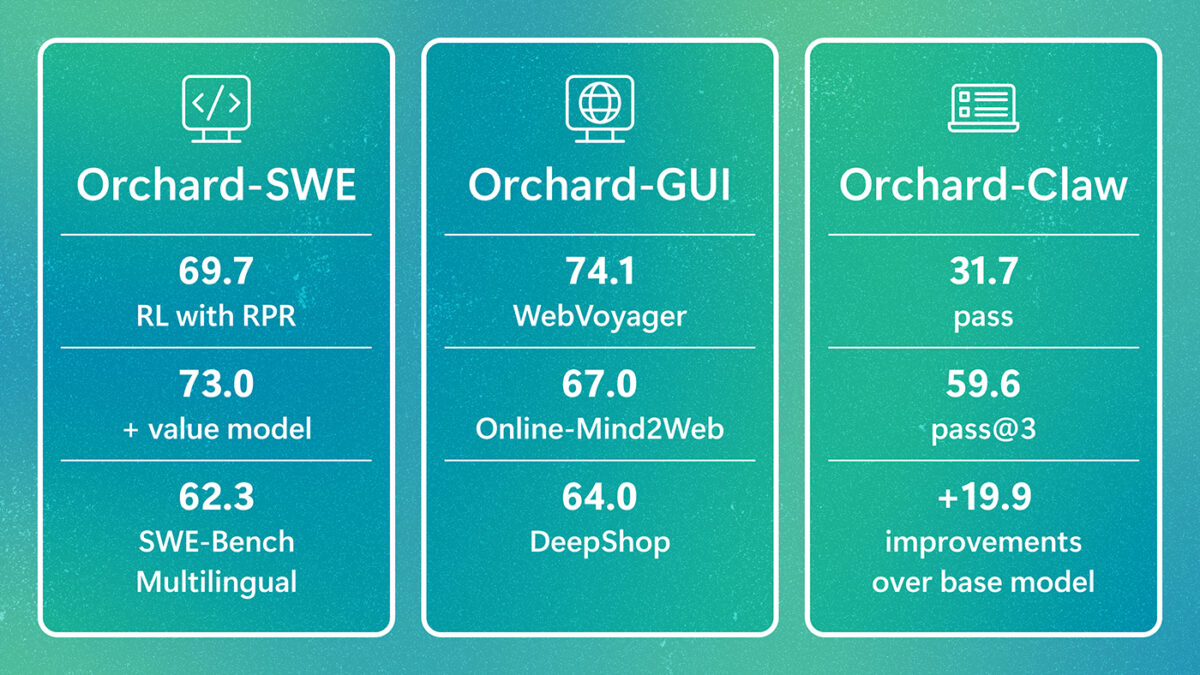
To demonstrate the approach, Microsoft Research released three domain-specific training recipes, as detailed in the Orchard announcement. Orchard-SWE trains a model to autonomously solve software-engineering tasks, reaching 69.7% on SWE-bench Verified — 73.0% with value-model reranking — using roughly 3 billion active parameters. That result approaches frontier systems with more than ten times larger models.
Orchard-GUI trains a 4-billion-parameter vision-language model as a browser agent. Despite limited supervision — 400 distilled demonstrations and 2,200 open-ended training tasks — it achieves 74.1% on WebVoyager, 67.0% on Online-Mind2Web, and 64.0% on DeepShop, for an average of 68.4%. These results place it among the strongest open-source web agents to date.
Orchard-Claw focuses on personal-assistant workflows, training on just 200 synthetic tasks, as documented in the Orchard announcement. On Claw-Eval, it completes 59.6% of tasks with up to three attempts, rising to 73.9% when paired with the ZeroClaw agent system. Training inside real deployment harnesses such as Codex and OpenClaw — rather than simplified reimplementations — substantially improves reliability. Under the Codex harness, success rate rises from 18.6% for the untrained model to 51.5% after Orchard training.
Microsoft Research is also releasing the training data and evaluation methods. The microsoft/Orchard dataset on Hugging Face bundles 107,185 multi-turn software-engineering trajectories and 3,070 web-browsing GUI rollouts, both produced inside the same Orchard Env sandbox infrastructure.
The release arrives as the AI industry debates how to make agentic systems practical outside well-funded labs. Orchard’s bet is that the environment layer matters as much as the model itself. By making that layer open and reusable, the project lowers the cost of entry for teams that want to study, train, and evaluate agents without rebuilding infrastructure from scratch.
For teams following open AI infrastructure, this release complements other collaborative efforts such as the NVIDIA, Microsoft and IBM Open Secure AI Alliance, which addresses adjacent trust and interoperability questions for open AI stacks.
Last verified August 8, 2026 against the Microsoft Research blog announcement, GitHub repository, and Hugging Face dataset page.