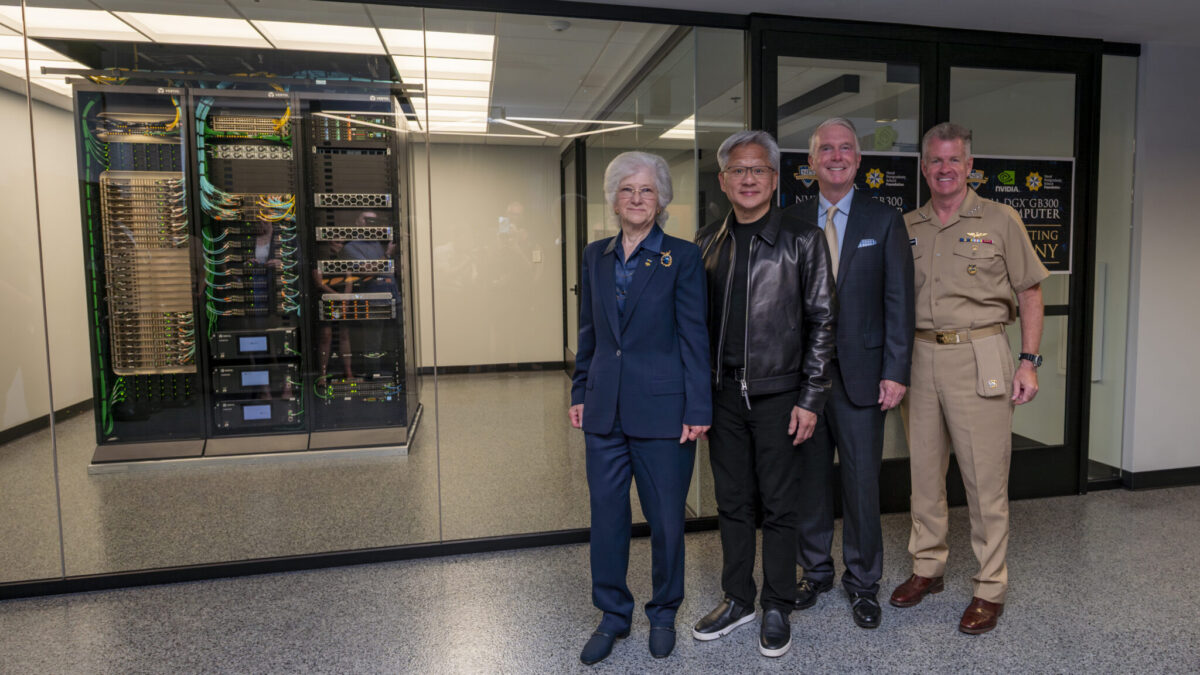
The U.S. military’s flagship graduate university now has one of the most powerful AI systems money can buy sitting on its own campus. NVIDIA CEO Jensen Huang traveled to Monterey, California, to personally commission a DGX GB300 system at the Naval Postgraduate School, bringing large-scale model training and inference fully on premises for the school’s roughly 1,500 in-resident students and 600 faculty. The commissioning, announced on July 22, 2026, took place during Converge @ NPS, the school’s three-day technology event.
The system runs NVIDIA’s Mission Control software for cluster operations and anchors an NVIDIA AI Technology Center on the Monterey campus — a dedicated hub for AI research and graduate instruction that the two organizations have been building toward through an ongoing collaboration. The named target workloads are notably unglamorous and practical: weather prediction, cybersecurity, and disaster resilience and response planning.
A frontier-class box on a graduate campus
The GB300 placement is unusual in the academic world. Most universities that touch this class of hardware do it through cloud allocations or national lab partnerships, with queue times and data-handling constraints attached. NPS educates active-duty officers and international partners across disciplines from space operations to ocean science, and much of what its students work on is exactly the kind of material a defense institution prefers to keep on its own floor. On-prem capacity means faculty can train foundation models in house and run high-fidelity simulations at scale without shipping sensitive data off campus.
Huang framed the machine in operational terms rather than research ones. “Nothing is more valuable to you than information and insight, and information and insight in a timely way, and to understand its impact and consequence,” he told attendees, addressing the officers in the room directly.
Admiral Samuel Paparo, commander of the U.S. Pacific Command, made the institutional logic explicit: “As we modernize our technology, we must also modernize how we educate our leaders. Access to advanced computing capability means NPS students and faculty understand the opportunities and responsibilities that come with these technologies.” Paparo also told students they will command in AI-enabled environments where information moves at speeds that compress response times — the clearest statement yet of why the Navy wants officers trained on the same class of hardware the frontier labs use.
The curriculum is the other half of the deal
The hardware headline obscures the arguably bigger commitment: NVIDIA is threading AI through the school’s teaching, not just its compute budget. The company has expanded the collaboration through its Deep Learning Institute, putting instructor toolkits in the hands of NPS faculty so AI coursework runs through graduate curricula across departments rather than living in a single computer science elective.
Huang’s advice to non-specialist officers was characteristically direct — engage the technology rather than defer to experts. “It’s not as hard as you think it is,” he said, “and the reason for that is because, on first principles, technology is supposed to get smarter and smarter over time.” For a student body of mid-career officers awarding graduate degrees around applied research, that pitch matters: the school’s programs center on problems with direct operational relevance, and the DGX GB300 gives those programs the technical depth to build AI tools with immediate applicability instead of writing about ones built elsewhere.
The commissioning also lands in a broader pattern of NVIDIA planting flagship systems inside U.S. government institutions rather than waiting for procurement cycles to catch up. A DGX GB300 with Mission Control is the same stack NVIDIA sells to enterprises standing up AI factories; putting one at the Navy’s premier technical graduate school seeds a generation of officers who will spec, buy, and command around NVIDIA’s platform. That is a long game, and it is being played in plain sight — one campus commissioning at a time.