

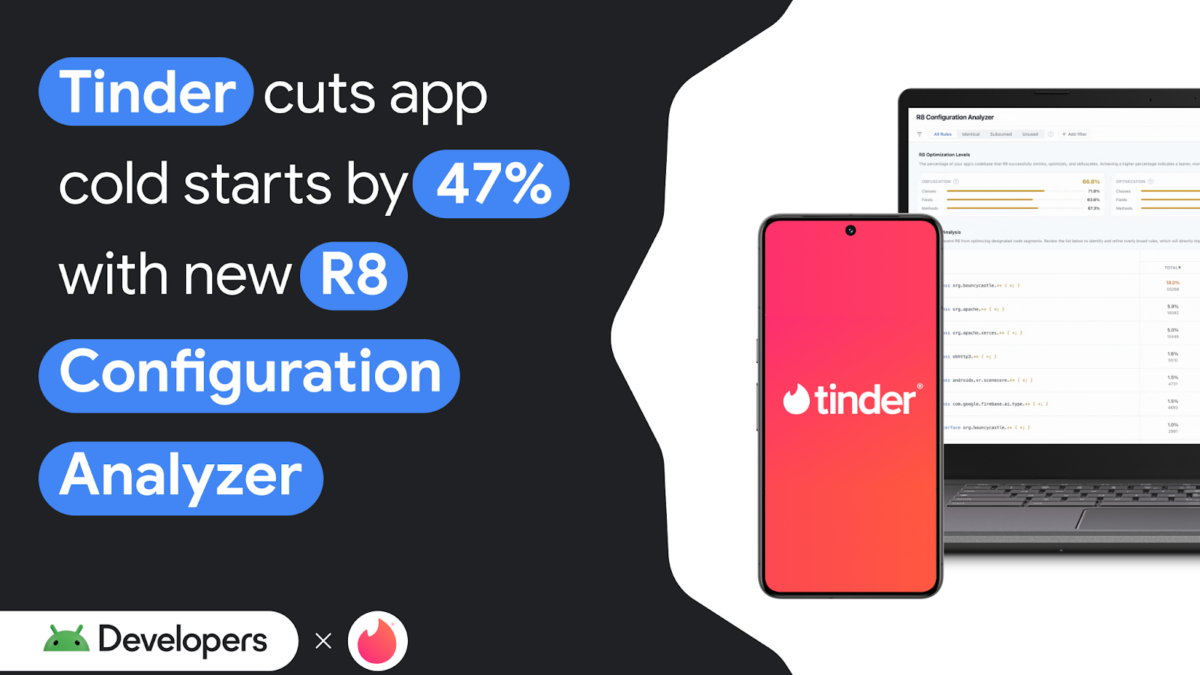
- 18 August 2026 → Android Developers Blog — Google published the Tinder R8 optimization breakdown on this date
- September 30 → zBrandco — Android developer verification rule takes effect on this date (contextual internal link)
Tinder’s Android app once shipped 17 separate DEX files, three of them loaded just to start the program. On a cheap phone in a low-RAM market, that weight surfaced as slow cold starts and the occasional frozen screen before the app came alive.
Google published the breakdown on 18 August 2026 Android Developers Blog. Before the fix, roughly 70% of the app’s code went unoptimized, and perceived “application not responding” errors sat at 0.35% of sessions.  See the Android Developers Blog post. Tinder’s Android team had already switched on R8, Google’s code shrinker, yet much of its potential stayed locked behind keep rules nobody could fully see.
A safety net that became a tax
The analyzer landed on a single line buried in Tinder’s own in-house library: -keep public class * { public protected *; }. The rule was broad by design. It preserved nearly every public class and member across the app so that features using reflection would not crash at runtime. That protection worked — which is exactly why it became a problem. Engineers stopped writing precise replacement rules for new code, and the over-broad guard quietly compounded into a tax on every launch.
Stripping it open was not free. The same rule had been masking reflection calls that would otherwise break, so untangling it meant re-learning which classes truly needed protection. Tinder’s Android team treated the change as surgery, not a tidy cleanup.
Faster, smaller, but not finished
Removing the rule let R8 optimize classes that never needed shielding. Cold starts that felt slow dropped 47%. The download shrank from 86.6 MB to 61.5 MB, a 28.98% cut. Perceived ANRs fell from 0.35% to 0.28%, and engagement rose about 3%, with the biggest gains in markets where low-RAM phones dominate Android Developers Blog. The optimization score also climbed only to about 50%, so the team still sees room to grow.
Yet the work is incomplete in a more telling way. The damage came not from a third-party library but from Tinder’s own “stable” internal module — the kind of code teams trust precisely because it has not broken. That is the warning the team now repeats to other developers.
The Tinder Android team built a guardrail into CI/CD so a future broad rule can’t creep back unnoticed. Their advice is blunt: audit your internal libraries, not just the dependencies you downloaded, because the homegrown module is often the silent blocker.
The analyzer ships inside Android Gradle Plugin 9.3, and Google has also published an R8 Analyzer skill so agentic coding tools can read the report and surface the five most damaging keep rules Android Jetpack.
For Android developers, a separate shift is arriving: a new verification requirement for who can ship to Android users takes effect on September 30 zBrandco, tightening the pipeline that tools like R8 help keep lean.