The feature you have probably used without naming it is called ultra-wideband, and it is quietly doing some of the most useful radio work in your pocket. When your phone points an arrow at a lost key fob and tells you it is three steps to the left, that is UWB. When a car unlocks as you walk up with the key in your bag, that is often UWB too. It has been sliding into flagship phones since 2019, but 2026 is the year it stops being a spec-sheet curiosity and becomes something a buyer should actually check for.
Ultra-wideband is a radio technology that transmits at very low energy across a wide slice of spectrum, which makes it superb at one thing Bluetooth and Wi-Fi are bad at: measuring distance and direction with centimeter-level accuracy. Where ordinary wireless figures out that two devices are “nearby,” UWB works out exactly how far apart they are and which way, by timing how long a sharply defined pulse takes to travel — the radio equivalent of measuring the echo. That single trick unlocks precise locating, tracking, and even low-resolution radar imaging.

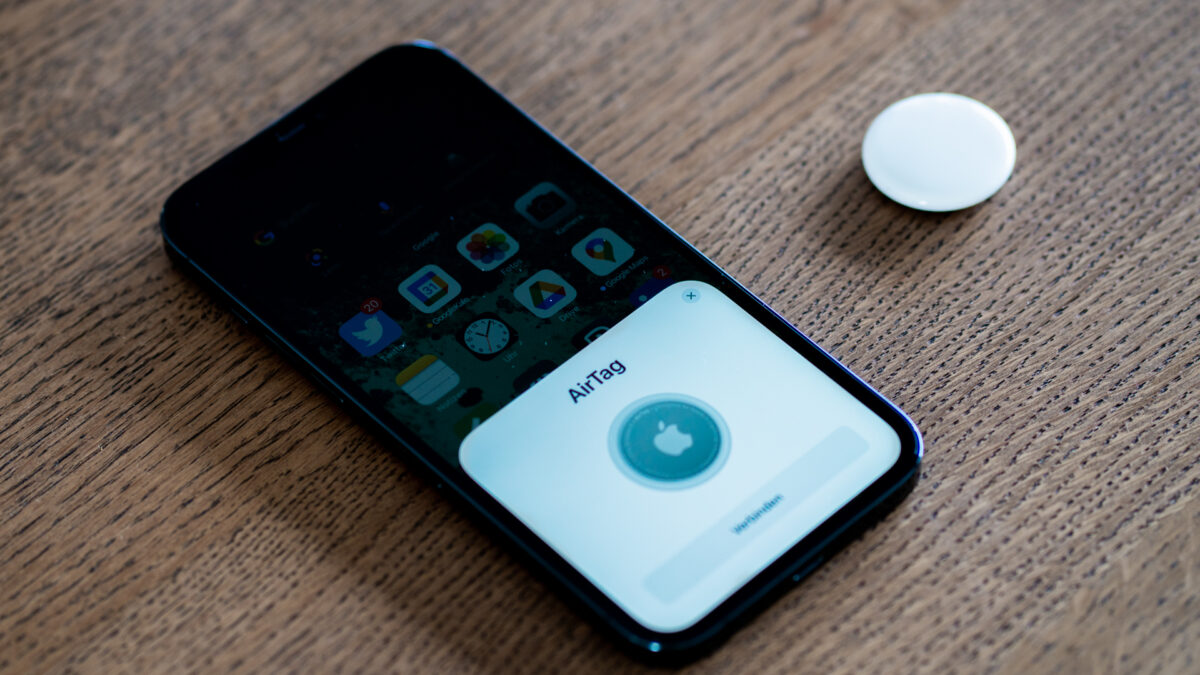
Image: Apple AirTags setup, via Wikimedia Commons (CC).
Why UWB beats Bluetooth for finding things
This is the comparison that matters to buyers. Bluetooth can tell your phone that a tracker is “close” or “very close,” but it infers that from signal strength, which walls, pockets, and bodies scramble constantly. UWB does not guess — it times the trip of a radio pulse, so it returns a real distance and a real angle. The practical difference is the difference between “your keys are somewhere in this room” and “your keys are 1.2 meters that way, behind the cushion.”
That precision has a security upside as well. Distance-bounding makes the old “relay attack” — where thieves extend a key’s signal from inside the house to a car at the curb — far harder, because UWB can prove the key is actually right next to the door rather than being relayed from elsewhere. For car makers building hands-free, walk-up unlock, that resistance is the whole point.
Where you already meet UWB
If you have owned a recent iPhone, you have already used it. Apple’s AirTag, on the market since 2021, uses UWB so that a phone with the right chip can show a directional arrow and exact range to a misplaced tag during “Precision Finding.” That capability requires a UWB-equipped phone — on Apple’s side, an iPhone 11 or later (the budget iPhone SE, and the iPhone 16e and 17e, omit the chip), which is exactly the kind of detail a buyer should note.
The other place UWB quietly runs is the car key. The Car Connectivity Consortium’s Digital Key specification uses UWB in its newer releases to enable a phone to unlock and start a vehicle without being taken out of a pocket or bag, while resisting relay attacks. A handful of automakers have shipped or are shipping this, and it is one of the clearer reasons a 2026 phone buyer might specifically want the radio on board.
Samsung’s Galaxy SmartTag family and rivals such as Chipolo also play in this space, and the wider finder networks — Google’s Find My Device among them — are steadily improving precision by pooling detections from many phones. The accuracy you get still depends on how many devices nearby can “hear” the tag, which is why the brand of your phone and the size of its finder network both matter.
The stalker-tracking backlash changed the rules
No discussion of item trackers is complete without the dark side. A precise tag is also a precise surveillance tool, and AirTags in particular were abused to follow people. The industry’s response — led by an Apple and Google joint specification for detecting unwanted trackers, rolling out from 2023 onward — means a modern phone should alert you if an unknown tracker appears to be moving with you, and should let you locate and silence it. When you are weighing a 2026 phone or a tracker to pair with it, the presence and quality of these unwanted-tracker protections is now a legitimate buying criterion, not a footnote.
What to check on a 2026 phone
If UWB matters to you — for finder precision, for hands-free car unlock, or simply because you want the capability future-proofed — verify four things before you buy. First, does the specific model have a UWB chip? It is not universal, and budget and “e” editions of otherwise capable lines frequently drop it, so do not assume from the series name. Second, which finders use it? Precision Finding-style directional locating only works between a UWB tag and a UWB phone, so match the ecosystem you live in. Third, car-key support — if walk-up unlock is the goal, confirm both your phone and your vehicle list each other for the UWB Digital Key profile. Fourth, stalker protection — check that the OS surfaces unknown-tracker alerts and that you can act on them.
Bottom line
UWB will not show up in the marketing the way “camera megapixels” do, but it is one of the radios that makes a phone feel intelligent rather than merely connected. For most buyers it is a quiet bonus today; for anyone who lives by item finders, or who wants phone-as-car-key to actually work without fumbling, it is a checkbox worth confirming. Read the fine print on the exact model, match it to the finder network and car you use, and the 2026 phone you choose will still feel current long after the spec sheet is forgotten.
Sources:
– Ultra-wideband — Wikipedia
– AirTag — Wikipedia
– Samsung Galaxy SmartTag — Wikipedia