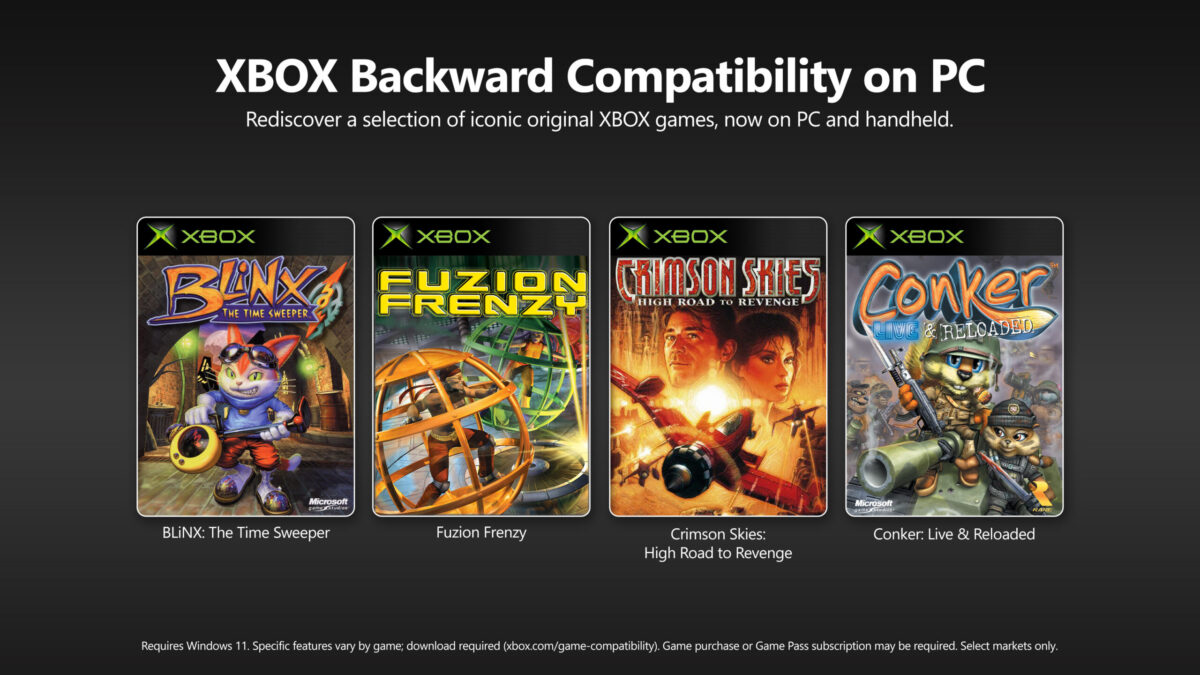
For the first time, a handful of original Xbox games no longer need a 2001-era console — or an emulator — to run. On July 22, Microsoft turned on Xbox Backward Compatibility on PC, an early-release program that puts four classic original Xbox titles on Windows PCs and handhelds like the ROG Xbox Ally and Xbox Ally X. Each game is sold individually on PC and is also folded into every Xbox Game Pass tier, and if you already hold a digital console license, it now follows you onto PC at no extra cost.
The four launch titles are a deliberately eclectic set drawn straight from the early-2000s Xbox catalog: BLiNX: The Time Sweeper, Conker: Live and Reloaded, Crimson Skies: High Road to Revenge, and Fuzion Frenzy. It is a curious opening lineup — none are the marquee Halo or Fable names you might expect a preservation push to lead with — and that is telling. These are exactly the kinds of games that tend to disappear from storefronts and become expensive collector cartridges. Getting them running natively on modern hardware is a more meaningful proof of concept than re-releasing a title that has already been remastered twice.
Preservation with a PC coat of paint
Microsoft is not shipping these as untouched ROMs. According to the announcement, the PC versions add graphics options the originals never had: up to 4x resolution upscaling, VSync, fullscreen and windowed display modes, anisotropic filtering, and enhanced anti-aliasing, alongside customizable language and audio settings. The company frames this as enhancing the experience “while preserving the original gameplay” — a distinction that matters to anyone who has watched a remaster quietly change hit boxes or physics. Upscaling and display flexibility change how a game looks, not how it plays.
That approach lands the program somewhere between a straight emulator and a remaster. Enthusiasts have long run original Xbox titles through community emulators, and dedicated front-ends have made that increasingly turnkey. What Microsoft adds is a legitimate, license-backed path with vendor-tuned rendering options and, crucially, storefront and Game Pass distribution. The trade-off is scope: the community can throw the entire back catalog at an emulator, while Microsoft is starting with four sanctioned titles and promising to expand “over time.”
How it works — and what you’ll need
Access runs through the Xbox on PC app rather than a separate launcher. Because the games are wired into Xbox Play Anywhere and Xbox Cloud Gaming, a single license spans console, cloud, PC, and handheld, and progress is meant to travel with you across those surfaces. For anyone already deep in the Xbox ecosystem, that continuity is the real hook — the same purchase quietly becomes playable on more devices without a second transaction.
The hardware bar is modest, which fits games built for 2001 silicon. Microsoft lists a minimum of a Windows 11 PC with an Nvidia GTX 950, AMD Radeon RX 550, or Intel Arc A310 GPU, a four-core/eight-thread CPU such as an Intel Core i3-10300 or AMD Ryzen 3 3100 (or the Ryzen Z2 A found in handhelds), 8GB of RAM, and 4GB of video memory. The recommended tier steps up to a Radeon RX 6800S, GTX 1070 Ti, or Intel Arc A770, a six-core/twelve-thread chip like the Core i5-10400 or Ryzen 5 3600, 16GB of RAM, and 8GB of video memory. In practice, almost any current gaming handheld or budget laptop clears the minimum comfortably.
Achievements are the tell
The detail worth watching is what Microsoft flagged for later this year: Achievements are coming to select original Xbox titles on both console and PC, with the first four preview games slated to gain them in the coming months. Achievements did not exist on the original Xbox — they debuted with the Xbox 360 — so retrofitting them signals that Microsoft intends to treat these ports as first-class modern releases rather than nostalgia curios. It is also the sort of feature that only makes sense if the company plans to grow the catalog meaningfully.
The near-term reality is small: four games, an “early release” label, and an explicit promise of more. But the framing is bigger than the launch lineup. Microsoft is positioning PC as a durable home for its back catalog, with the Game Pass and Play Anywhere plumbing already in place to carry whatever comes next. For players sitting on years of Xbox purchases, the pitch is simple — the games you already own are starting to follow you everywhere, and the list is only supposed to get longer.