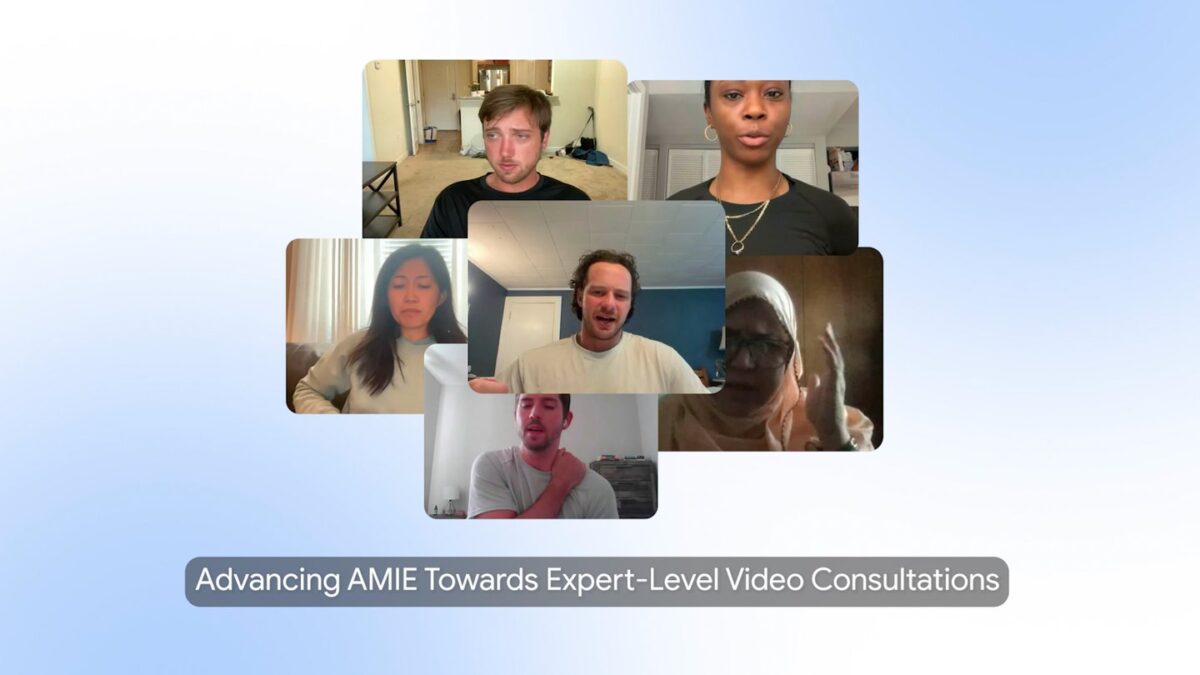
Google has pushed its medical research AI out of the chat box and into a video call. On August 11, 2026, Google Research and Google DeepMind said AMIE, the company’s Articulate Medical Intelligence Explorer, can now hold real-time clinical video consultations, interpreting what it sees and hears while it reasons about a diagnosis (Google AI announcement).
That is a bigger jump than it sounds. Every earlier version of AMIE worked in text, which forced patients to translate a limp, a rash, or a wet cough into typed words. Google’s researchers describe that text-only interface as a fundamental constraint on the work, because it discards the visual and auditory dimensions that clinicians rely on (Google Research).
What the study actually measured
Google ran a randomized study using simulated consultations with patient actors, comparing AMIE against a group of primary care physicians. Clinical evaluators rated AMIE favorably across core competencies including history-taking thoroughness, diagnostic accuracy, management appropriateness, and communication quality, and the patient actors preferred the video experience to text chat (Google AI announcement). Google describes the result as a first-of-its-kind demonstration of expert-level performance in this setting, and the claim is the company’s own rather than an independent assessment (Google Research).
The system is built on Gemini and Project Astra using a multi-agent architecture, and Google says it interprets visual and auditory cues, guides virtual physical exam maneuvers, and reasons diagnostically as the conversation unfolds (Google AI announcement).
How AMIE got here
The video work sits on a long research ladder. AMIE first showed expert-level performance in text-based diagnostic dialogue and as a differential diagnosis aid for clinicians, then moved beyond diagnosis toward managing disease over time, then toward specialist-level evaluations in oncology, cardiology, and ophthalmology, plus multimodal reasoning over images and clinical documents (Google Research).
Google has also started testing outside the lab. The team points to a framework for physician-centered oversight, a clinical feasibility study with Beth Israel Deaconess Medical Center, and an ongoing nationwide randomized study run with Included Health (Google Research).
The caveats matter
Patient actors are not patients. Simulated consultations remove the messiness that defines real primary care: incomplete histories, comorbidities, bad lighting, dropped connections, and the liability that follows a wrong call. Google says plainly that AMIE remains a research system and that more research is needed before responsible real-world clinical deployment (Google AI announcement).
For practitioners building health AI, the useful signal is architectural rather than clinical. Google is treating a consultation as a continuous multimodal stream instead of a turn-based text exchange, and it is wrapping that stream in a multi-agent system rather than a single prompt-and-response model. That pattern — real-time perception feeding a reasoning loop — is showing up well beyond medicine, including in NVIDIA’s Cosmos-H-Dreams surgical simulations that run in real time.
The open question is regulatory rather than technical. A model that guides a virtual physical exam is doing something closer to practicing than summarizing, and nothing in Google’s announcement suggests a timeline for clearance or a named deployment partner beyond the studies already under way.