
TReNDS, a joint research center spanning Georgia State University, Georgia Institute of Technology, and Emory University, announced a new AI‑powered system that automates root‑cause analysis for production errors using Amazon Bedrock.
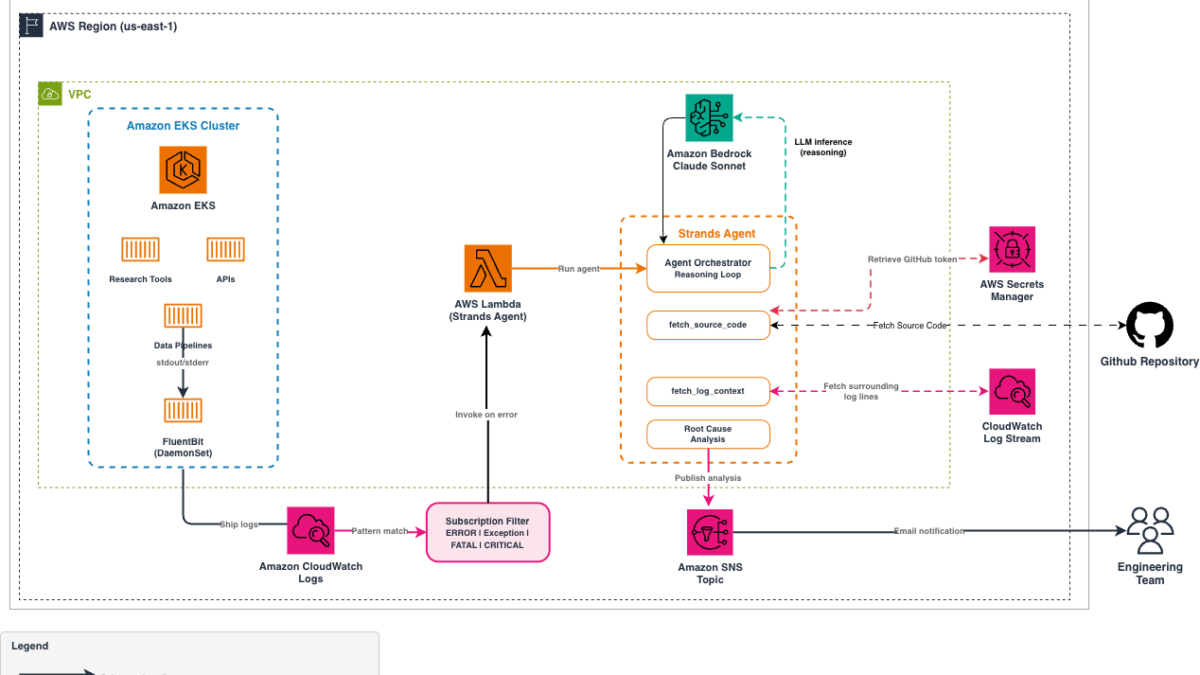
Since 2019, the TReNDS team has run its research tools on Amazon Elastic Kubernetes Service (EKS), shipping logs to Amazon CloudWatch via FluentBit. Over the years they built a variety of applications, but the error‑investigation workflow remained manual and time‑intensive. Engineers typically spent 15–30 minutes on straightforward errors and considerably longer on complex, multi‑service incidents, as detailed in the TReNDS automation announcement.
The new architecture replaces that manual effort with an automated pipeline that detects error‑level log patterns, invokes an AWS Lambda function, and then hands the log context to a Strands Agents SDK‑driven AI agent running on Amazon Bedrock. CloudWatch subscription filters watch for ERROR, Exception, FATAL, and CRITICAL patterns and trigger the Lambda function with compressed log events, as described in AWS CloudWatch documentation. The agent calls a Bedrock foundation model to reason about the error, fetch relevant source code from GitHub, and produce a structured analysis with severity, root cause, and a suggested fix.
In production the system has cut investigation time to under 60 seconds—a more than 20× speed‑up compared with the prior 15–30 minute cadence, according to the TReNDS automation announcement. The Lambda handler decodes base64‑encoded, gzip‑compressed events and passes them to the agent, which autonomously decides which tools to call based on what it discovers in the error message. If a stack trace reveals clear file paths, the agent triggers source‑code retrieval; if the error lacks a stack trace, it may search the code base for the error string instead.
Because TReNDS handles health‑related research data, the pipeline respects HIPAA‑eligible services. The architecture leverages HIPAA‑compliant AWS offerings, ensuring that protected health information remains within the AWS boundary, as explained in the TReNDS automation announcement. Amazon Bedrock processes requests within the TReNDS AWS account, so log data and source code stay within the same environment as the rest of the application.
The authors note that the solution reflects their own experience and does not constitute official guidance from the partnered universities. For readers looking to adopt Amazon Bedrock in their own projects, see our guide on using GPT‑5.6, Sol, Terra, and Luna on Bedrock for practical examples.
The TReNDS automation showcases how large-language models can be integrated into operational tooling to accelerate error diagnostics, lower engineer toil, and maintain compliance for sensitive data workloads.
Editorial note: Citation cleanup: we trimmed duplicate citation links that repeated the same source after multiple paragraphs. Every fact and quote is unchanged; the source remains cited where each claim appears.